Pangram Rolls Out Detection Tools for AI-Generated Video and Images
The text-detection startup now claims 98 per cent accuracy on synthetic video and above 99 per cent on images, positioning itself as a multi-modal gatekeeper against AI slop.
From Text to Multi-Modal: Pangram's Expansion
Pangram, the startup that built its reputation on spotting machine-written text, has shipped detection capabilities for video and images. Subscribers can now upload video files to receive an analysis that distinguishes fully synthetic clips from those that have been partially edited with generative tools. The release arrives as synthetic media proliferates across social platforms, stock libraries, and news feeds, complicating content moderation and trust signals for publishers, educators, and platforms alike.
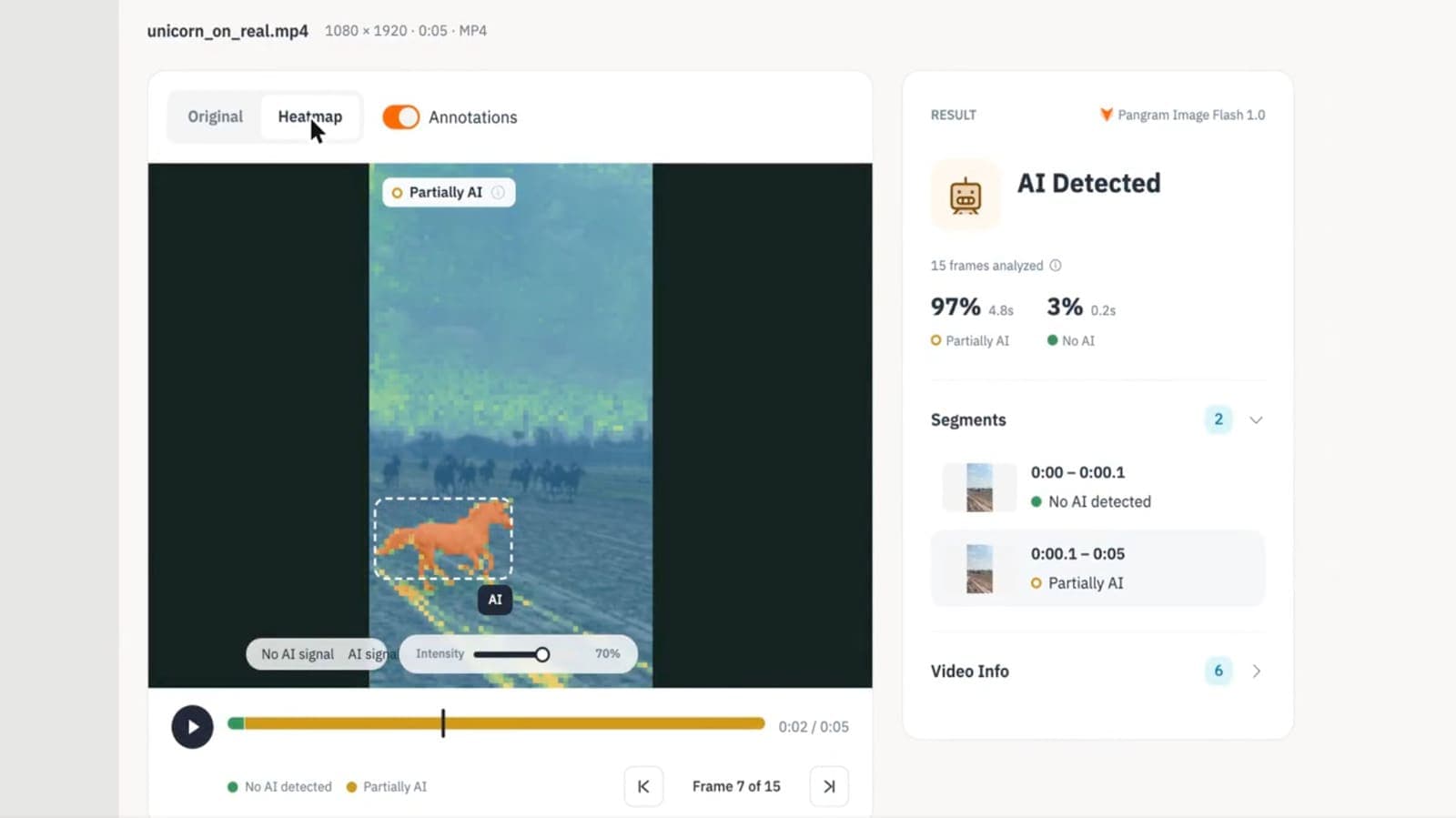
The video tool employs what Pangram describes as a heatmap interface, highlighting segments within a clip that its model flags as likely AI-generated. According to the company, internal tests on frontier AI video models returned accuracy above 98 per cent. That claim positions Pangram ahead of competing detection services, though the company has not disclosed the size or composition of the test set, nor whether it includes adversarial examples designed to fool classifiers.
Image Detection Moves from Research to Production
Pangram's image model, previously available only as a research preview under the label "Image 1.0," is now integrated into the company's Chrome extension. The browser add-on scans photographs and illustrations as a user scrolls, flagging synthetic content with a confidence score. In testing, the model identified more than 99 per cent of AI images while returning a false positive rate of 0.27 per cent, according to Pangram.
Yet the tool carries limitations tied to resolution and post-processing. Pangram warns that images below 512 × 512 pixels will trigger a reduced-confidence disclaimer. That threshold may explain why a demonstration shared by CEO Max Spero on Pinterest returned "unsure" verdicts on two visibly synthetic images, the resolution of which was not disclosed.
The Post-Processing Problem
Modern smartphone cameras introduce a wrinkle that complicates detection. Spero noted that devices including recent iPhone models apply AI-driven enhancements to every photograph, adding texture, sharpening edges, and adjusting exposure in ways that can resemble generative edits. Pangram delayed its image rollout to fine-tune the model on images captured with iPhone 18 Pro handsets, after early versions incorrectly classified camera output as fully synthetic.
This tension between computational photography and detection accuracy is not unique to Pangram. At Opentechwire, we have tracked similar challenges across forensic tooling: as device manufacturers lean harder on neural networks for image signal processing, the boundary between a "real" photograph and an AI-modified one blurs. Pangram's approach appears to hinge on training data that encompasses a wide range of hardware and software pipelines, though the company has not published details on how it curates or weights that corpus.
Access and Pricing
The video and image detection features are available to Pangram subscribers. Users on the free tier can analyse a limited number of images without upgrading to a paid plan, though video analysis and bulk scanning require a subscription. Pangram has not disclosed pricing tiers or enterprise licensing terms publicly.
The Chrome extension enables passive scanning, a design choice that mirrors anti-phishing and tracker-blocking add-ons but raises questions about client-side processing versus cloud inference. If Pangram routes image data to its servers for classification, latency and privacy considerations come into play, particularly for users handling proprietary or sensitive visuals. The company has not commented on whether the extension performs on-device inference or relies on API calls.
Detection Arms Race
Pangram's move into video and images reflects a broader industry shift. As generative models become cheaper and faster, detection tools face an adversarial dynamic: each improvement in classifier accuracy prompts model developers to refine outputs that evade detection. Watermarking schemes, such as those proposed by the Coalition for Content Provenance and Authenticity, offer an alternative by embedding metadata at creation time, but adoption remains patchy and watermarks can be stripped or corrupted in post-production workflows.
Pangram's claim of high accuracy on "frontier AI video" suggests the model was trained on outputs from recent releases by labs including OpenAI, Anthropic, and Runway. However, the company has not specified whether the training set includes adversarial examples or whether the model generalises to lesser-known open-weight video generators, which are proliferating on platforms such as Hugging Face and Civitai.
Implications for Publishers and Platforms
For newsrooms and content platforms, multi-modal detection tools offer a potential safeguard against synthetic media entering editorial pipelines or user-generated feeds. Yet reliance on probabilistic classifiers introduces risk: a false positive can flag legitimate photojournalism as fake, while a false negative allows synthetic content to slip through. Pangram's reported false positive rate of 0.27 per cent on images translates to roughly one misclassification per 370 scans, a rate that may be acceptable for moderation queues but problematic for automated content rejection.
The video heatmap feature could prove useful for forensic workflows, allowing editors to isolate questionable segments within longer clips rather than rejecting entire files. However, the tool's efficacy will depend on how well it handles hybrid content, such as live-action footage with AI-generated backgrounds or deepfake face swaps applied to real video.
What Remains Unsaid
Pangram has not released technical papers or open-sourced its models, a stance that contrasts with academic detection efforts and some commercial competitors. Without transparency into training data, architecture, or failure modes, independent validation of the company's accuracy claims is difficult. The startup also faces the challenge of model drift: as generative tools evolve, detection models trained on older outputs may degrade in performance, requiring continuous retraining and dataset refreshes.
The company's decision to integrate detection into a browser extension rather than offering an API-first product suggests a focus on individual users and small teams over enterprise workflows. Whether Pangram will expand into licensing deals with platforms or publishers remains to be seen, but the technical and commercial dynamics favour tools that can be embedded into moderation stacks at scale.
For now, Pangram's expansion into video and images positions it as one of the few startups attempting to cover text, image, and video detection under a single subscription. Whether that breadth translates into sustained accuracy as generative models advance will determine whether the company becomes a standard tool or another casualty of the detection arms race.