Nvidia's Arm-Based RTX Spark Brings Unified Memory and Blackwell Graphics to Windows
The new system-on-a-chip targets AI developers and creators who need massive RAM pools, arriving six years after Apple Silicon redefined laptop architecture.
An Efficiency Play That Took Six Years
Nvidia announced RTX Spark at Computex earlier this year, and the company's recent launch events have crystallised what the chip represents: a fundamental shift in how Windows PCs handle power, memory, and compute workloads on a single die. The SoC architecture pairs up to 20 Grace Arm CPU cores with a Blackwell GPU featuring as many as 6,144 CUDA cores, all sharing access to as much as 128GB of LPDDR5x unified memory running at 9,400 Mbps.
The design mirrors the approach Apple introduced with M1 in 2020. By consolidating CPU, GPU, and memory onto one chip, Nvidia claims RTX Spark systems consume roughly half the power of a conventional laptop pairing an Intel Core Ultra 9 285H with a discrete RTX 5070 GPU, when both configurations are gaming at 60 watts. Performance should land somewhere near that RTX 5070 baseline, according to Nvidia, though discrete-GPU systems can draw significantly more power when thermal headroom permits.
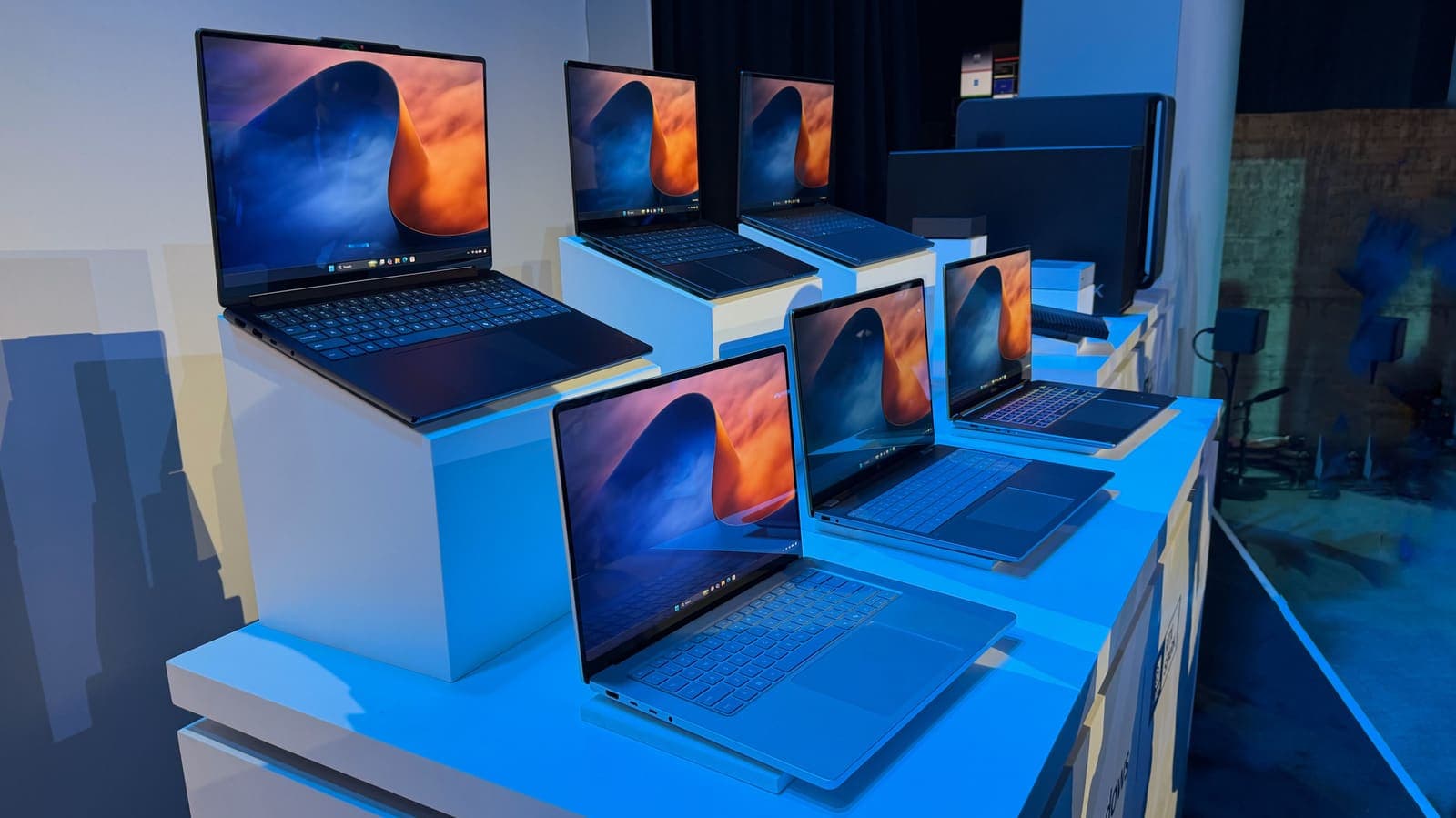
Microsoft's Surface Laptop Ultra is the flagship RTX Spark device, starting at $2,600 for the 18-core variant and climbing to $3,700 for the full 20-core configuration. A top-specification model with 128GB of unified RAM carries a $5,900 price tag. That figure undercuts a comparable 16-inch MacBook Pro with M5 Max and 128GB of memory by more than $1,000, a gap that matters for the AI researchers and developers Nvidia is courting.
Unified Memory as the Real Draw
At Opentechwire, we've tracked the slow arrival of high-capacity unified memory on Windows laptops, and RTX Spark represents the first time Nvidia's GPU technology has shared a memory pool with the CPU on a consumer-grade system. That architectural choice has immediate implications for anyone running large language models locally. A 125-billion-parameter model such as Qwen3.8-Flash-Next can load entirely into RAM without spilling over to slower storage or requiring cloud inference tokens.
The 128GB ceiling also opens workflows that were impractical on most Windows notebooks until now: multi-track video timelines in Adobe Premiere, large Blender scenes, or simultaneous execution of multiple AI agents. Adobe is re-architecting both Photoshop and Premiere specifically for Nvidia's platform, a signal that the software giant expects Arm-based Windows systems to gain traction beyond niche use cases.
Nvidia's Grace CPU cores split into ten performance cores and ten efficiency cores in the top configuration, a layout that borrows from Arm's big.LITTLE design philosophy. The Blackwell GPU includes fifth-generation tensor cores, fourth-generation ray tracing cores, and a video engine that supports AV1 UHQ encoding and decoding in 4:2:2 chroma subsampling. All of that silicon sits on a single package, which Nvidia says allows RTX Spark laptops to maintain full performance on battery power rather than throttling when unplugged.
Gaming on Arm, With Caveats
Nvidia is positioning RTX Spark as a 1440p gaming platform, leveraging DLSS 5 frame generation to push frame rates well above native rendering speeds. In Cyberpunk 2077, a new performance mode for DLSS Frame Generation can deliver 280 frames per second with six-times frame generation enabled, compared with 213fps without the mode active. The company has not detailed what visual trade-offs that performance mode entails.
Because RTX Spark uses Arm instruction sets, not every Windows game will run natively. Microsoft's Prism emulator translates x86 software on the fly, and Nvidia confirmed that Control Resonant, Gears of War: E-Day, NBA 2K27, and World of Warcraft: Forever will be supported at launch. The company is also working with anti-cheat providers to ensure multiplayer titles function correctly, a longstanding pain point for Arm Windows devices.
Emulation introduces latency and compatibility risk. Gamers who prioritise the widest possible library and the highest frame rates will still find better value in an Intel or AMD laptop with a discrete GPU. But for users who split time between content creation, AI experimentation, and occasional gaming, RTX Spark offers a compelling middle ground, provided the software they need has been validated.
Who Pays $5,900 for a Laptop?
Nvidia is explicit that RTX Spark is not aimed at mainstream buyers. The entry price of $2,600 already excludes most consumers, and the memory configurations that unlock the chip's full potential push total cost well above typical laptop budgets. The target audience is AI researchers who previously relied on cloud compute, creative professionals who need to edit 8K timelines on location, or developers building and testing AI agents locally.
Microsoft is adding deeper support in Windows 11 for on-device AI tools such as Perplexity, alongside simplified setup for agents including OpenClaw and GitHub Copilot. That software layer matters as much as the hardware: unified memory is useful only if applications can actually take advantage of it. Adobe's commitment is a strong vote of confidence, but the broader Windows software ecosystem has been slow to optimise for Arm in the past.
One researcher at Nvidia's Editor's Day event noted that colleagues working on Macs could easily run large models locally, while he had been forced to rely on cloud services or desktop workstations. RTX Spark closes that gap, at least in theory. Whether Windows software developers follow through with native Arm builds will determine how quickly that theory becomes practice.
The Competitive Ripple
RTX Spark does not exist in a vacuum. AMD's Ryzen AI Max 400 chips also offer high-capacity unified memory, with the added advantage of native x86 compatibility that sidesteps emulation entirely. Intel's Core Ultra Series 3 processors have pushed single-threaded performance and efficiency in response to AMD's recent gains. Qualcomm's Snapdragon X Elite and X Plus chips already power a wave of Copilot+ laptops at lower price points, targeting the mainstream segment Nvidia is ignoring.
At Opentechwire, we've followed the funding rounds and product cycles across the region, and the pattern is clear: Arm-based SoCs are no longer experimental. TSMC's advanced packaging enables the kind of high-bandwidth memory integration that RTX Spark relies on, and every major chip designer is now shipping or announcing Arm products for Windows. The question is no longer whether Arm will gain a foothold in the PC market, but how quickly x86 incumbents can respond with competitive efficiency and memory bandwidth.
Nvidia's entry into the SoC space also pressures Intel and AMD to rethink their own roadmaps. Intel has historically resisted integrating high-end GPU cores onto its laptop chips, preferring to leave that market to discrete cards. AMD has been more aggressive with integrated graphics, but the Ryzen AI Max 400 series is its first attempt at true unified memory at scale. Both companies now face a competitor with deep GPU expertise and a software ecosystem, in CUDA and RTX tooling, that developers already know.
What RTX Spark Actually Changes
The arrival of RTX Spark will not suddenly make every Windows laptop an AI powerhouse, nor will it convert gamers away from discrete GPUs overnight. But it does establish a new performance and efficiency ceiling for Arm-based Windows systems, one that finally approaches the level Apple set in 2020. For the first time, a Windows user who needs 128GB of unified memory, GPU acceleration, and all-day battery life has a credible option that does not require switching to macOS.
The pricing remains a barrier. At $5,900 for a fully loaded Surface Laptop Ultra, Microsoft is asking buyers to make a significant bet on Arm software compatibility and the long-term viability of the platform. But the same was true of the original M1 MacBook Pro, and Apple's sustained investment in chip design and developer tools eventually paid off. If Nvidia and Microsoft commit to similar multi-year support, RTX Spark could reshape expectations for what a high-end Windows laptop can deliver.
For now, RTX Spark is a specialist tool: powerful, expensive, and best suited to users who can articulate exactly why they need 128GB of RAM and a Blackwell GPU in a laptop chassis. But the technology it introduces, unified memory and system-on-a-chip integration at the high end, will filter down to more affordable systems over the next two years. That is when the real test begins.