Google Labs Launches Tabletop, an AI-Powered Tool for Personal Project Coordination
The experimental platform generates bespoke interactive workspaces through natural language prompts, targeting family and social planning rather than enterprise collaboration
A Consumer Play in the Collaboration Software Market
Google Labs has opened limited beta access to Tabletop, an artificial intelligence-driven platform that generates purpose-built collaborative environments for personal and family coordination. Unlike the company's established enterprise suite, the tool targets social planning scenarios through an interface that constructs interactive features on demand.
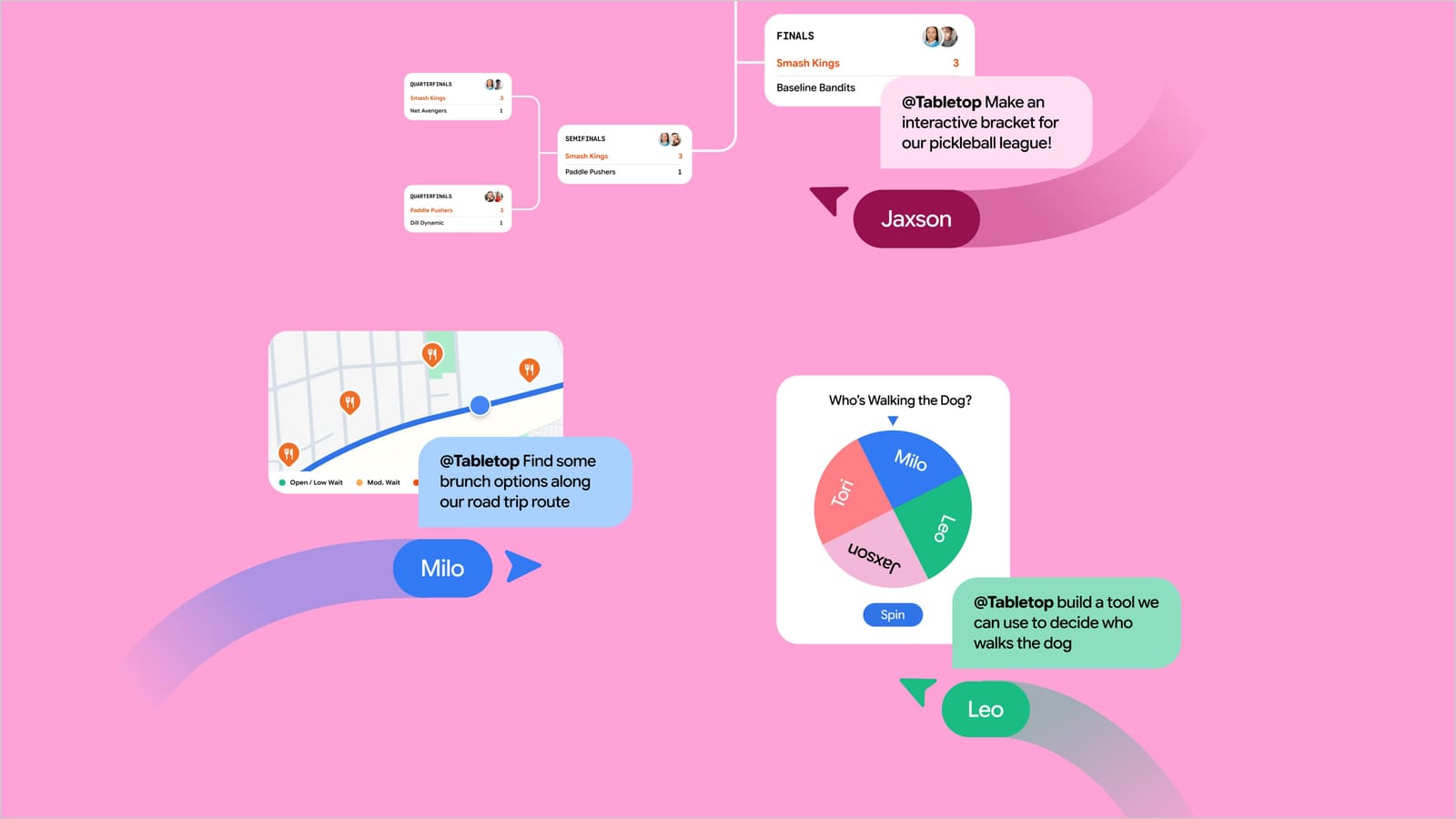
The platform operates through conversational prompts: users describe the functionality they need, and the system assembles corresponding interactive components such as budget calculators, voting mechanisms, scheduling grids, or task allocation boards. According to Roman Nurik, design and engineering lead at Google Labs, the approach removes the configuration overhead typically associated with project management software.
Tabletop's beta rollout is currently restricted to users aged 18 and above within the United States, with access distributed through a waitlist system. The age restriction appears provisional, given that several demonstration use cases involve household coordination scenarios that would naturally include younger family members.
Generative Interfaces for Non-Technical Users
The core mechanism differentiates Tabletop from template-based collaboration tools. Rather than selecting from pre-configured layouts, users articulate their requirements to an AI agent, which then constructs the appropriate interface elements. The system can process uploads of documents, links, and unstructured notes alongside the natural language instructions.
Examples outlined by Nurik include itinerary builders for group travel, polling systems for restaurant selection, shared expense ledgers with automatic splitting logic, and bracket generators for informal tournaments. Each workspace supports real-time concurrent editing similar to Google Docs, with shareable invitation links for distribution through messaging platforms.
The technical architecture suggests integration with Google's Gemini language models, though the company has not disclosed specific inference details. The ability to interpret contextual requirements and translate them into functional UI components indicates fine-tuning for interface generation tasks, a relatively nascent application area for large language models.
Positioning Against Established Consumer Tools
Tabletop enters a crowded market segment where consumer planning tools have proliferated over the past decade. Splitwise dominates expense sharing, Doodle handles scheduling polls, and Notion has captured substantial mindshare among users seeking flexible workspace tools. The platform's AI-driven generation capability represents a potential efficiency gain, particularly for one-off coordination needs that do not justify manual tool configuration.
The visual design borrows conventions from workplace collaboration software such as Asana and Monday.com, presenting information in card-based layouts with configurable columns. However, the interaction model assumes shorter-term projects and smaller groups compared to enterprise software optimised for sustained team workflows.
Google's positioning as a personal coordination tool rather than a business productivity platform may reflect strategic caution. The company's track record with consumer communication products has been inconsistent, with numerous messaging and social tools discontinued over the past 15 years. Framing Tabletop as an experimental Labs project manages expectations while allowing iteration based on usage patterns.
Regional Implications for Collaborative Software Development
The US-only rollout follows a pattern common to Google's AI experiments, where regulatory considerations and model safety testing constrain initial availability. Asia-Pacific markets have seen parallel development in collaborative planning tools, with platforms such as Singapore-based Glints expanding into team coordination features, and Japan's Line integrating scheduling and poll functions directly into its messaging ecosystem.
The willingness of users in Seoul, Jakarta, and Manila to adopt lightweight coordination tools within existing messaging apps suggests a different interaction model than standalone platforms. WeChat's mini-program ecosystem in China has long enabled similar functionality through conversational interfaces embedded in chat threads. If Tabletop gains traction, its architecture may need adaptation to compete in markets where coordination tools are expected to live inside communication platforms rather than as separate destinations.
European privacy regulations will likely influence any expansion beyond the United States. The platform's reliance on processing user-uploaded content and conversational prompts to generate interfaces raises questions about data retention and model training practices. Google has not yet published detailed privacy documentation for Tabletop, though beta participants are presumably covered under existing Google account terms.
The Practical Limits of Generative Collaboration Interfaces
The appeal of generating custom tools through description rather than configuration is clear, but the approach carries inherent constraints. Generative interfaces excel at producing novel combinations of known patterns but struggle with highly specialised requirements that fall outside training distributions. Users with complex coordination needs may find themselves iterating through multiple prompts to approximate desired functionality, eroding the efficiency advantage over manual tool selection.
Latency represents another practical consideration. Generating interface components through model inference introduces delay compared to instantiating pre-built templates. The platform's responsiveness during concurrent editing sessions, particularly as workspaces accumulate data and participants, will determine whether it can match the fluidity users expect from real-time collaboration tools.
The age restriction currently in place highlights an unresolved tension. Many of the platform's proposed use cases involve family coordination, yet minors cannot access the beta. This limitation may stem from legal considerations around collecting data from users under 13 in the United States, governed by the Children's Online Privacy Protection Act. If Tabletop transitions from experimental status to a supported product, resolving this restriction will be necessary for the platform to serve its stated purpose.
Integration Potential and the Google Ecosystem
Tabletop's positioning within Google Labs rather than as a core product leaves its long-term trajectory uncertain. The company has a history of experimenting with collaborative tools through Labs initiatives, with variable outcomes. Some projects graduate to full products, while others are quietly discontinued when usage fails to meet thresholds.
The platform's architecture suggests potential integration points with existing Google services. Calendar data could inform scheduling features, Drive storage could underpin file attachments, and Contacts could streamline invitation workflows. However, such integrations are not evident in the current beta, which operates as a standalone destination.
The decision to build Tabletop as a separate platform rather than extending Google Docs or Sheets with generative capabilities is notable. It suggests the company views conversational interface generation as a distinct product category rather than a feature layer atop existing tools. Whether this separation proves strategically sound will depend on user behaviour: if coordination tasks remain fragmented across multiple tools, a unified generative interface holds appeal; if users prefer consolidating within established platforms, Tabletop's standalone model may limit adoption.
What Comes Next for AI-Driven Coordination Tools
The beta rollout will provide data on whether natural language interface generation resonates with users outside technical or productivity-focused demographics. Early adopters of collaboration software tend to tolerate configuration overhead in exchange for customisation; mainstream users often prefer simplicity over flexibility. Tabletop's conversational model attempts to deliver both, but the quality of generated interfaces under diverse real-world prompts remains to be validated at scale.
Competitors are likely monitoring the experiment closely. Microsoft's Copilot initiatives have focused on augmenting existing Office applications rather than generating net-new interfaces, while Notion's AI features emphasise content generation within its block-based system. A successful Tabletop launch could accelerate investment in generative interface capabilities across the collaboration software sector.
The waitlist mechanism allows Google to control onboarding velocity and gather qualitative feedback before broader release. Expansion beyond the United States will require navigating varied regulatory environments and adapting to regional preferences in coordination tool design. For now, the platform represents a test case for whether AI-driven interface generation can simplify personal project coordination enough to carve out a defensible position in a mature market.