Anthropic Launches Spreadsheet Tool and Meeting Agent to Challenge Productivity Giants
Claude Sheets enters a market dominated by Google and Microsoft, while new whiteboard and meeting features target enterprise collaboration workflows
Spreadsheet Entry Marks Strategic Shift
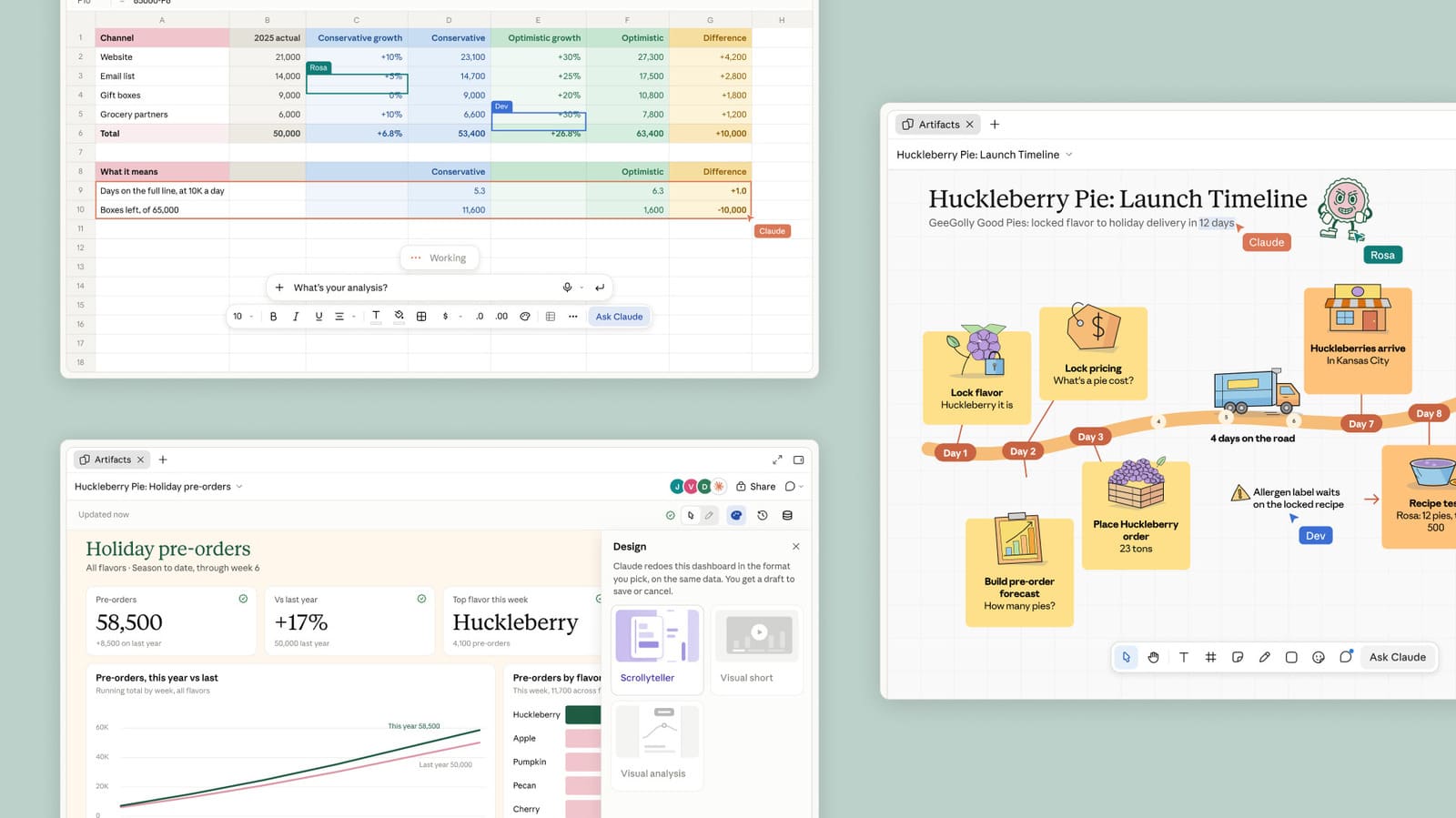
Anthropic introduced Claude Sheets at a San Francisco event on 10 November, bringing its AI assistant into territory long controlled by Google Sheets and Microsoft Excel. The spreadsheet application allows Claude to generate and modify tabular data, complete with multiple tabs, formula support, and standard formatting controls.
The company positions Sheets as a collaborative environment where human edits and AI-generated changes appear side by side. When Claude modifies a file, those alterations are logged and visible to everyone with editing permissions. Files export to Excel format, and the tool integrates with Anthropic's existing Google Workspace plugin. Claude Sheets is available in beta to paid subscribers across web, desktop, and mobile platforms.
The move reflects a broader pattern among foundation-model developers: rather than rely solely on third-party integrations, they are building native applications that keep users inside their ecosystems. For Anthropic, spreadsheets represent a high-frequency use case where AI assistance, from formula generation to data summarisation, can demonstrate immediate value.
Meeting Agent Enters Crowded Field
Claude Meetings, Anthropic's transcription and note-taking agent, launches initially within Google Meet. The agent joins video calls as a named participant, posts a notice in the chat, and captures conversation for later queries. Users can ask Claude about action items or decisions surfaced during the call.
Anthropic built guardrails into the feature: Claude will not join meetings with external guests unless an administrator explicitly permits it, and the agent exits automatically if an outside participant enters. The functionality is restricted to Team and Enterprise customers, a segmentation that suggests the company is prioritising controlled deployments in regulated or sensitive environments.
The meeting-agent category has grown rapidly over the past two years, with Otter.ai, Fireflies, and Grain all offering similar capabilities. Google's own Gemini assistant provides meeting summaries within Meet, meaning Anthropic's tool competes directly with the host platform's native feature. Differentiation will likely hinge on Claude's reasoning quality and how tightly the transcripts integrate with other Claude tools.
Whiteboard Tool Adds Visual Layer
Claude Whiteboards is a collaborative brainstorming interface that clusters ideas by theme and generates task lists as teams contribute. Anthropic designed it to work in tandem with Claude Meetings, allowing a single session to span verbal discussion and visual organisation.
The company framed Whiteboards as a response to existing user behaviour: many subscribers already use Claude for ideation, then copy outputs into separate tools for sharing. By embedding that workflow, Anthropic reduces friction and keeps the entire process within its application suite. The whiteboard is available in beta to all paid users.
Visual collaboration tools have proliferated since the remote-work surge of 2020, with Miro, Mural, and FigJam establishing strong positions. Anthropic's entry is less about competing on canvas features and more about leveraging Claude's language model to synthesise and structure unstructured input in real time.
Data Dashboards Renamed and Expanded
Anthropic renamed Claude Dashboards to Claude Data and began rolling the tool out to all paid subscribers. The company explained that customers use their data for purposes beyond visualisation alone, prompting the broader label.
Claude Data connects to customer-relationship-management systems and other enterprise data sources, enabling the assistant to answer specific queries about records, pipeline status, or customer history. The expansion reflects Anthropic's effort to move Claude from a general-purpose chatbot into a platform that sits atop proprietary business information.
Plugin Architecture Gains Embedded Apps
Anthropic upgraded its plugin system to allow full applications to open inside the Claude interface. Previously, connectors pulled information from services such as Canva and Notion; now, Claude can view and interact with those apps directly within its window.
More than 9,000 connectors are available through the Claude Marketplace, according to the company. The embedded-app rollout begins with Adobe, Atlassian, and HubSpot, three partners whose tools span design, project management, and marketing automation.
The architecture mirrors developments at OpenAI and Google, both of which have moved toward letting users complete multi-step workflows without leaving the AI interface. For Anthropic, the shift reduces context-switching and positions Claude as a central workspace rather than an auxiliary assistant.
Enterprise Focus Sharpens
Taken together, the announcements signal Anthropic's focus on enterprise customers who pay for Team and Enterprise tiers. Meetings remains exclusive to those segments, while Sheets, Whiteboards, and Data target the collaborative, multi-user workflows common in corporate settings.
The strategy aligns with Anthropic's funding profile: the company has raised billions from investors including Google, and it competes less on consumer scale than on trust, safety, and suitability for business-critical tasks. By building productivity tools in-house, Anthropic can control the user experience, data handling, and compliance posture in ways that third-party integrations do not permit.
Whether Claude's reasoning advantage translates into sustained differentiation in productivity software remains an open question. Google and Microsoft benefit from enormous installed bases, default presence in enterprise IT stacks, and decades of feature refinement. Anthropic's bet is that superior language understanding and tighter integration across its own suite will be enough to carve out meaningful share in a market where switching costs are high but dissatisfaction with incumbent AI features is growing.