Etched Draws Bids Up to $50B Just Months After $21B Round
The AI chip startup's aggressive hardware push and early customer wins are fuelling another valuation leap, giving it ammunition for a costly battle against Nvidia.
A Compressed Fundraising Cycle
Etched, the four-year-old AI chip startup, is reviewing incoming investment proposals that place its valuation between $40 billion and $50 billion, according to people with knowledge of the discussions. The offers arrive only two months after the company closed a $700 million financing at a $21 billion valuation, marking one of the steepest and fastest revaluation arcs in recent venture history.
The range reflects differing appetites: top-tier investors are bidding around $40 billion, while less prominent backers are willing to stretch to $50 billion. Talks remain at an early stage, and any eventual terms may shift. Etched declined to comment.
At Opentechwire, we've tracked the rising cost of entry into AI infrastructure, and Etched's trajectory illustrates why capital velocity has become as important as capital efficiency. The startup is not building software or licensing IP. It is manufacturing complete AI hardware systems around its own silicon, a capital-intensive path that demands continuous infusions of cash to stay ahead of production timelines and competitor roadmaps.
If Etched secures another $700 million tranche, the funding would extend its runway by roughly 3.5 years, according to a person familiar with the company's burn rate. That window is critical: the startup needs to prove it can manufacture at scale, deliver on a growing order book, and hold performance advantages over Nvidia's inference accelerators before the next wave of competitors emerges from stealth.
Why Investors Are Crowding In
Etched's pitch centres on inference, the stage of AI computation that runs after a user submits a prompt. The company designed two components from the ground up to accelerate token throughput, aiming to process more tokens faster and at lower cost per token than Nvidia's H100 and successor architectures.
That speed advantage has already translated into commercial traction. Etched announced in July that it had secured $1 billion in customer orders, including a deployment to Jane Street, the quantitative trading firm that also led the September $700 million round. For a trading operation where microsecond latency differences can mean millions in profit or loss, Etched's inference performance is not a nice-to-have, it is table stakes.
The company manufactured its test chip at a TSMC facility over the northern-hemisphere summer, a milestone that de-risked the technical feasibility question for investors. Jane Street took delivery of an early system, providing a proof point that the hardware can leave the lab and enter production environments.
Etched's ability to recruit from Nvidia has also caught attention. Roughly 15 per cent of its 400-person workforce previously worked at the GPU incumbent, according to figures cited by The Wall Street Journal. That talent density signals both technical credibility and cultural appeal, two factors venture investors weigh heavily when backing hardware challengers.
The startup operates a 10-megawatt data centre in Silicon Valley, giving it in-house infrastructure to test and benchmark systems without relying on third-party cloud capacity. It has also established a coordination facility in Taiwan, positioning engineering and supply-chain staff near TSMC's fabs to tighten feedback loops during production ramps.
The Founders and the Harvard Math Course
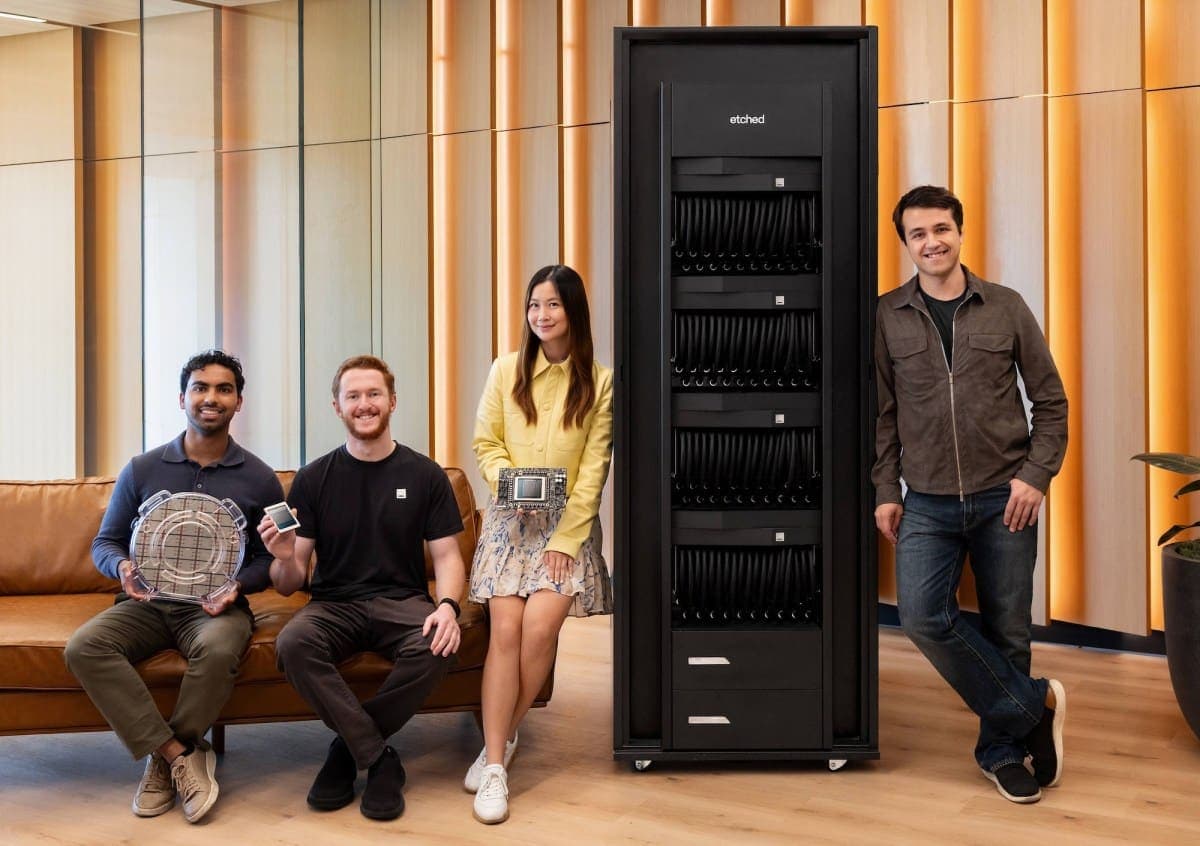
Co-founders Gavin Uberti and Chris Zhu met in an advanced mathematics course at Harvard. Robert Wachen, who serves as chief operating officer, was Uberti's roommate. The trio dropped out to pursue Etched full-time, a familiar narrative in Silicon Valley but one that carries added weight when the technical domain is custom silicon rather than software.
Wachen has been vocal in investor conversations about why Etched's architecture can sustain a lead. The company's chips are optimised specifically for transformer models, the architecture underlying large language models. That specialisation allows Etched to strip out general-purpose logic that Nvidia's GPUs retain, freeing up die area and power budget for inference throughput.
The trade-off is obvious: Etched's silicon cannot train models, and it cannot serve non-transformer workloads. But the bet is that inference, not training, will become the dominant cost centre as AI applications scale to hundreds of millions of users. If that thesis holds, a chip that does one thing exceptionally well may capture more margin than a chip that does many things adequately.
A Pattern of Rapid Revaluations
Etched's fundraising velocity is not an anomaly; it is a strategy. The startup announced a $300 million round at a $10.3 billion valuation in July, led by Sequoia Capital. Two months later, it closed the $700 million round at $21 billion, led by Jane Street. Now, two months after that, it is fielding offers that could double the valuation again.
This pattern, splitting what is effectively a single financing into multiple tranches with stepped valuations, has become more common among high-momentum startups. Each tranche allows the company to raise at a higher price as it hits interim milestones, and it allows later investors to pay a premium for reduced risk. The structure also creates competitive pressure: if you wait for the next tranche, you may pay 50 per cent more for the same equity.
For Etched, the approach makes strategic sense. Hardware development has discrete, expensive phases: tape-out, pilot production, volume manufacturing, and system integration. Each phase can serve as a natural checkpoint for a new valuation. The risk is that if any phase slips or underperforms, the valuation staircase can reverse just as quickly.
The Nvidia Shadow
Every AI chip startup exists in Nvidia's shadow, and Etched is no exception. Nvidia's CUDA software ecosystem, its vertically integrated hardware-software stack, and its decade-long head start in AI acceleration create formidable moats. Customers who have already invested in Nvidia tooling face switching costs that go beyond hardware price.
Etched's counter is to target workloads where inference speed and cost per token matter more than software compatibility. Quantitative trading is one such domain. Real-time video generation, voice synthesis, and autonomous vehicle perception are others. If Etched can dominate a few high-value niches, it can build sustainable revenue without needing to displace Nvidia across the entire AI stack.
The company's $1 billion order book suggests it has found early product-market fit in at least one segment. Whether that expands to a broader set of customers, or remains concentrated among a handful of performance-obsessed buyers, will determine whether the $40 billion to $50 billion valuation range is justified or speculative.
Capital Intensity and the 3.5-Year Clock
Etched's business model is fundamentally different from software-centric AI startups. It owns silicon IP, coordinates fabrication with TSMC, integrates chips into full systems, and operates data centre infrastructure for testing and customer deployments. Each layer requires capital, and each layer has long lead times.
The 3.5-year runway estimate, assuming another $700 million raise, reflects that reality. Chip design cycles run 18 to 24 months from architecture to tape-out. Fab capacity must be reserved quarters in advance. System integration and customer pilots add another six to twelve months. If Etched wants to launch a second-generation chip before competitors catch up, it needs to start that process now, while the first generation is still ramping.
The question for investors is whether 3.5 years is enough. If Etched can achieve volume production, expand its customer base beyond early adopters, and demonstrate sustained performance leadership, the valuation could climb further. If it encounters yield issues, design flaws, or a faster-than-expected response from Nvidia, the runway may prove insufficient, and the valuation may compress.
What the Bid Range Reveals
The $40 billion to $50 billion spread is unusually wide for a company of Etched's maturity. Top-tier investors bidding at the lower end are pricing in execution risk and competitive dynamics. Lesser-known backers stretching to $50 billion are likely prioritising access over price, willing to pay a premium to secure allocation in a deal that may be oversubscribed.
That bifurcation signals confidence in Etched's narrative but uncertainty about its durability. The company has de-risked the technology with a working chip and a marquee customer. It has de-risked the market with a $1 billion order book. What remains unproven is whether it can scale production, maintain performance advantages through multiple hardware generations, and build a defensible moat in a market where Nvidia has near-total dominance.
At Opentechwire, we see this dynamic playing out across the AI hardware landscape. Startups with differentiated silicon and early traction can command extraordinary valuations, but the window to prove scale is narrow. Etched's ability to close another round at a steep valuation, just months after the last one, reflects both the opportunity and the pressure. The capital will buy time. Whether it buys victory is still unwritten.