Five Startups Emerge from Pear VC's Latest Cohort
A chip designer promising to bypass traditional memory, a spatial AI model for 3D environments, and a privacy-first personal assistant stood out at the accelerator's San Francisco showcase last week.
A Selective Programme with a Track Record
Pear VC operates one of the venture industry's most selective accelerators. The firm caps each cohort at 20 companies, runs a 12-week programme twice yearly, and has produced exits that include Known, a voice AI dating platform backed by Forerunner Ventures, and Andera, which raised $37 million from Lightspeed this summer for its corporate audit automation software.
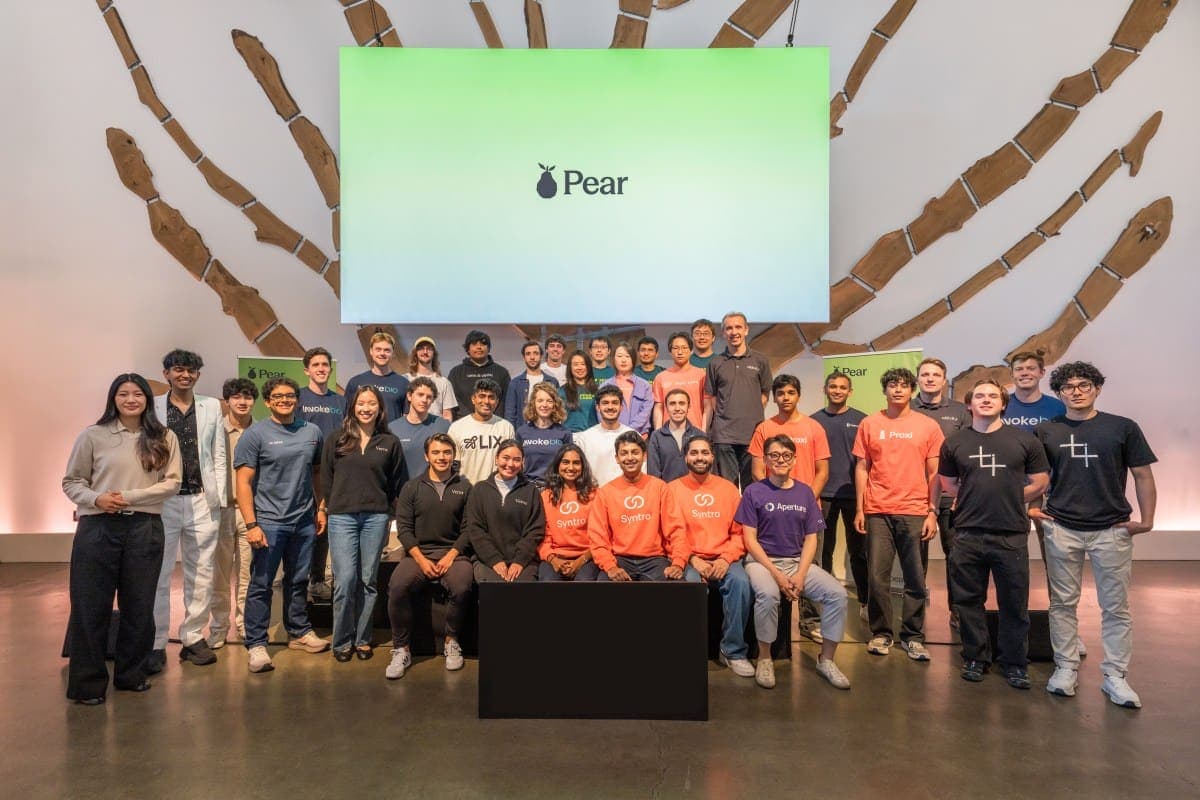
The latest batch, which presented in San Francisco last week, comprised 16 startups. Unlike larger accelerators that deploy standard terms, Pear VC writes cheques as large as $2 million and maintains operational secrecy until presentation day. At Opentechwire, we've tracked several cohorts from this programme, and the pattern holds: a focus on technical depth over consumer buzz, with founding teams that often bring domain expertise from research labs or industrial incumbents.
Five companies generated sustained interest from attending investors. Below, we examine what each is building and why they attracted attention in a capital environment where pre-seed rounds increasingly require proof of technical moats.
Speridlabs: Queryable Spatial Models
Speridlabs is developing spatial foundation models designed to power robotics, gaming engines, and visual effects pipelines. The core product, Mundus, addresses a limitation the founders see in existing world models from Runway, Odyssey, and Google's Genie: those systems generate 3D environments but do not allow users to query or modify specific elements whilst maintaining geometric consistency.
Mundus preserves geometry when a component is altered. The startup describes this as "3D Midjourney", a reference to the image generation tool that popularised iterative refinement. For robotics applications, queryable spatial models could enable real-time environment manipulation. For game developers, the technology promises procedural generation that responds to design constraints rather than producing fixed outputs.
The market for spatial AI is contested. Multiple well-funded teams are pursuing similar architectures, and the compute cost of training 3D foundation models remains prohibitive for most startups. Speridlabs will need to demonstrate inference efficiency and commercial traction in at least one vertical before larger players replicate the approach.
Saia: Inference from Flash Storage
Saia is designing a chip architecture that runs AI inference directly from flash storage, bypassing the high-bandwidth memory that underpins Nvidia's GPUs and Google's tensor processing units. The startup claims its design delivers superior speeds and eight times the capacity of Nvidia's Jetson platform, a widely deployed edge AI board, whilst consuming one quarter of the power.
The technical premise rests on eliminating the memory bottleneck that constrains local AI workloads. Traditional architectures shuttle data between DRAM and processing cores; Saia's chip reads model weights directly from flash. If the approach scales, it could reduce both the cost and power envelope for on-device inference, a constraint that has limited deployment in mobile and embedded systems.
Saia is in discussions with Samsung regarding memory integration. The startup plans to fabricate test chips in 2027 and begin mass production the following year. Hardware timelines are notoriously elastic, and the startup faces the dual challenge of proving the architecture in silicon and securing design wins before incumbents iterate.
The founder, Ayaan Govil, is 20 years old. He convinced Mar Hershenson, a Pear VC co-founder and semiconductor engineer with a doctorate in circuit design, to back the project. Hershenson's involvement lends technical credibility, but also underscores the risk: established chip designers have explored flash-based inference architectures for years without commercial breakthrough.
Ren: Privacy-First Personal Assistants
Ren is building an AI personal assistant that emphasises security and privacy. The product offers functionality comparable to Muse and Instinct, two consumer AI assistants that gained traction in 2025, but processes data on-device where feasible and routes sensitive tasks through a private cloud rather than third-party infrastructure.
The startup enforces user-defined guardrails that restrict which actions the assistant can execute. Ren also avoids human operators in its voice system. Competitors in the personal assistant category have relied on call centre staff to place phone calls or complete tasks that exceed their automation capabilities; Ren's architecture removes human involvement to reduce privacy exposure.
The challenge for privacy-focused assistants is feature parity. On-device models lag behind cloud-based counterparts in reasoning capability, and users have shown limited willingness to trade functionality for privacy. Ren must either close the performance gap or convince a segment of users that the trade-off is acceptable.
The regulatory environment may provide a tailwind. Data residency requirements are tightening in multiple jurisdictions, and enterprises are evaluating on-premise AI tools to reduce exposure to third-party data handling. If Ren can pivot from consumer to enterprise workflows, the privacy architecture becomes a compliance feature rather than a consumer differentiator.
Veros: Automated Trust and Estate Planning
Veros is applying AI to trust and estate planning, a legal and financial service that typically requires coordination between attorneys, wealth managers, and trust administrators. The startup's software recommends trust structures and automates asset management over multi-decade timeframes.
Veros is managing $250 million in assets under management and is pursuing a trust charter that would allow it to operate as a regulated trust company. The charter, if granted, would enable Veros to serve as trustee rather than merely providing software to existing trustees. That shift from software vendor to regulated fiduciary changes the business model and competitive positioning.
The trust and estate market is fragmented and relationship-driven. Attorneys and wealth managers defend their client bases, and switching costs are high. Veros must either partner with incumbents or target younger clients who have not yet established relationships with traditional advisers. The latter cohort is smaller and less wealthy, but more open to digital-first services.
Automation in legal and financial services faces regulatory scrutiny. If Veros's AI recommends a trust structure that later proves suboptimal, liability questions arise. The startup will need robust compliance and audit trails to satisfy regulators and limit exposure.
Datum: Geometric Search for Industrial Design
Datum is indexing libraries of 3D engineering designs and enabling engineers to search by shape rather than filename or metadata. The startup's Geometric Fingerprint technology identifies components based on their geometry, allowing design teams to reuse existing parts rather than modelling new ones.
The value proposition is cycle time reduction. Industrial design teams at automotive, aerospace, and consumer electronics firms maintain vast libraries of CAD files. When an engineer needs a bracket or housing, they often model a new part rather than searching for an existing one. Duplicate parts increase tooling costs, inventory complexity, and supply chain fragmentation.
Datum's search technology could reduce redundancy, but adoption depends on integration with existing product lifecycle management systems. Engineers will not switch tools for marginal gains. The startup must embed its search capability into Siemens, Dassault Systèmes, and PTC workflows, or convince firms to adopt a standalone tool that justifies the friction.
The industrial design software market is mature and consolidated. Incumbents have distribution, integration, and support infrastructure that startups cannot replicate. Datum's path to scale likely involves acquisition by one of the major PLM vendors, or a narrow focus on a single vertical where the search capability delivers disproportionate value.
Capital Allocation in a Selective Environment
The five companies span chip design, spatial AI, privacy infrastructure, financial automation, and industrial software. None are pursuing consumer social or e-commerce, categories that dominated venture funding in prior cycles. The shift reflects both investor preference for technical moats and the diminished appetite for consumer plays in a market where user acquisition costs have risen and exits have slowed.
Pear VC's model, selective cohorts with flexible terms, positions the firm to write larger cheques into companies that require capital for hardware development or enterprise sales. That contrasts with accelerators that deploy standard terms and rely on downstream investors to provide growth capital. The trade-off is lower volume and higher diligence burden, but the firm's exits suggest the approach generates outliers at a competitive rate.
Whether these five startups become those outliers depends on execution over the next 18 months. For Saia and Datum, technical validation is the gate. For Ren and Veros, product-market fit in a crowded category. For Speridlabs, differentiation against better-funded competitors. All five are navigating a venture environment where pre-seed capital remains available but Series A bars have risen, and investors are demanding proof of progress before committing growth rounds.