Asia's Largest AI Exits Went Through Exchanges. America's Went Through Acquirers
Asian exchanges set the price for AI hardware in the third quarter of 2026 while American acquirers bought the software. The two routes did not compete for the same assets.
Global venture funding reached US$159 billion in the third quarter of 2026 across close to 6,000 companies, according to Crunchbase data compiled as of 2 October. The quarter was the weakest of the year, down 25 per cent from the US$212 billion raised in the second quarter, and still ahead of every quarter since the middle of 2022. Underneath that total, 27 companies raised rounds of US$1 billion or more, the highest count on record, against 16 in the second quarter and 14 in the first. Those 27 companies absorbed roughly a third of all venture capital invested worldwide in the three months.
The funding numbers have been widely reported. The exit numbers have not, and they describe something the funding numbers do not: in the third quarter, the biggest AI hardware companies were priced by Asian stock exchanges, while the biggest AI software companies were bought by American corporate buyers. Two different mechanisms, split along a clean line of geography and asset type. For founders and investors building semiconductor, robotics or infrastructure companies in Asia's markets, that is a change in where the exit is likely to come from.
The two exit routes did not overlap
Four of the five largest listings of the quarter were Asian, and three of those four were chip or robotics companies.
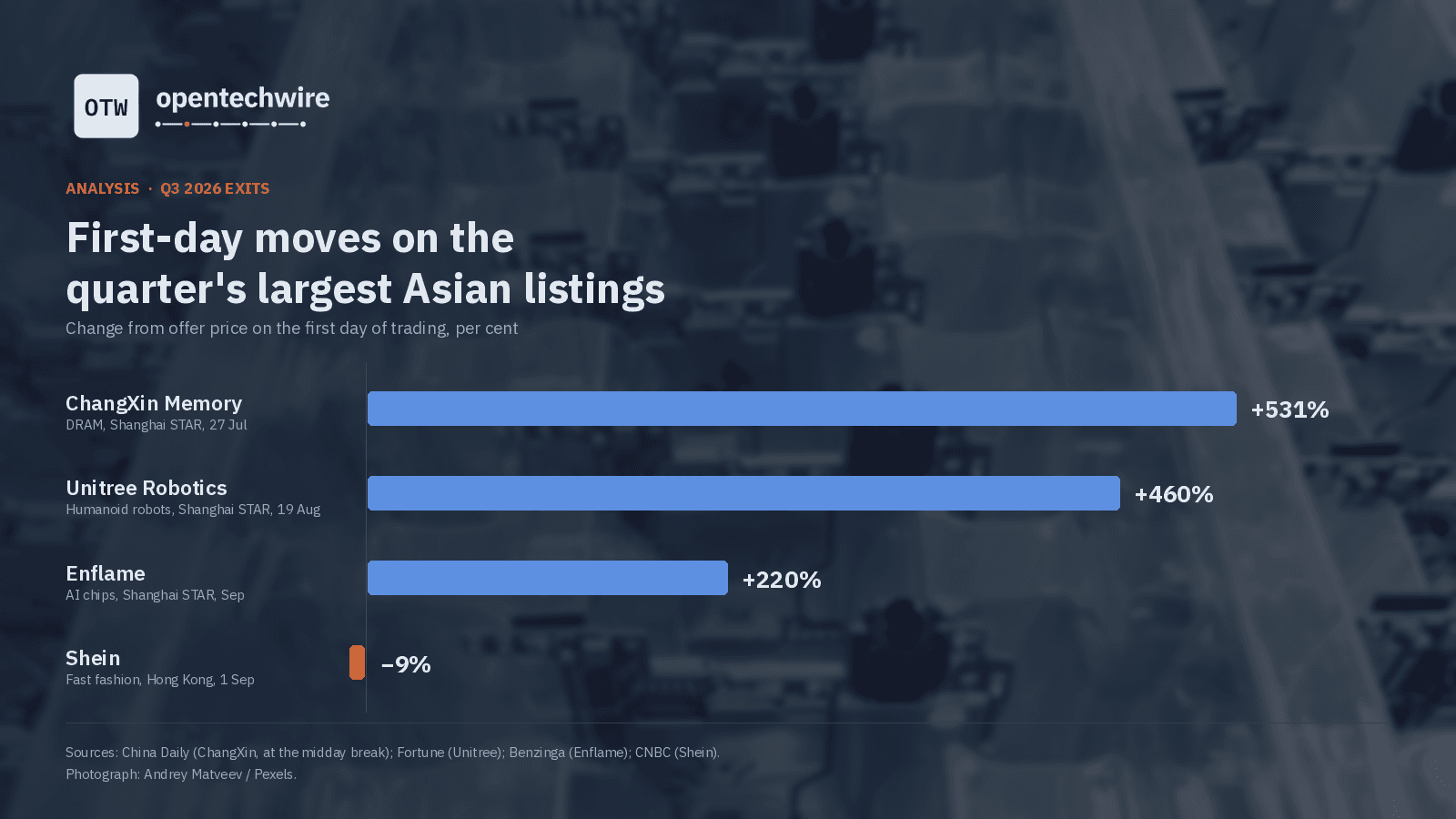
ChangXin Memory Technologies, the Hefei-based DRAM manufacturer, was the largest IPO of the quarter. Crunchbase records the raise at US$8.6 billion at a valuation of US$85.5 billion. It listed on Shanghai's STAR Market on 27 July at an offer price of 8.66 yuan. China Daily reported the stock at 54.65 yuan by the midday break of its first session, up 531 per cent, taking its market value to 3.66 trillion yuan and making it the most valuable company on the A-share market.
Enflame, the Shanghai AI chip designer backed by Tencent and a domestic competitor to Nvidia, raised US$912 million in a September listing. Caixin reported in early September that the company was targeting a valuation of around US$9 billion in the offering; Benzinga reported the stock up more than 220 per cent on its debut. Crunchbase records the company at US$25.5 billion, a figure consistent with the post-debut price. The offer price implies the lower number.
Unitree Robotics, the Hangzhou humanoid robotics manufacturer, listed on the same exchange on 19 August, raising about US$900 million at a US$9 billion offer valuation. Fortune reported the stock up 460 per cent on the day, closing at a valuation of about US$66 billion. That is the number worth holding onto. Figure AI, the best-capitalised American humanoid robotics company, was valued at US$39 billion in a private round in September 2025. A Chinese robotics manufacturer reached a public valuation 69 per cent above that in a single trading session, on a market American institutional capital largely cannot buy into.
The American side of the quarter's large exits looks nothing like this. The three biggest acquisitions were all US buyers purchasing software and model assets. Nvidia confirmed on 3 September that it would acquire Hugging Face, the New York open-weight model platform, for US$12.9 billion, as reported by TechCrunch and CNBC. AMD announced on 28 September that it would buy World Labs, Fei-Fei Li's San Francisco spatial intelligence company, for US$8.2 billion in stock, with Li joining as chief scientist, per CNBC. Stripe agreed in August to acquire OpenRouter, the AI model router, in a deal reported by CNBC at US$7.5 billion.
The one large software listing of the quarter went to the United States as well. Bending Spoons, the Milan app company that has acquired Airtable and Miro, listed on Nasdaq, raising US$1.6 billion at a valuation of US$18.4 billion.
Why the capital is moving this way
The sector allocation inside the quarter explains part of it. AI companies across the stack raised US$102 billion, or 64 per cent of global venture capital, a share down from the two preceding quarters but 14 percentage points above the third quarter of 2025. Within that, the physical end of the stack absorbed an unusual amount: aerospace, robotics, data centres, semiconductors and energy each took US$10 billion or more in the quarter.
Those are capital-intensive businesses with long build cycles, and they sit disproportionately in East Asian manufacturing economies. A DRAM fabricator or a humanoid robotics manufacturer carries plant, equipment and an order book. Public equity markets price that kind of asset without needing to form a view on the next model release. A corporate acquirer buying a model platform is buying engineers, distribution and a position in a standards fight, which is a purchase a strategic buyer can justify and a retail investor usually cannot.
The second reason is access. Chinese semiconductor and robotics companies have limited paths to a foreign acquirer under current export and investment restrictions, and the STAR Market has been the policy-designated venue for exactly these listings. The route is open domestically and closed internationally, so the exits went where the route was open. Crunchbase notes that half of all startup capital invested in the quarter went to companies founded since 2022, and that five of the eight companies raising US$3 billion or more were founded within the past four years. These are young companies reaching exit scale quickly, and the venue they reach is the one available to them.
Where the pattern breaks
Three things complicate the reading, and two of them are serious.
The first is that Asia is not financing hardware alone. Of the eight companies that raised US$3 billion or more in the quarter, two were Chinese AI software companies. Moonshot AI closed a round TechNode reported at US$3.5 billion at a US$35 billion valuation in late July, roughly tripling its valuation in six months. Kling AI, the video generation company spun out of Kuaishou, raised at around US$18 billion. Asia's model companies are being funded at scale; the funding is arriving privately and has not yet produced a public exit, which is a different claim from the one the headline exits suggest on their own.
The second is the quality of the public prices themselves. ChangXin's debut float was 6.73 per cent of post-IPO share capital, about 4.5 billion of roughly 67 billion shares, with institutional demand reported at more than 500 times the shares offered. A price set on under 7 per cent of a company in conditions of engineered scarcity is a poor estimate of what the whole company is worth. The same structural feature applies across STAR Market debuts, and it means the 531 per cent and 460 per cent first-day moves should be read as evidence of allocation scarcity before they are read as evidence of value. What they are not is imaginary: the cash raised at the offer price is real money on the balance sheet, and the comparison with Figure AI rests most safely on the offer valuations.
The third is that Asian exchanges did not reward everything. Shein, headquartered in Singapore, listed in Hong Kong on 1 September at a valuation of US$26.3 billion, raising about US$1.7 billion, and fell roughly 9 per cent on its first day, the only large debut of the quarter that did not rise. Its 2022 private peak was US$100 billion. Consumer internet at scale was repriced down by about three-quarters in the same market that paid five times the offer price for a memory manufacturer. The appetite is specific, and it is not simply an appetite for Asian listings.
Taken together, these narrow the claim. The defensible version is this: in the third quarter of 2026, Asian public markets became the price-setting venue for AI hardware, American corporate balance sheets became the buyer of last resort for AI software, and the two did not compete for the same assets. The stronger version, that Asia has no software exit route and America has no hardware one, is not supported by a single quarter and is contradicted by the private rounds.
What would confirm or break this
Three things are checkable over the next two to three quarters, and each has a named source a reader can go to.
Whether the hardware listing window stays open. The STAR Market's pipeline is public through the Shanghai Stock Exchange's own issuance disclosures. A continued run of semiconductor and robotics listings would confirm the route; a pause would indicate the third quarter was a clearing of a backlog rather than a standing mechanism.
Whether the debut prices hold. ChangXin and Unitree both closed their first sessions at multiples of their offer prices on thin floats. Lock-up expiries will put materially more stock into both markets, and the prices on the other side of those expiries are the first honest test of the valuations. The lock-up schedules are in each company's prospectus.
Whether American acquirers start buying Asian hardware, or are prevented from doing so. Neither Nvidia nor AMD has acquired an Asian semiconductor or robotics asset at scale in this cycle. Whether that reflects price, strategy or regulatory constraint cannot be established from the deal record alone, and company filings and any CFIUS or export-control actions are where it would become visible.
One question nobody can answer yet: whether a Chinese robotics manufacturer trading at US$66 billion can convert a shipment-led position into sustained earnings. HSBC analysts cautioned in August that the humanoid robot shipment upcycle is unlikely to be sustained over the next one to two years without significant advances in AI capability. The venture market has priced an outcome the revenue has not yet demonstrated, and that is true on both sides of the Pacific.
Sources
Funding and exit totals from Crunchbase News, "Crunchbase Data: Q3 2026 Posted A Record Count Of Billion-Dollar Rounds As The Global AI Race Heats Up," by Gene Teare, 5 October 2026, with data as of 2 October. First-day trading figures from China Daily (ChangXin, at the midday break), Fortune (Unitree, 19 August 2026), Benzinga (Enflame, September 2026) and CNBC (Shein, 1 September 2026). Offer terms and valuations from Caixin Global (Enflame, 2 September 2026), FashionNetwork (Shein) and K4I (ChangXin free float). Acquisitions from TechCrunch and CNBC (Nvidia and Hugging Face, 3 September 2026), CNBC (AMD and World Labs, 28 September 2026) and CNBC (Stripe and OpenRouter, 19 August 2026). Private rounds from TechNode (Moonshot AI, 30 July 2026). Listing details for Bending Spoons from The Next Web. Lead photograph by Andrey Matveev, Pexels Licence.