Austin Startup Builds AI Assistant That Cannot Read Your Files
Maple's architecture places user data inside hardware-encrypted servers, leaving the company unable to decrypt personal information even when compelled by law.
A Former Apple Engineer's Answer to AI Surveillance
Maple has secured $5.3 million in seed funding to expand an AI assistant platform built on a principle most rivals consider impractical: the company cannot decrypt its users' data under any circumstance.
The Austin- and San Francisco-based startup operates AI chat and desktop automation tools that place customer information inside Trusted Execution Environments, hardware-encrypted servers where decryption keys exist only on user devices. Mark Suman, co-founder and chief executive, spent six years at Apple developing computer vision systems under strict privacy constraints. His experience there shaped Maple's technical foundation: open-source code paired with server infrastructure users can audit independently.
EPIC Ventures led the oversubscribed round, joined by Draper Associates, Planetary VC, and Epoch VC. The financing follows an angel round below $1 million and positions Maple to pursue Series A capital in the first half of 2027. The company reports 60-times growth over the past three months, a surge it attributes to heightened unease over AI agents gaining access to email archives, file systems, and browser activity.
The Technical Architecture Behind Zero-Knowledge AI
Maple's approach rests on client-side encryption combined with Trusted Execution Environments housed in US data centres. A European partner operates equivalent infrastructure for customers subject to data residency rules in that jurisdiction.
When a user sends a query or file to Maple's servers, the application first encrypts the payload on the local device using a password known only to that user. The encrypted data travels to a TEE, where it is decrypted, processed by one of several open models, and re-encrypted with the same user-held key before being returned. Maple's own engineers and systems administrators see only ciphertext at every stage.
Suman describes the design as a deliberate constraint. If hackers breach Maple's network or a government subpoena arrives, the company can hand over only encrypted files it cannot unlock. The architecture eliminates the need for trust-based promises common in privacy policies: Maple cannot misuse data it cannot read.
The startup runs multiple open models inside its TEE infrastructure, including versions of DeepSeek, Kimi, GLM, Inkling from Thinking Machines, Google's Gemma, and OpenAI's open-source GPT releases. Users select models individually or toggle between a faster option and a more capable one. The interface resembles standard AI chatbots, masking the cryptographic operations beneath.
Desktop Automation Without Surveillance
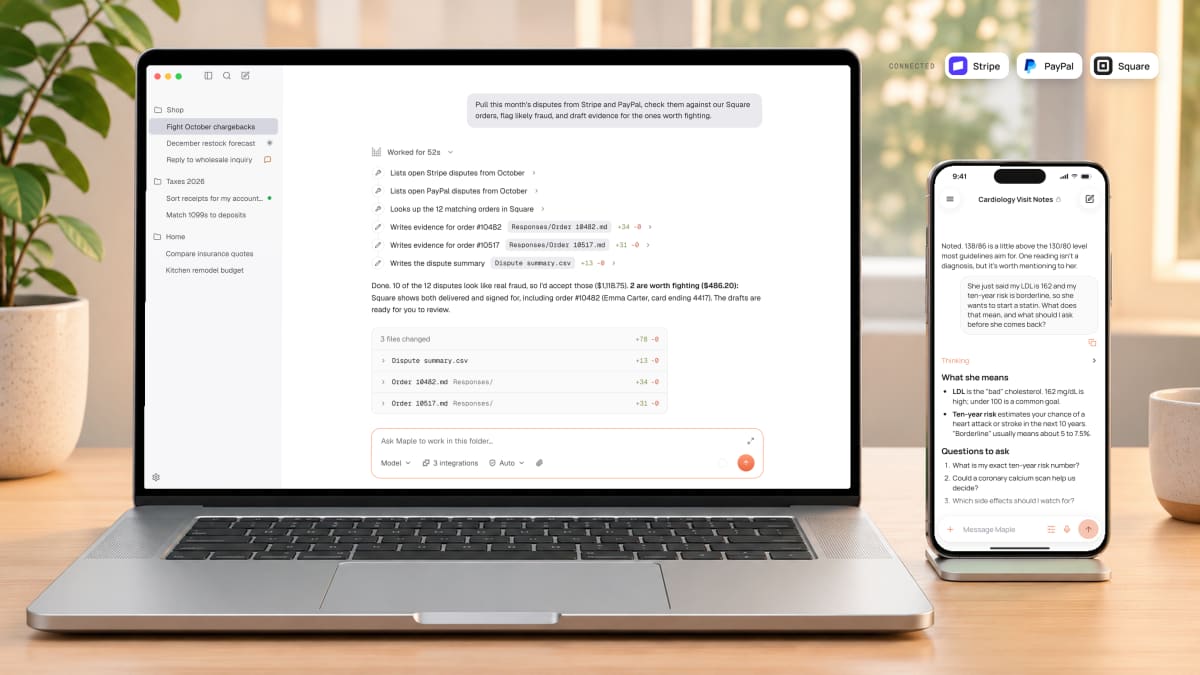
Maple Work, the company's newly released desktop application, extends the zero-knowledge model to agentic tasks. The software can control a user's computer, manipulate files, open applications, and operate a browser to complete multi-step workflows. Unlike cloud-native agents that store task history and context on vendor servers, Maple Work keeps all execution data encrypted and local.
An integration marketplace inside the application allows connections to Gmail, calendar systems, and other productivity tools. Users grant access selectively, limiting what each integration can see. Maple Work also supports the Agent Client Protocol, enabling it to spin up sub-agents that operate within other AI applications such as Claude or Codex. This lets customers use specialised tools for specific jobs without exposing their entire data set to those third-party services.
The design addresses a friction point in enterprise AI adoption. Small businesses and teams often want the productivity gains from automation but baulk at the data-sharing agreements required by mainstream platforms. Maple's model offers a middle path: convenience without wholesale data transfer.
The company's next product, a cloud-based agent capable of running tasks while a user's computer is offline, will place Maple in more direct competition with consumer-facing AI services from Meta and others. That agent will also rely on TEE infrastructure, maintaining the same zero-knowledge guarantee.
Market Timing and the Privacy Backlash
Maple's growth coincides with mounting scrutiny of AI companies' data practices. High-profile incidents involving training on user content, opaque data retention policies, and broad permissions requests have eroded consumer confidence. Regulatory pressure in Europe and parts of Asia has accelerated demand for privacy-preserving alternatives, particularly among knowledge workers handling sensitive client information.
Suman's background at Apple gave him firsthand exposure to privacy-first product development. His work on computer vision systems required techniques that obscured individual identities while still enabling machine learning. Anthony Ronning, Maple's co-founder and chief technology officer, brings experience from defence technology, security, and networking. Ronning founded the precursor company in 2023 as a privacy-focused fintech; when Suman joined in August 2024, the pair pivoted to AI. Maple's mobile app launched publicly the following January.
The shift from fintech to AI reflects a broader pattern among startups with cryptographic expertise. As large language models become embedded in daily workflows, the attack surface for sensitive data expands. Financial technology companies already navigate strict data-handling regimes; applying those disciplines to AI tools is a logical adjacency.
Maple's revenue model relies on tiered subscriptions comparable to other AI providers. A Pro plan costs $20 per month. Two higher tiers, Max and Max Plus, are priced at $100 and $200 per month respectively, targeting power users and small teams. The company declined to disclose registered user numbers but noted that growth has accelerated as security concerns intensify.
Enterprise Ambitions and Compliance Hurdles
Maple plans pilot projects with enterprise customers in 2027, a move that will require completing SOC 2 compliance and passing third-party security audits. The enterprise pitch centres on zero data retention: Maple does not store most customer data, and the small amount it must retain for operational reasons remains encrypted with user-held keys.
Enterprise adoption of AI agents has lagged consumer uptake, held back by risk and compliance teams wary of data exfiltration. Legal departments in regulated industries - finance, healthcare, legal services - face particular pressure to demonstrate that client information never leaves controlled environments. Maple's architecture offers a technical mechanism to satisfy those requirements, though proving it in practice will depend on audit outcomes and case studies from early adopters.
The four-person team is hiring as it scales both the technical platform and go-to-market operations. Suman indicated that the Series A round planned for early 2027 will fund expansion into enterprise sales, additional model integrations, and geographic expansion beyond the US and European markets.
The Trade-Off Between Privacy and Model Performance
Maple's reliance on open models introduces performance trade-offs. Proprietary systems from OpenAI, Anthropic, and Google often outperform open alternatives on complex reasoning tasks, and those vendors tightly control access to their most capable releases. By committing to models that can run inside user-controlled environments, Maple accepts a ceiling on task performance in exchange for privacy assurances.
The calculation may shift as open models continue to close the capability gap. DeepSeek's recent releases, for example, have approached frontier performance on several benchmarks, and the open ecosystem benefits from rapid iteration across multiple research groups. If open models reach parity with closed systems, Maple's architecture becomes less of a compromise.
Another constraint lies in the TEE infrastructure itself. Trusted Execution Environments add latency and cost compared to standard cloud deployments. Maple absorbs those costs within its subscription pricing, but the economics may limit how far it can undercut competitors. Enterprise customers accustomed to per-seat licensing may find the pricing reasonable; consumer users comparing against free-tier offerings from incumbents may not.
Regulatory Tailwinds and the Path Ahead
Data localisation mandates in markets including Indonesia, Vietnam, and India create natural demand for Maple's approach. Governments increasingly require that certain categories of data remain within national borders, and some insist on encryption key sovereignty. Maple's partnership model for European infrastructure offers a template for similar arrangements in Asia-Pacific, though each jurisdiction brings distinct compliance requirements.
The company's open-source commitment also aligns with emerging regulatory frameworks that favour transparency. The European Union's AI Act, for instance, imposes disclosure obligations on high-risk systems. While Maple's consumer tools fall outside that definition, the precedent suggests that auditable code and verifiable infrastructure will become competitive advantages as regulation tightens.
Suman emphasised that Maple's business model intentionally excludes data monetisation. The company does not train models on user content, does not sell anonymised insights, and does not participate in data broker ecosystems. Revenue comes exclusively from subscriptions, a constraint that simplifies compliance but requires scale to reach profitability.
Whether that model can compete with advertising-subsidised or data-leveraged rivals remains an open question. Privacy-first products have historically struggled to gain mainstream traction outside of niche user bases willing to pay premiums. Maple's bet is that AI's expanding permissions - access to email, files, calendars, browsers - will push privacy concerns from the margins into the centre of purchase decisions. The next eighteen months, as the company moves from early adopters into broader markets, will test that thesis.