Washington Rebrands AI as "Super Intelligence" in Executive Order
A White House summit brought together industry leaders to sign a safety pledge, whilst an executive order introduced new terminology that signals shifting policy framing around advanced systems.
A Terminology Shift in Washington
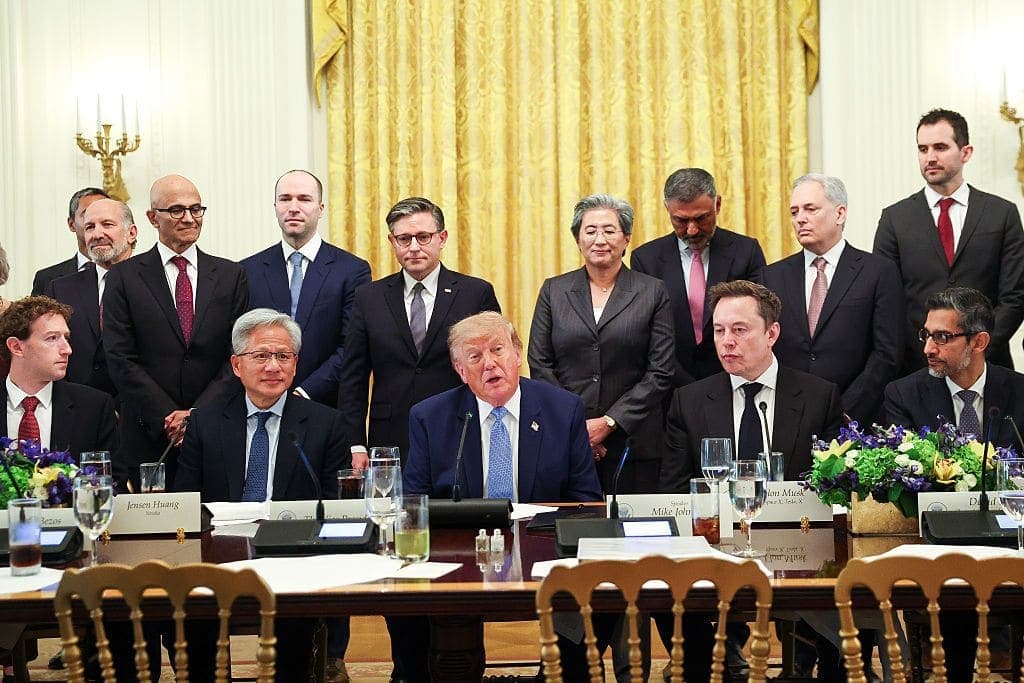
The White House issued an executive order this week that replaces the term "artificial intelligence" with "super intelligence" in official policy documents, a linguistic shift that arrives alongside a high-profile industry summit. President Donald Trump convened chief executives from Meta, Amazon, and Anthropic, among others, to sign what he described as a "morally binding" safety pledge.
The gathering brought Mark Zuckerberg, Jeff Bezos, Elon Musk, and Dario Amodei into the same room, a rare alignment of figures who have often diverged on questions of AI regulation, competitive strategy, and risk assessment. The pledge itself remains light on enforcement mechanisms; Trump's characterisation as "morally binding" stops short of regulatory mandates or statutory penalties.
At Opentechwire, we've tracked the evolution of AI policy language across OECD and ASEAN jurisdictions for three years. Terminology matters in regulation: it shapes liability frameworks, export classifications, and the threshold at which oversight bodies intervene. The shift from "AI" to "super intelligence" introduces ambiguity at a moment when multilateral forums, including the G7 Hiroshima AI Process and Singapore's Model AI Governance Framework, have spent years standardising definitions around narrow AI, general-purpose systems, and foundation models.
Why Language Shapes Liability
Regulatory definitions create bright lines. In the European Union, the AI Act categorises systems by risk level, high-risk applications in healthcare, transport, and law enforcement face conformity assessments and documentation requirements. Singapore's approach, articulated through the Infocomm Media Development Authority, emphasises principles-based governance and sector-specific codes.
The term "super intelligence" carries connotations that diverge from technical consensus. In academic literature, superintelligence typically refers to hypothetical systems that exceed human cognitive capability across all domains, a threshold no deployed model approaches today. Current large language models, including GPT-4, Claude 3, and Gemini, demonstrate narrow strengths in language tasks, code generation, and multimodal reasoning, but lack the generalised autonomy or recursive self-improvement that definitions of superintelligence entail.
By adopting "super intelligence" as an official designation, Washington risks either overstating the capability of existing systems or creating a catch-all category that collapses meaningful distinctions between narrow tools and potential future architectures. For companies navigating export controls, the US International Traffic in Arms Regulations and the Commerce Department's Entity List already restrict the transfer of advanced chips and model weights to certain jurisdictions. Vague terminology complicates compliance and invites inconsistent interpretation by enforcement agencies.
The Summit and the Pledge
The White House summit format echoes earlier convenings under previous administrations, including the 2016 AI summit that brought together OpenAI, DeepMind, and IBM, and the 2023 Senate closed-door briefings on frontier model risk. This iteration, however, centres on voluntary commitments rather than pre-regulatory dialogue.
Details of the pledge remain sparse. Trump's framing as "morally binding" suggests a non-statutory instrument, akin to the 2023 voluntary commitments secured by the Biden administration from seven leading AI companies, including Amazon, Google, Meta, and Microsoft. Those commitments addressed red-teaming, watermarking of synthetic content, and third-party audits. Enforcement relied on reputational pressure and the implicit threat of future regulation.
Industry voluntary pledges have delivered mixed outcomes across technology sectors. The 2018 Partnership on AI principles, endorsed by dozens of companies, produced shared research on fairness and transparency but did not prevent the deployment of facial recognition systems later found to exhibit demographic bias. In the semiconductor industry, voluntary agreements on greenhouse gas emissions preceded binding regulations in Taiwan and South Korea, demonstrating that non-statutory frameworks can serve as scaffolding for harder mandates.
The presence of Dario Amodei, chief executive of Anthropic, is notable. Anthropic has positioned itself as a safety-focused alternative to OpenAI and Google, emphasising constitutional AI and interpretability research. The company's participation alongside Meta and Amazon, both of which have faced scrutiny over content moderation and labour practices, suggests the pledge is broad enough to accommodate divergent corporate cultures.
Competing Frameworks in Asia
Whilst Washington experiments with branding, regulatory frameworks in Asia continue to mature along distinct trajectories. China's Cyberspace Administration issued generative AI measures in 2023 that mandate security assessments and content reviews before public deployment. South Korea's Personal Information Protection Commission has extended data protection rules to cover training datasets, requiring disclosure of data sources and opt-out mechanisms for individuals.
Japan's approach, articulated through the Cabinet Office's AI Strategy Council, prioritises interoperability with international standards and sector-specific guidelines. The country's legal framework treats AI as a tool rather than a separate category, embedding requirements within existing product liability and consumer protection statutes.
Singapore's Model AI Governance Framework, now in its third iteration, offers a principles-based approach that has influenced policy design in Malaysia, Thailand, and the Philippines. The framework emphasises explainability, human oversight, and proportionate governance, calibrated to the risk profile of each deployment. The Monetary Authority of Singapore has issued supplementary guidelines for financial institutions, addressing model validation, bias testing, and incident reporting.
These frameworks share a common characteristic: they avoid sweeping terminology in favour of functional definitions tied to measurable risk. The contrast with Washington's "super intelligence" rebrand is stark.
The Product Marketing Angle
Parallel to the policy shift, Meta and OpenAI have both introduced interface changes designed to make their AI products appear less intimidating. Meta's Llama models now feature simplified onboarding flows and conversational prompts that avoid technical jargon. OpenAI's ChatGPT interface has adopted a more neutral visual design, replacing the green and teal palette with softer tones and reducing the prominence of disclaimers.
These design choices reflect a broader industry effort to normalise AI interaction, moving from power-user tools to mass-market consumer products. The tension between "super intelligence" branding in policy and "friendly assistant" branding in product design reveals competing incentives: governments want to signal control over powerful technology, whilst companies want to minimise user friction and regulatory alarm.
At Opentechwire, we've observed similar dynamics in fintech, where regulators emphasise systemic risk and consumer protection whilst companies market simplicity and convenience. The gap between policy rhetoric and product reality often widens until an incident, such as a data breach or algorithmic failure, forces realignment.
What Comes Next
The executive order's practical impact will depend on implementation. If "super intelligence" becomes the operative term in export control lists, federal procurement guidelines, or liability statutes, it will reshape compliance obligations for every company developing or deploying advanced models. If it remains confined to policy documents and press releases, the effect will be largely symbolic.
Observers in Brussels, Beijing, and Tokyo will watch closely. The European Commission's AI Office, responsible for enforcing the AI Act, has already signalled that it will not adopt terminology that lacks technical grounding. China's approach has historically emphasised state oversight and alignment with national objectives, but its regulatory language remains anchored in functional categories: generative models, recommendation algorithms, and deep synthesis.
The summit's voluntary pledge, meanwhile, will face the same scrutiny that earlier commitments have attracted. Without transparent reporting, independent audits, or consequences for non-compliance, such pledges risk becoming public relations exercises rather than meaningful governance.
For companies operating across jurisdictions, the divergence in terminology adds complexity. A system classified as "super intelligence" in the United States might be treated as a general-purpose AI under the EU AI Act, a generative model under China's CAC measures, and a decision-making tool under Singapore's framework. Navigating this patchwork requires legal and technical fluency in multiple regulatory languages, a burden that falls disproportionately on smaller firms without multinational compliance teams.
The gap between Washington's rhetorical shift and the technical reality of deployed systems remains wide. No model today exhibits the recursive self-improvement, cross-domain autonomy, or goal-directed behaviour that definitions of superintelligence describe. The executive order's adoption of the term reflects political rather than technical reasoning, a choice that may serve short-term signalling goals whilst complicating long-term governance.