US Grants Five-Year Triangle Waiver for Autonomous Freight Trucks
Federal regulators replace a 1950s roadside-safety rule with cab-mounted beacons, clearing the path for commercial driverless freight operations across America.
A Decades-Old Rule Meets Driverless Reality
The Federal Motor Carrier Safety Administration has granted autonomous trucking firms a five-year exemption from a long-standing requirement that forced vehicles to stop deployment plans: the mandate to place reflective warning triangles on the roadside within ten minutes of a breakdown. Aurora Innovation and Kodiak AI are among the first beneficiaries of the ruling, which permits cab-mounted warning beacons as an alternative to physical roadside markers.
The regulation dates to an era when every commercial truck carried a human driver capable of exiting the cab, walking to the rear of the vehicle, and positioning three reflective triangles at prescribed distances. For autonomous freight operators, the requirement presented an impossible contradiction. A mechanical fault might strand a truck on the shoulder, but no one sat inside to deploy the warning devices. The mismatch between mid-century safety protocols and 21st-century vehicle architecture had become the most visible regulatory barrier to commercial driverless freight.
Aurora Innovation escalated the matter to federal court after initial requests for exemption were denied, eventually appealing to the District of Columbia Court of Appeals. Operators worked under temporary waivers whilst the litigation proceeded. The new five-year exemption, announced this week, ends that uncertainty.
Beacons Over Triangles
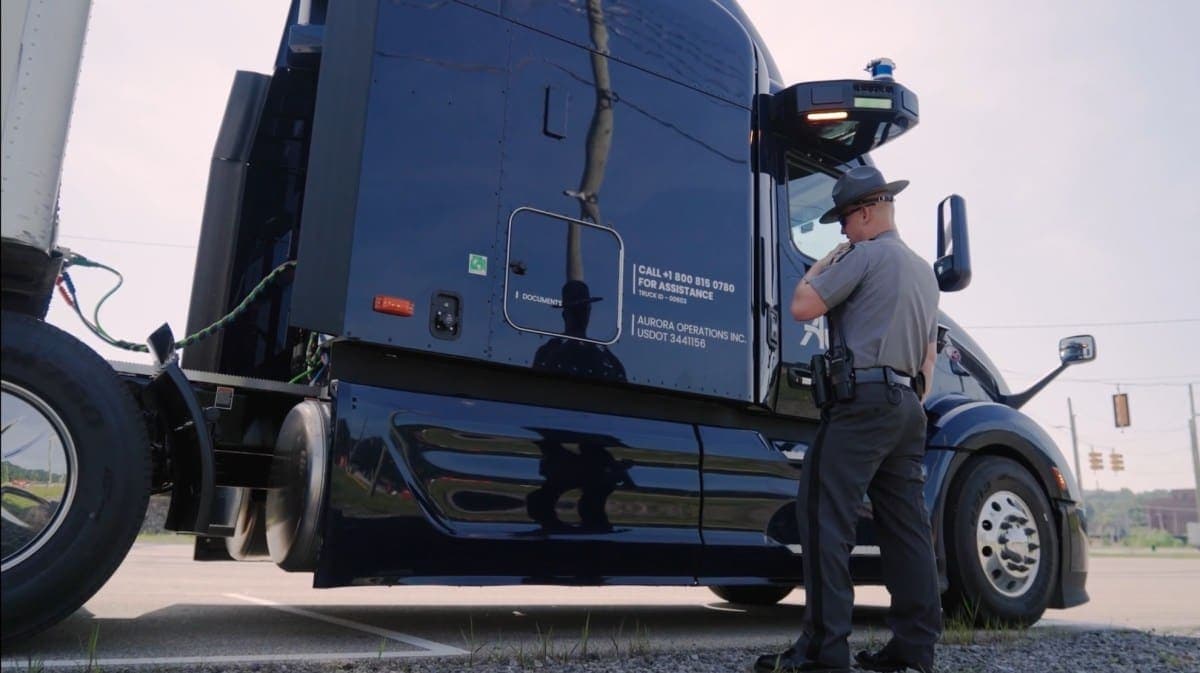
Cab-mounted warning beacons offer a different approach to roadside visibility. Instead of requiring a person to walk along the highway and position static reflectors, the autonomous truck activates high-visibility lights mounted on its exterior. Aurora Innovation's first-responder protocol demonstrates the system: when a vehicle detects a fault and executes a minimal-risk condition manoeuvre to the roadside, it immediately activates roof-mounted beacons visible from extended distances, then transmits its precise location and status to remote operators and emergency services.
The agency's decision reflects a judgement that electronic warning systems can meet or exceed the safety intent of the original rule. Reflective triangles require a human to traverse active traffic lanes, a task that has injured and killed roadside workers for decades. Automated beacons eliminate that exposure whilst providing continuous illumination rather than passive reflection.
Gerardo Interiano, Aurora's head of government relations and public affairs, described the beacons as a solution that "enhances roadside safety by immediately alerting other road users without ever needing to put a person in harm's way," according to the company. Daniel Goff, vice president of external affairs at Kodiak AI, said the exemption would help "usher in an autonomous era of freight movement on US roads, one that can save lives and improve the efficiency of goods delivery."
The Precedent Question
The exemption raises an adjacent possibility: whether cab-mounted beacons might eventually migrate to human-driven trucks. If the technology proves safer and more effective than triangles in driverless operations, the same logic could apply to conventional fleets. Equipping every commercial vehicle with automated warning beacons would eliminate one of the most hazardous tasks drivers face during roadside emergencies. No regulatory mandate exists yet, but the FMCSA's acknowledgment that beacons satisfy the safety objective opens the door.
Autonomous freight operators have argued that their vehicles can execute emergency stops with greater precision than human drivers, positioning themselves further from active lanes and selecting locations with better sight lines. Pairing that capability with immediate, high-visibility illumination creates a safety profile distinct from the manual triangle process. If beacon technology becomes standard across the industry, it would represent a rare case of autonomous-vehicle innovation reshaping practices for human-operated fleets rather than the reverse.
What the Waiver Unlocks
The five-year exemption removes one of the last federal compliance barriers to revenue-generating autonomous freight operations. Aurora Innovation has been preparing to launch commercial driverless routes along key corridors in Texas, where it has already logged hundreds of thousands of test miles. Kodiak AI recently announced a new 435-mile route between Dallas and Laredo, hauling refrigerated and dry freight for consumer packaged goods and food and beverage customers, according to the company.
Both firms have spent years building relationships with freight carriers, shippers, and state regulators whilst the triangle question remained unresolved. The exemption does not alter other federal or state requirements around vehicle inspections, insurance, or operational design domains, but it does remove the single most visible point of conflict between existing motor-carrier rules and driverless technology.
Elsewhere in the sector, Waymo raised five billion dollars in debt financing this week, its first use of credit markets to fund expansion. PIMCO, Blackstone, and Sixth Street led the arrangement, with participation from Capital Group, T. Rowe Price, Apollo, Fidelity Management & Research Company, and others. The structure reflects investor confidence in the company's commercial trajectory and provides capital to scale operations in existing cities whilst entering new markets in the United States, Europe, and Japan. Waymo has historically relied on equity from parent company Alphabet and venture investors; the shift to debt signals a maturation in how the market finances autonomous-vehicle deployment.
Diverging Paths in Policy and Product
Regulatory environments continue to shape product strategy in uneven ways. Tesla changed the name of its advanced driver-assistance system in Europe after pushback from Germany's transportation ministry. The feature previously marketed as "Full Self-Driving (Supervised)" is now labelled "Tesla Assisted Driving" in European markets. The renaming reflects ongoing tension between marketing language and the legal definitions of automation levels. German regulators objected to terminology that could mislead drivers about the system's capabilities and the requirement for continuous supervision.
In London, Uber and Chinese autonomous-vehicle maker Pony.ai plan to launch a robotaxi service as part of an expanded partnership to bring driverless cars to Europe. The announcement follows Pony.ai's efforts to secure operating permits in multiple jurisdictions and Uber's strategy to integrate third-party autonomous fleets into its ride-hailing platform. London's regulatory framework allows for driverless trials under controlled conditions, though full commercial deployment will require further approvals.
Parallel Systems, a startup developing rail vehicles capable of moving several tonnes of freight as far as 500 miles without an operator, raised 100 million dollars in a Series C round led by AVP. The company's approach addresses a different segment of the freight market, focusing on short-haul and mid-haul rail rather than highway trucking. Investors included Hillspire, Agility Global, Cobalt Capital, Anthos Capital, Congruent Ventures, Riot Ventures, and Collaborative Fund.
The Road Ahead for Autonomous Freight
The triangle exemption matters because it resolves a compliance question that had no elegant answer within the existing regulatory structure. Autonomous freight operators can now proceed with commercial launches without the legal ambiguity that shadowed earlier test programmes. The five-year term gives the industry time to demonstrate safety performance with cab-mounted beacons whilst providing the FMCSA an opportunity to gather real-world data before deciding whether to make the exemption permanent or revise the underlying rule.
For Aurora and Kodiak, the immediate effect is operational clarity. Both companies have been preparing for commercial deployment, and the exemption removes one of the last administrative obstacles. The broader question is whether the beacon technology becomes a template for other regulatory adaptations, a signal that federal agencies are willing to rewrite mid-century rules when the safety case supports it.
Autonomous trucking has always faced a longer path to commercialisation than passenger robotaxis, in part because freight vehicles operate across state lines and fall under a more complex web of federal and state regulations. The triangle exemption is a small but concrete example of how those rules are beginning to bend.