Uber Pushes Gravity Robotaxis onto Bay Area Streets Without Safety Drivers
The ride-hailing giant, Lucid and Nuro have begun fully autonomous testing in California, setting the stage for a commercial launch targeting early 2027 and a fleet order that dwarfs existing robotaxi deployments.
Deployment Milestone in Palo Alto
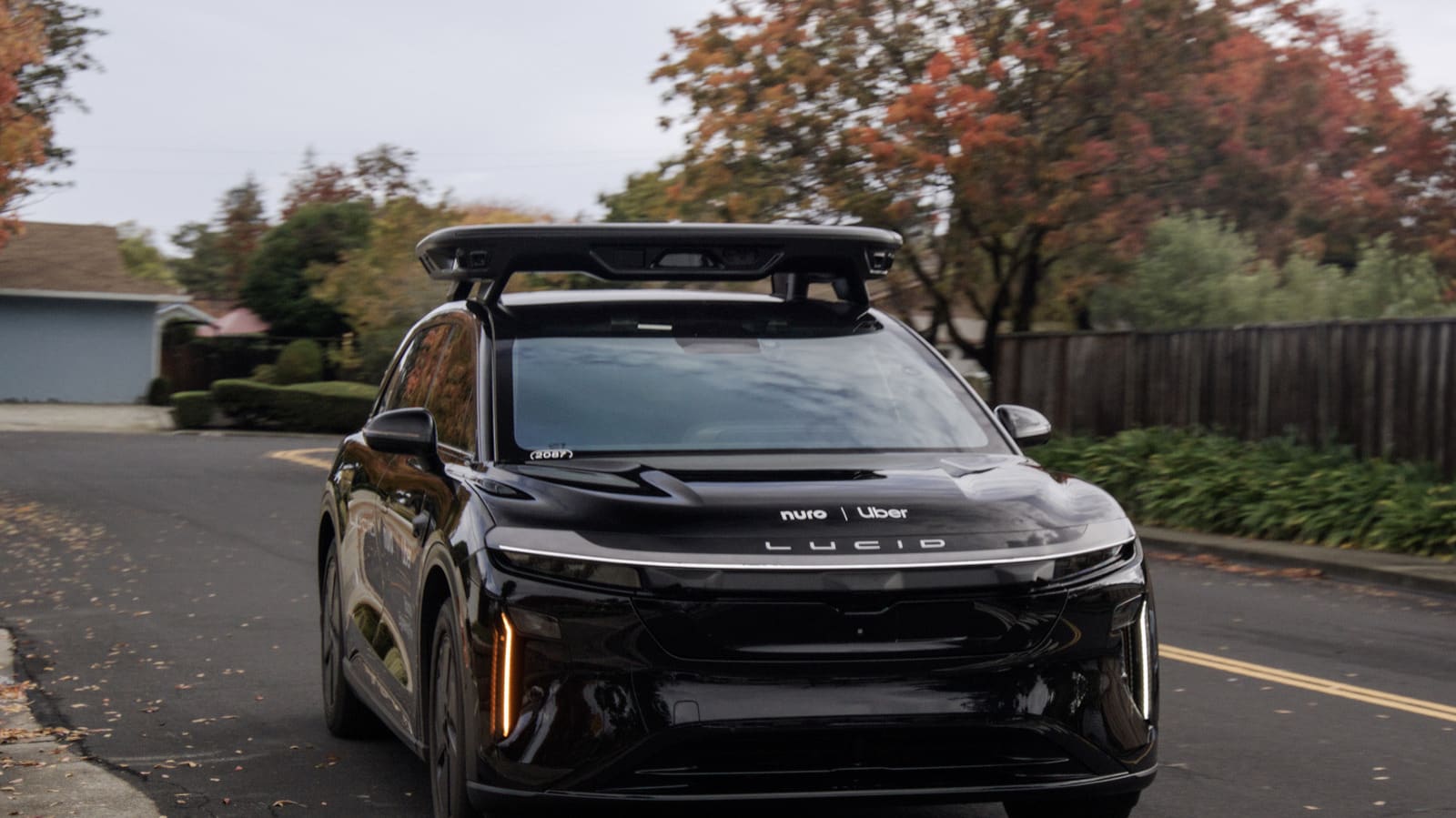
Uber has removed safety drivers from a fleet of Lucid Gravity SUVs operating on public roads in the San Francisco Bay Area, marking the latest stage in a robotaxi programme that the company first outlined in mid-2025. The vehicles, manufactured by Lucid and equipped with the Nuro Driver autonomous system, are now conducting fully driverless testing across Palo Alto, Mountain View, Los Altos and Sunnyvale, Uber announced on 24 November. Employee rides are scheduled to begin shortly, ahead of a planned commercial rollout in the first quarter of 2027.
The progression from supervised testing to uncrewed operation follows the granting of a California Department of Motor Vehicles Driverless Testing Permit in May. That authorisation allows Uber, Lucid and Nuro to operate vehicles without a human behind the wheel on designated public roads within the state. The trio had been conducting on-road trials with safety drivers since December of the previous year, accumulating mileage on the same routes now open to driverless operation.
Lucid disclosed that its robotaxi fleet currently comprises 100 vehicles, though the companies did not specify how many of those units are actively participating in the initial driverless phase. The testing footprint is set to expand into additional Bay Area municipalities in 2026, though specific cities have not yet been named.
Hardware and Software Architecture
The modified Gravity SUVs carry a sensor suite that includes high-resolution cameras, LIDAR units and radar arrays, all feeding data into the Nuro Driver platform. Nuro, a Mountain View-based autonomous vehicle developer, built the system as an end-to-end architecture, meaning perception, planning and control functions are integrated rather than modular. That design choice reflects a broader industry shift towards neural-network models that process raw sensor input directly into driving commands, reducing the handoffs between discrete subsystems that characterised earlier generations of self-driving software.
Lucid's role extends beyond supplying the base vehicle. The electric SUV was selected in part for its native electrical architecture, which supports the power and data throughput demands of continuous sensor operation and real-time compute. The Gravity platform offers a spacious cabin and a relatively high ride height, attributes that Uber has indicated will inform the interior experience it is designing for passengers. Rider-facing controls, support interfaces and in-cabin amenities will be managed by Uber, which retains responsibility for the customer layer even as Lucid and Nuro handle the vehicle and autonomy stack.
Scale Ambitions and Fleet Economics
Uber committed to purchasing 35,000 Lucid-Nuro robotaxis and has stated its intention to deploy the vehicles globally, a figure that would place the programme among the largest autonomous fleet orders disclosed to date. For context, Waymo operates several hundred vehicles across its commercial service areas in San Francisco, Phoenix and Los Angeles, while Cruise paused operations in late 2023 after regulatory scrutiny and has yet to resume at scale. A 35,000-unit order signals confidence in both regulatory approval timelines and the unit economics of operating electric, autonomous vehicles on a ride-hailing network.
The economics hinge on several variables. Eliminating the driver removes the largest variable cost in ride-hailing, but autonomous systems introduce new line items: vehicle capital expenditure, sensor and compute hardware, insurance, remote monitoring and fleet maintenance. Lucid's manufacturing cost per Gravity unit, Nuro's licensing or integration fees and Uber's margin structure will determine whether the programme can undercut human-driven fares while still generating a return. Early-stage robotaxi operators have typically subsidised rides to build user familiarity, but sustained profitability requires either lower costs or higher utilisation than traditional ride-hailing achieves.
Uber's existing network offers a structural advantage. The company can route autonomous vehicles through its dispatch algorithm alongside human drivers, dynamically allocating robotaxis to trips where wait times, distance or fare structure make them more efficient. That hybrid model allows Uber to scale autonomy incrementally, avoiding the cold-start problem that pure-play robotaxi operators face when building rider demand from zero.
Regulatory and Operational Context in California
California's permitting regime for autonomous vehicles is among the most developed in the world, but also among the most cautious following a series of high-profile incidents. In October 2023, a pedestrian was dragged by a Cruise robotaxi after being struck by a human-driven vehicle, prompting the California Public Utilities Commission to suspend Cruise's driverless deployment permit. The California DMV subsequently revoked Cruise's testing authorisation, and the company recalled its fleet for a software update.
Those events hardened scrutiny on driverless testing applications. The DMV's driverless testing permit, which Uber, Lucid and Nuro obtained in May, does not confer commercial operating authority; that requires a separate deployment permit and approval from the Public Utilities Commission. The companies have not disclosed whether they have applied for deployment permits, though a Q1 2027 commercial launch would necessitate approval well in advance to allow for rider onboarding and insurance arrangements.
San Francisco presents a particularly demanding test environment. The city's dense urban fabric, steep gradients, frequent fog, cyclist and pedestrian traffic, and unpredictable road users create edge cases that stress perception and planning systems. Waymo has operated commercially in San Francisco since mid-2023 and has logged millions of driverless miles, but the service has drawn complaints over blocked traffic, confused manoeuvres at construction sites and occasional collisions. Uber's decision to begin testing in suburban Peninsula cities rather than downtown San Francisco suggests a phased approach to complexity, mirroring the strategy Waymo employed when it expanded from Phoenix to more congested markets.
Competitive Landscape and Strategic Positioning
Uber's partnership with Lucid and Nuro positions the company as a platform operator rather than a vertically integrated autonomy developer. That contrasts with Waymo, which builds its own sensor suite and software, and with Tesla, which is developing both the vehicle and the Full Self-Driving system in-house. Uber's model relies on integrating third-party technology, a strategy that allows the company to avoid the capital intensity of hardware development but also cedes control over the pace of technical progress.
The choice of Lucid as the vehicle supplier is notable. Lucid remains a relatively small manufacturer, delivering approximately 9,000 vehicles in 2025 and facing ongoing questions about production scale and cash burn. A 35,000-unit order from Uber would represent a material share of Lucid's near-term production capacity and provide revenue visibility that could ease investor concerns. For Lucid, the robotaxi programme offers a path to volume that consumer sales alone have not yet delivered.
Nuro, meanwhile, has pivoted from its original focus on small, low-speed delivery bots to licensing its autonomy stack for passenger vehicles. The company raised over 2 billion US dollars in venture funding between 2016 and 2021, but the delivery-bot market proved slower to materialise than anticipated. Partnering with Uber and Lucid on a large-scale passenger deployment allows Nuro to monetise its software in a higher-value segment, though it also exposes the company to the technical and liability challenges of operating at highway speeds in mixed traffic.
What Happens Between Now and Launch
The months between now and the planned Q1 2027 launch will be critical. Uber, Lucid and Nuro must demonstrate to California regulators that the system can handle the full range of scenarios it will encounter in commercial service, including interactions with emergency vehicles, construction zones, adverse weather and unpredictable human behaviour. The companies will also need to show that their remote monitoring and intervention capabilities can handle edge cases without introducing unacceptable delays.
Employee rides, which the companies indicated will begin soon, serve as a controlled beta phase. Internal users are more forgiving of rough edges and more willing to provide detailed feedback than paying customers, and their trips generate data on comfort, usability and system performance under real-world conditions. If the employee phase surfaces persistent issues - say, uncomfortable braking, poor route selection or cabin interface confusion - the companies can iterate before opening to the public.
The expansion from four Peninsula cities to a broader Bay Area footprint in 2026 will test the system's ability to generalise. Each new municipality introduces different road layouts, traffic patterns and regulatory nuances. Some cities have been more welcoming to autonomous testing than others; San Francisco's Board of Supervisors has called for greater oversight of robotaxi operations, while smaller cities have sometimes granted permits with fewer conditions.
Commercially, Uber must determine pricing, service hours and geographic coverage. Will robotaxis cost less than human-driven rides, the same or more? Will they operate around the clock, or only during daylight and dry weather? Will the service cover the entire Bay Area, or remain confined to a subset of neighbourhoods? Those decisions will shape adoption and set expectations for the global rollout that Uber has signalled.
Implications for the Broader Market
If Uber's programme reaches commercial scale, it will validate the platform-integrator model and demonstrate that ride-hailing incumbents can compete with pure-play autonomy companies. It will also test whether consumers are willing to ride in vehicles with no human supervisor present, a question that remains unsettled despite years of Waymo operation. Survey data consistently shows that comfort with fully autonomous rides increases with exposure, but translating that into mass-market adoption requires not just technical reliability but also trust in the operator, transparent communication about safety and a smooth user experience.
For Lucid and Nuro, success would cement their roles in an emerging supply chain for autonomous mobility. Lucid could position itself as the premium vehicle provider for robotaxi fleets, leveraging its electric architecture and design capabilities. Nuro could license the Nuro Driver platform to additional partners, creating a recurring revenue stream analogous to the model that companies like Mobileye have pursued in advanced driver-assistance systems.
Failure, or even a protracted delay, would raise questions about the timeline for profitable autonomous ride-hailing. The sector has already seen multiple retrenchments: Uber sold its own self-driving unit to Aurora in 2020, Ford and Volkswagen shut down Argo AI in 2022, and Cruise remains sidelined. Capital markets have grown sceptical of autonomy timelines, and another high-profile stumble could further dampen investment.
The Bay Area testing phase is therefore more than a technical milestone. It is a signal to regulators, investors and the public that the coalition of Uber, Lucid and Nuro believes the technology is ready for unsupervised operation at scale. Whether that belief proves justified will become clear over the coming quarters, as the vehicles navigate real streets, real passengers and the real complexities of urban mobility.