Singapore Battery Recycler Closes Oversubscribed Round as Lithium Recovery Gains Investor Traction
NEU Battery Materials raises USD 7.6 million to scale recycling operations, backed by climate-focused funds and Singapore's state-backed venture arm
Oversubscribed Close Reflects Sector Momentum
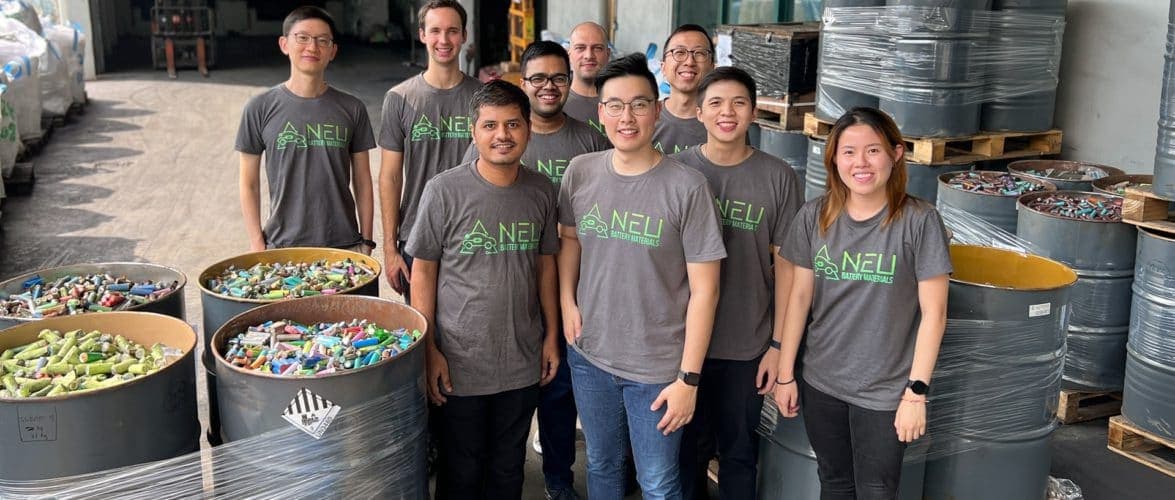
NEU Battery Materials has closed a USD 7.6 million funding round that attracted more commitments than initially targeted, with co-leads Shift4Good and SGInnovate anchoring the transaction. The Singapore-based lithium recycling firm also brought in Lotus Singapore Group and M7 Holdings as new backers, while Paragon Ventures I returned for a second round.
The oversubscription points to a broader shift in climate-tech appetite across Southeast Asia. At Opentechwire, we have tracked a steady uptick in battery-adjacent financing since mid-2025, as institutional investors begin to view end-of-life battery processing not as waste management but as a strategic node in the critical-minerals supply chain. NEU's ability to pull in both impact-oriented funds and commercial capital in the same round suggests that the unit economics of lithium recovery are starting to pencil out at scale.
Why Lithium Recycling Matters Now
Battery demand in Asia is outpacing the pace of new mine development, and regulatory pressure is mounting. The European Union's Battery Regulation, which took effect in 2024, mandates minimum recycled content in new cells sold within the bloc, and similar frameworks are under discussion in Japan, South Korea, and parts of ASEAN. For battery manufacturers with global supply chains, securing access to recycled lithium, cobalt, and nickel is no longer optional.
NEU's model centres on hydrometallurgical processing, a chemical recovery method that avoids the energy intensity of pyrometallurgy and can achieve higher purity levels for reintroduction into cell production. The company has been piloting its process with regional battery manufacturers and automotive OEMs, focusing on lithium-ion chemistries common in consumer electronics and electric two-wheelers, categories where end-of-life volumes are already material in Southeast Asia.
The participation of SGInnovate, Singapore's state-backed deep-tech investor, is noteworthy. The fund typically takes longer-term positions in ventures that require patient capital and technical validation before scaling. Its presence alongside climate-focused Shift4Good suggests that NEU has cleared early technical milestones and is moving toward commercial throughput.
Regional Context and Competitive Landscape
Singapore has positioned itself as a hub for battery and energy-storage innovation despite having no domestic automotive manufacturing at scale. The city-state's strategy relies on aggregating technical talent, providing access to regional manufacturing clusters in Malaysia and Indonesia, and offering regulatory sandboxes for circular-economy pilots. NEU fits squarely into this playbook, leveraging Singapore's infrastructure while eyeing feedstock from across Southeast Asia.
Competing recyclers in the region include Brunp Recycling, a subsidiary of CATL operating primarily in China, and South Korea's SungEel HiTech, which has expanded into Europe and North America. In Southeast Asia, however, formal recycling capacity remains limited, and much end-of-life battery material is either exported to China or handled by informal scrap networks that recover only the most valuable metals. NEU's challenge will be to secure consistent feedstock agreements with device manufacturers, mobility operators, and municipal waste systems before larger Chinese or Korean players establish local beachheads.
Capital Allocation and Next Steps
The USD 7.6 million will fund capacity expansion, though NEU has not disclosed the location or timeline for new facilities. Industry observers expect the company to prioritise securing long-term offtake agreements with cell manufacturers, which require proof of consistent output quality and regulatory compliance before committing to multi-year contracts.
The round also positions NEU to pursue certifications under emerging battery-passport schemes, which will require traceability of recycled material from collection through reintroduction into production. These digital credentials are expected to become a prerequisite for selling into European and potentially Japanese markets by 2027, and early movers in the certification process may enjoy a first-mover advantage in securing premium pricing from manufacturers under compliance pressure.
What This Signals for Battery-Adjacent Venture Activity
The funding environment for battery recycling has improved markedly over the past eighteen months. Early-stage ventures in the space were historically constrained by high capital intensity, long payback periods, and uncertain feedstock supply. The fact that NEU attracted four distinct investor types in a single round, including impact funds, state-backed venture, family offices, and traditional venture capital, suggests that the risk profile of the sector is being reassessed.
We expect to see more capital flow into adjacent segments: battery diagnostics, logistics networks for end-of-life collection, and software platforms that match feedstock suppliers with recyclers. The battery value chain is fragmenting into specialised layers, and investors are beginning to recognise that not all value accrues to cell manufacturers. Companies that control critical chokepoints in reverse logistics or materials recovery may capture outsised returns as regulatory mandates tighten and feedstock competition intensifies.
NEU's next test will be execution. Raising capital in an oversubscribed round is a vote of confidence, but scaling recycling operations requires navigating permitting, securing industrial partners, and managing commodity-price volatility. The funding gives the company runway to prove its model, but the real validation will come when it signs its first multi-year offtake contract with a Tier 1 cell producer.