WindBorne Secures $49 Million Air Force Deal for Balloon-Sourced Weather Intelligence
The Redwood City startup's 700-balloon constellation feeds both government operations and its own deep-learning forecast model, marking a shift in how atmospheric data reaches military planners.
A Fleet in the Sky
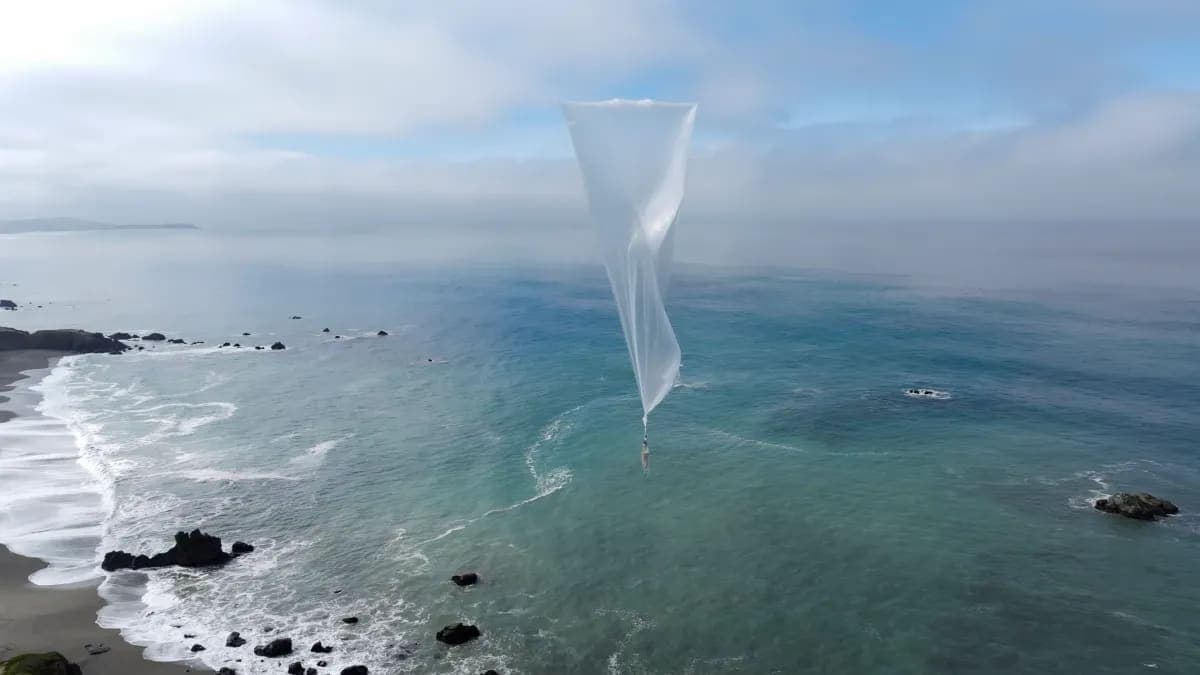
Seven hundred autonomous balloons drift across the planet's atmosphere right now, collecting temperature, pressure, and wind readings that flow into both military planning systems and a commercial weather model. WindBorne Systems, the Redwood City company that operates this constellation, has just secured its largest government contract: a vehicle potentially worth $49 million through which the US Air Force can order atmospheric data on demand.
The arrangement works as a call-off contract. The Air Force committed the ceiling figure but pays only when it needs coverage, placing orders for specific regions and time windows. So far, $1.7 million has been obligated. WindBorne executives anticipate steady follow-on orders as operational requirements emerge.
"This is largely a vehicle through which continued growth of the constellation can be supported, as well as some work on research and development to continue to improve the hardware and performance of the balloons," WindBorne co-founder and chief technology officer Andrey Sushko explained. The contract was awarded sole-source, meaning the Air Force determined that WindBorne alone could meet the technical parameters for global atmospheric sensing at the required scale and responsiveness.
The Physics of Steering Without Engines
WindBorne's balloons carry no propulsion. Instead, the company navigates by adjusting altitude - bleeding air to descend, dropping sand ballast to rise - so that vehicles catch wind currents moving in the desired direction. It is a constrained optimisation problem: forecast wind patterns, calculate trajectories, and position assets where they will be needed hours or days ahead.
In August, WindBorne became the first organisation to manoeuvre an unpowered system into the eye of a typhoon. "That's a pretty novel step, and the two ingredients for that are one, having good wind and weather models, and knowing how to navigate them; and two, having a large enough constellation that you have balloons in the right places," Sushko said. "It's one of the first times that a deep-learning model was used for actual operational decisions."
The typhoon intercept was both a technical demonstration and a proof of concept for the company's dual role: WindBorne sells sensor observations to customers including the National Weather Service, the Air Force, and the Navy, but it also uses those observations to train and refine its own forecasting model, WeatherMesh.
Empirical Data Meets Transformer Architecture
WindBorne, founded in 2015, is among the first organisations to feed fresh empirical readings directly into a deep-learning weather model rather than relying solely on reanalysis datasets. The latest iteration, WeatherMesh 6, released earlier this year, claims accuracy improvements over the traditional numerical model operated by the European Centre for Medium-Range Weather Forecasts, which simulates atmospheric behaviour using the Navier-Stokes equations and thermodynamic laws.
The shift from physics-based simulation to end-to-end learning has accelerated since the ECMWF published a large-scale historical weather dataset and transformer architectures proved capable of ingesting decades of observations to issue predictions in minutes rather than hours. Google DeepMind's cyclone forecasting tools now inform US government hurricane response; frontier labs and national meteorological agencies are converging on hybrid approaches that blend numerical simulation with learned models.
Yet the frontier remains jagged. Physics-based models still outperform AI in certain scenarios - high-resolution nowcasting, rare extreme events, and regions with sparse historical data. Most operational meteorologists treat the two paradigms as complementary rather than competitive. WindBorne's advantage lies in its ability to improve both: the balloon data enhances traditional models by filling observational gaps, and it trains the company's own AI model with real-time atmospheric states that satellites and ground stations cannot easily capture.
Government as Anchor Customer and Growth Engine
WindBorne raised a $37 million Series B round in August, capital earmarked for expanding the constellation and refining balloon hardware. The new Air Force contract functions as both revenue source and development subsidy: orders fund incremental deployment, while research-and-development provisions support hardware iteration.
The company has cultivated close ties with US government weather and defence agencies. The National Weather Service relies on WindBorne observations to fill coverage gaps over oceans and the Southern Hemisphere, where radiosonde launches from land stations are sparse. The Air Force and Navy use the data for mission planning in regions where adversary activity or operational security concerns limit the use of crewed reconnaissance flights or fixed satellite passes.
This relationship poses a strategic question. WindBorne's balloon fleet is global, and atmospheric data is not inherently classified. Commercial weather services, reinsurers, and agricultural firms could all benefit from the same observations. Yet the company's deepest integration is with US defence and intelligence customers, a pattern that may shape how international clients perceive the service.
At the same time, the sole-source determination by the Air Force suggests that no competitor - neither established satellite operators nor other balloon ventures - currently matches WindBorne's combination of global reach, responsiveness, and cost. That moat is partly technical and partly operational: manoeuvring unpowered balloons at scale requires not just hardware but also the forecasting models that enable navigation, creating a feedback loop that advantages the incumbent.
The Weather Model Arms Race
AI weather forecasting has moved from research curiosity to operational reality faster than most domains of applied machine learning. The reasons are structural: weather data is abundant, physics provides strong inductive biases, and forecast skill is easy to measure. Unlike language models, where evaluation remains contested, a weather model either predicts tomorrow's temperature accurately or it does not.
WindBorne occupies a particular niche within this landscape. Unlike DeepMind or ECMWF, which train models on historical reanalysis data, WindBorne ingests observations from its own sensors, creating a proprietary data advantage. Unlike satellite operators, which capture snapshots at fixed intervals, WindBorne's balloons drift continuously, sampling vertical profiles of the atmosphere that reveal temperature inversions, wind shear, and moisture gradients invisible from space.
The company's typhoon intercept illustrates the strategic value of this approach. Hurricanes and typhoons are among the costliest and deadliest weather phenomena, yet initialising forecast models inside the storm's core - where pressure gradients are steepest and prediction errors compound fastest - requires observations that satellites struggle to provide. If WindBorne can routinely position balloons in the paths of developing cyclones, it gains a data stream that directly improves the forecasts guiding evacuation orders, naval deployments, and reinsurance pricing.
What the Contract Signals
The $49 million ceiling is not transformational capital for a company that recently raised $37 million in equity, but the contract's structure reveals how the Air Force thinks about atmospheric intelligence in an era of great-power competition. Rather than building its own balloon fleet or procuring a fixed dataset, the service is buying optionality: the ability to task coverage over denied areas, contested regions, or emerging theatres without long procurement lead times.
This on-demand model mirrors trends in satellite imagery and signals intelligence, where the US Department of Defence increasingly relies on commercial providers to supplement classified systems. The advantage is flexibility and cost; the risk is dependence on a single vendor whose global operations and customer base may not always align with national security priorities.
For WindBorne, the contract provides validation and runway. Sole-source awards are rare and signal that the customer sees no viable alternative. The research-and-development provisions allow the company to improve balloon endurance, sensor precision, and navigation algorithms with partial government subsidy, investments that will benefit both military and commercial customers.
The question now is whether WindBorne can translate government traction into broader commercial adoption. Weather forecasting is a competitive market, dominated by incumbents with decades of customer relationships and operational track records. WindBorne's edge is its unique data, but data alone does not guarantee market share. The company must prove that WeatherMesh forecasts - informed by balloon observations - deliver measurable value to airlines, energy traders, and agricultural clients who already subscribe to established services.
If it succeeds, the Air Force contract may be remembered as the inflection point when a startup's experimental balloon fleet became critical infrastructure for both military operations and civilian weather prediction. If it does not, the contract will have funded an interesting experiment in atmospheric sensing that never quite escaped its niche.