Samsung Electro-Mechanics Bets $5 Billion on Vietnam's Semiconductor Substrate Play
The South Korean firm's investment through 2028 signals Vietnam's shift from assembly hub to critical node in AI and high-performance computing supply chains.

Vietnam Moves Beyond Assembly
Samsung Electro-Mechanics has committed close to $5 billion to expand semiconductor substrate production across South Korea and Vietnam through 2028, a capital allocation that underscores Vietnam's evolving position in the global electronics value chain. The investment targets substrates used in artificial intelligence servers and high-performance computing systems, components that sit between silicon dies and circuit boards and have become bottlenecks as AI infrastructure scales.
At Opentechwire, we've tracked Vietnam's electronics industry for over a decade - first as the destination for low-margin smartphone assembly, then as a testing and packaging node, and now as a candidate for more technically demanding substrate work. This latest commitment from Samsung Electro-Mechanics, the components arm of the Samsung conglomerate, represents the clearest signal yet that Vietnam is climbing into the intermediate tiers of semiconductor manufacturing, a zone historically dominated by Taiwan, South Korea and Japan.
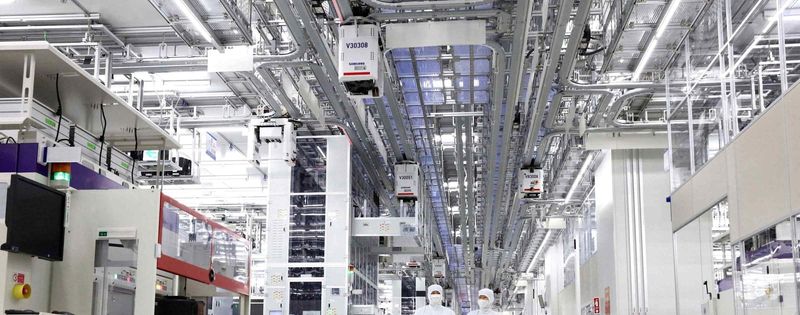
The company announced the investment plan in October 2026, splitting the capital between its home market and Thai Nguyen province in northern Vietnam, where Samsung already operates smartphone and consumer electronics plants. Construction of a new semiconductor facility in Thai Nguyen was visible in satellite imagery from May 2026, suggesting the project timeline had already begun before the formal disclosure.
What Substrates Mean for AI Infrastructure
Semiconductor substrates are multilayer boards that provide electrical connections and mechanical support for processor and memory chips. As AI accelerators and high-bandwidth memory modules have grown in complexity, substrate technology has had to keep pace. Advanced substrates for graphics processing units and AI inference chips require finer line widths, more metal layers, and tighter tolerances than the substrates used in consumer devices a generation ago.
The supply of these advanced substrates has lagged demand. Hyperscalers building AI data centres have faced lead times stretching beyond six months for certain substrate types, a constraint that has rippled through server assembly schedules. Samsung Electro-Mechanics' decision to allocate nearly $5 billion to this segment reflects both the margin opportunity and the strategic imperative to secure substrate capacity for its own semiconductor customers, including Samsung Electronics' foundry and memory divisions.
Vietnam's inclusion in this expansion is notable. The country has long served as a high-volume assembly location for Samsung's smartphones and displays, but substrate production demands cleanroom environments, precision lithography for trace patterning, and quality control regimes closer to those in wafer fabrication than in final assembly. By siting substrate capacity in Vietnam, Samsung Electro-Mechanics is effectively testing whether the country's industrial base can support processes that require tighter process windows and more sophisticated metrology.
Regional Context and Competitive Pressure
Vietnam's economy expanded 9.95 per cent year-on-year in the third quarter of 2026, the fastest growth rate in four years, driven in part by electronics exports and foreign direct investment inflows. The semiconductor sector has been a particular focus: LG Electronics committed over $1 billion to semiconductor-related projects in Vietnam earlier in 2026, and the government has signalled its intention to attract more upstream investment through tax incentives and infrastructure support.
Elsewhere in Southeast Asia, Singapore has also moved to capture substrate capacity. Broadcom and Toppan jointly opened Singapore's first advanced chip substrate facility in 2026, a project aimed at serving the co-packaged optics and high-bandwidth memory markets. Malaysia, through firms like SkyeChip, has positioned itself within Japan's Rapidus semiconductor ecosystem, targeting substrate and advanced packaging roles.
The regional competition is sharpening. Vietnam offers lower labour costs and an established Samsung footprint, but Singapore provides deeper process engineering talent and proximity to design centres. Malaysia brings decades of backend semiconductor experience and government backing for advanced packaging. Samsung Electro-Mechanics' decision to split investment between South Korea and Vietnam suggests a hedging strategy: keeping the most advanced processes at home while scaling proven substrate types in Vietnam.
Risks in the Transition
Moving substrate production to Vietnam is not without friction. Substrate manufacturing requires stable power supply, ultra-pure water, and chemical logistics that can handle corrosive etchants and photoresists. Thai Nguyen province has invested in industrial parks with dedicated power substations, but the infrastructure remains less redundant than in South Korea's semiconductor clusters around Suwon and Cheonan.
Talent is another variable. Vietnam's engineering graduates have proven capable in process control and yield management for assembly and test operations, but substrate production involves materials science and failure analysis disciplines that take years to build. Samsung Electro-Mechanics will likely staff the Vietnam facility with a mix of local engineers and expatriate specialists from South Korea, a model Samsung Electronics has used in its Vietnamese smartphone plants but one that carries overhead and retention challenges.
Geopolitical risk also looms. Vietnam's proximity to China and its deepening trade ties with both Beijing and Washington create exposure to export control shifts and supply chain rewiring. Substrates for AI accelerators could fall under future restrictions if regulators decide that advanced packaging and substrate technology contributes meaningfully to compute capability. Samsung Electro-Mechanics would then face the choice of ring-fencing its Vietnam output for non-restricted markets or relocating capacity.
Implications for Vietnam's Industrial Strategy
The $5 billion commitment arrives as Vietnam's government attempts to articulate a coherent semiconductor strategy. Hanoi has studied the playbooks of Taiwan, South Korea and Malaysia, each of which built semiconductor industries through different combinations of state capital, tax breaks, and anchor tenant partnerships. Vietnam's advantage lies in its existing electronics manufacturing base and its position outside the most contentious zones of US-China tech rivalry, but it lacks domestic semiconductor design firms and equipment suppliers.
Samsung Electro-Mechanics' investment offers Vietnam a pathway into the substrate segment without requiring the country to build a full-stack semiconductor industry. Substrates are less capital-intensive per unit of output than wafer fabs, more scalable than advanced packaging, and less dependent on cutting-edge lithography tools subject to export controls. If the Thai Nguyen facility succeeds, it could anchor a cluster of substrate material suppliers, metrology service providers, and logistics firms - a vertical slice of the semiconductor value chain that Vietnam can realistically capture over the next decade.
The funding rounds we've followed across the region suggest that substrate and packaging startups are attracting venture capital and strategic investment at a pace not seen since the smartphone boom of the early 2010s. Vietnam's challenge will be to convert Samsung's anchor investment into a broader ecosystem, one that includes local firms rather than remaining entirely dependent on foreign multinationals.
For Samsung Electro-Mechanics, the Vietnam expansion is both a capacity play and a cost arbitrage. Substrates for AI servers command higher margins than consumer substrates, but competition from Japanese and Taiwanese suppliers is intensifying. By splitting production between South Korea and Vietnam, the company gains flexibility to allocate high-mix, low-volume orders to its home plants while running high-volume, standardised substrates in Vietnam at lower cost.
The timeline through 2028 aligns with projections for AI infrastructure buildout. If demand for AI accelerators continues on its current trajectory, substrate capacity will remain tight, and Samsung Electro-Mechanics' early move into Vietnam could yield first-mover advantages in customer qualification and supply chain relationships. If AI capital expenditure plateaus or shifts toward edge inference, the company will have overcapacity in a location with less process flexibility than its South Korean base.
Vietnam's semiconductor ambitions will be tested by how well it can absorb this wave of investment. The country has the workforce scale and manufacturing discipline to succeed in substrates, but it will need to build supporting infrastructure, deepen technical education, and manage geopolitical exposure. Samsung Electro-Mechanics' $5 billion bet is a vote of confidence, but it is also a challenge - one that will reveal whether Vietnam can sustain the transition from assembly economy to component producer in an industry where margins and technical demands are rising in tandem.