Microsoft Doubles Down on Custom Silicon to Escape Nvidia's Grip
Maia 300, the company's third-generation inference chip, promises 40 per cent efficiency gains and signals a strategic shift in cloud AI infrastructure
The Economics of Inference
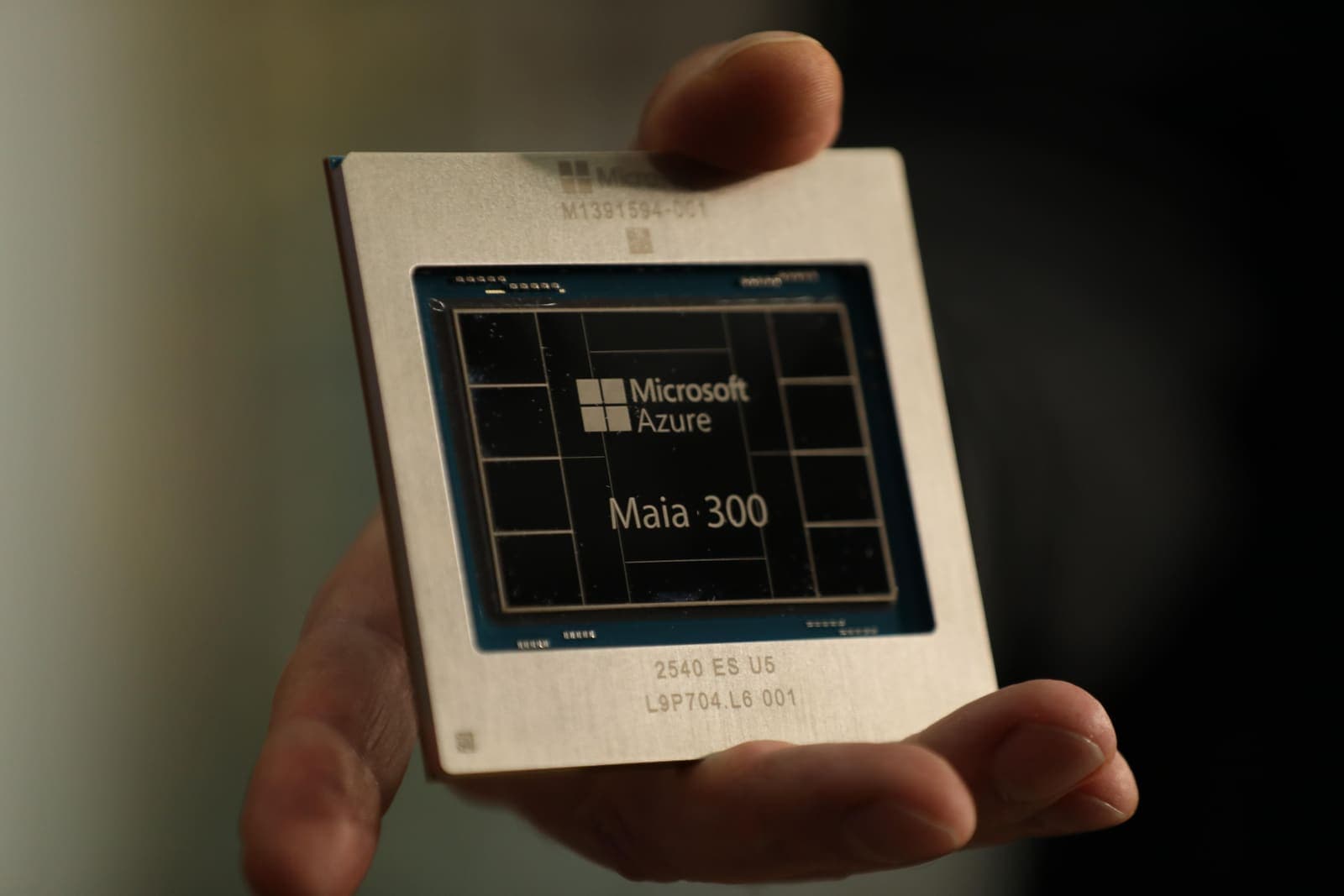
Microsoft has confirmed its Maia 300 chip will enter production deployment across its cloud infrastructure in 2027, marking the third iteration of the company's effort to design silicon tailored for AI workloads. The chip targets inference rather than training, a deliberate architectural choice that reflects where hyperscalers now see both cost pressure and competitive advantage.
Scott Guthrie, who leads Microsoft's cloud division, pegged the efficiency improvement at 40 per cent more tokens per megawatt when measured against contemporary GPU-based systems. That figure matters less as a performance benchmark than as an economic one. Inference cost scales with usage in a way training cost does not. Every query to Copilot, every API call to Azure OpenAI Service, every agentic workflow that loops through multiple reasoning steps burns through tokens. The more efficient the silicon, the wider the margin.
At Opentechwire, we have tracked the rising capital intensity of AI infrastructure across the region. Seoul, Singapore and Tokyo have all seen hyperscale expansions bump up against power grid constraints. A 40 per cent reduction in energy per token is not a minor optimisation. It translates directly into rack density, into how many inference clusters a single substation can support, and ultimately into whether a cloud provider can profitably serve the next wave of generative applications.
Designed for Reasoning, Not Just Completion
Maia 300 has been engineered with newer model architectures in mind. The chip is optimised for reasoning models, the class of large language models that produce intermediate steps before arriving at a final answer, and for agentic tasks, where a model might invoke tools, evaluate outputs and loop back through decision trees.
These workloads differ from simple text completion. Reasoning models generate more tokens per query and exhibit less predictable latency. Agentic systems string together multiple inference calls, often with dependencies that prevent aggressive batching. Both patterns stress memory bandwidth and cache hierarchy in ways that first-generation inference accelerators, tuned for high-throughput completion tasks, handle poorly.
Microsoft has not disclosed the technical specifics of Maia 300's architecture, but the emphasis on reasoning and agency suggests design choices around on-chip memory, interconnect topology and perhaps mixed-precision arithmetic that favour iterative workloads. The company's willingness to label Maia 300 as the "primary AI inference system" for its products and services indicates confidence that the chip can handle production load, not merely pilot deployments.
The GPU Dependency Problem
The announcement arrives at a moment when the AI industry's reliance on a single GPU supplier has become both a financial and a strategic vulnerability. Lead times for high-end datacenter GPUs remain measured in quarters. Allocation negotiations resemble term-sheet discussions. For cloud providers, every dollar spent on GPUs is a dollar that does not flow to margin or to R&D elsewhere in the stack.
Custom silicon offers a hedge. It does not eliminate the need for GPUs, especially for training runs that demand the raw floating-point throughput and interconnect bandwidth only cutting-edge process nodes and HBM stacks can deliver. But inference is a different game. Models are frozen. Workloads are more predictable. The opportunity to trade some flexibility for cost and efficiency is real, provided the chip can keep pace with model evolution.
We have watched this pattern unfold in other parts of the cloud stack. A decade ago, hyperscalers began designing custom ARM-based CPUs to reduce dependence on x86 suppliers. Those chips now handle significant fractions of general-purpose compute. The same logic applies to AI inference, with the added urgency that inference workloads are growing faster than any other category of cloud demand.
Asia's Parallel Efforts
Microsoft is not alone in this shift. Across the region, we have documented similar moves by other hyperscale operators and national champions. South Korea's largest cloud providers have announced partnerships with domestic semiconductor firms to develop inference accelerators optimised for Korean-language models. Singapore's sovereign AI initiatives include funding for custom silicon research, aimed at reducing reliance on import-dependent supply chains.
China's cloud giants, meanwhile, have been designing inference chips for years, driven initially by export controls that restricted access to high-end GPUs. Those constraints forced early investment in alternatives. The result is a generation of inference accelerators now being deployed at scale in Hangzhou, Shenzhen and Beijing, handling workloads from recommendation engines to multimodal search.
The technical approaches vary. Some designs prioritise low precision arithmetic to maximise throughput. Others focus on memory bandwidth to support larger context windows. But the strategic calculus is consistent. Custom silicon shifts bargaining power back toward the cloud operator and insulates infrastructure planning from external supply shocks.
Production Rollout and Ecosystem Implications
Microsoft has set 2027 as the timeline for Maia 300 to move from tape-out to production. That cadence, roughly two years from announcement to deployment, aligns with typical schedules for custom accelerators at this scale. It also means the chip must be designed to support models that do not yet exist in production.
The bet is that reasoning models and agentic architectures, still in early deployment today, will represent a substantial share of inference workload by the time Maia 300 reaches volume. If that assumption holds, Microsoft will have silicon tuned to the workloads its customers actually run, rather than general-purpose GPUs that handle everything but excel at nothing.
For the broader ecosystem, the implications are mixed. Independent software vendors building on Azure will benefit from lower inference costs, assuming Microsoft passes efficiency gains through to API pricing. But the shift toward custom silicon also deepens the integration between cloud provider and hardware layer, making it harder for third-party accelerator vendors to compete and raising the capital threshold for any new entrant.
The Margin Calculation
Ultimately, Maia 300 is a margin play. Microsoft's cloud business is growing, but so is the cost of serving AI workloads. Every percentage point of gross margin matters when the denominator is measured in tens of billions of dollars. Custom silicon, if it delivers on efficiency targets, offers a path to defend margins without raising prices or throttling capacity.
The 40 per cent improvement in tokens per megawatt is a starting point. Real-world performance will depend on model mix, on how effectively Microsoft's orchestration layer can route inference jobs to the right accelerator, and on whether the chip's architecture remains relevant as models evolve. But the direction is clear. The era of relying exclusively on merchant GPUs for inference is closing. The hyperscalers are building their own silicon, and the competitive landscape for AI infrastructure is fracturing along lines of vertical integration.
We will be tracking how quickly Maia 300 scales across Microsoft's datacentre footprint and whether the efficiency claims hold under production load. For now, the announcement confirms what we have observed across the region: custom inference silicon is no longer an experiment. It is infrastructure strategy.