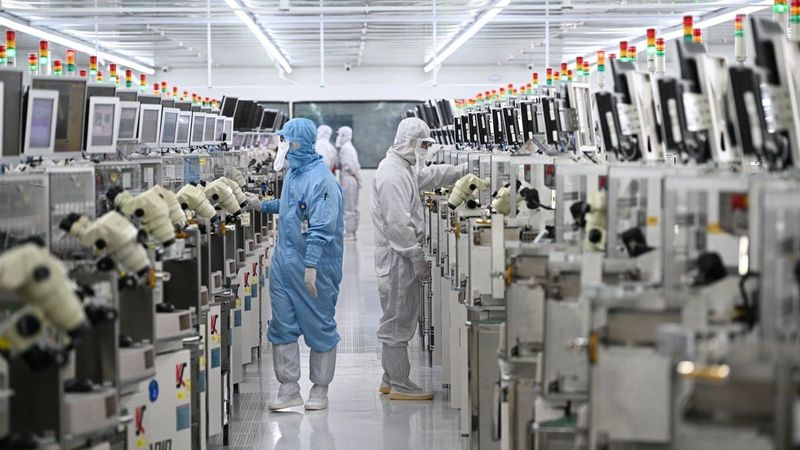
Chinese Factories Skip Traditional Automation, Deploy AI Agents Directly
Manufacturing software provider Black Lake says mainland plants are moving straight to agentic AI, bypassing decades of incremental digitalisation - and exporting the model overseas.

A New Manufacturing Leap
China's factory floors are witnessing a technological jump that recalls the country's rapid shift from cash to mobile wallets. Instead of methodically digitising legacy processes, many plants are deploying autonomous AI agents directly into production workflows, according to Zhou Yuxiang, chief executive of Black Lake, a Shanghai-based provider of cloud manufacturing software.
The parallel is striking. A decade ago, consumers across China moved from physical currency to QR-code payments without the intermediate step of credit card adoption that defined Western markets. Today, factories are exhibiting a similar pattern: they are skipping the expensive, years-long rollout of traditional enterprise resource planning systems and process automation, moving instead to AI tools that can monitor, decide, and act with minimal human oversight.
At Opentechwire, we have tracked the acceleration of AI adoption across Asian manufacturing hubs, but the speed and scope of agent-based deployments in mainland China mark a distinct phase. These are not pilot programmes confined to R&D labs. Black Lake reports that its AI agent toolkit is now embedded in production lines that serve global brands, handling tasks from inventory allocation to quality anomaly detection.
What Agentic AI Means on the Shop Floor
Agentic AI refers to software systems that pursue goals autonomously, making sequential decisions without waiting for human approval at each step. In a factory context, an agent might detect a bottleneck in component supply, query real-time inventory across multiple warehouses, adjust the production schedule, and notify logistics partners - all within seconds.
This contrasts sharply with earlier waves of factory software, which required operators to input data, run reports, and interpret dashboards before taking action. The agent model collapses that loop. It observes, reasons, and executes.
Black Lake's platform, which Zhou describes as a "neural network for manufacturing operations", connects machines, workers, and enterprise systems into a unified data layer. On top of that layer sit AI agents trained to optimise specific outcomes: reducing downtime, balancing workloads across shifts, or flagging defects before they propagate down the line.
The architecture mirrors developments in autonomous software more broadly - retrieval-augmented generation, multi-step reasoning, and tool use - but adapted to the constraints of industrial environments where latency, safety, and auditability matter as much as raw intelligence.
Why the Leapfrog Is Possible Now
Three factors have converged to make this jump feasible. First, the cost of compute and inference has fallen sharply. Running an AI agent continuously across a factory's data streams was prohibitively expensive even two years ago. Today, edge inference and optimised models have brought the cost within reach of mid-tier manufacturers.
Second, China's manufacturing base is younger and more digitally native than often assumed. Many factories built in the past decade already capture operational data electronically, even if they lack integrated ERP suites. That partial digitalisation provides enough signal for AI agents to begin delivering value without requiring a complete system overhaul.
Third, labour dynamics are shifting. Wages in coastal provinces have risen, and younger workers are less willing to perform repetitive monitoring tasks. AI agents fill that gap, handling the tedious but critical work of tracking hundreds of variables across production lines.
Zhou notes that factories adopting agentic AI are not necessarily the largest or most technologically advanced. Many are contract manufacturers supplying multinational brands that demand tight quality control and rapid turnaround. For these plants, the choice is not between AI and traditional automation - it is between AI and losing contracts to competitors who can respond faster.
Exporting the Model Beyond China
Black Lake's client base has expanded beyond mainland China to include factories in Southeast Asia, South Asia, and Latin America. Zhou reports that overseas plants, particularly those integrated into Chinese-led supply chains, are adopting the same agent-first approach.
This export of manufacturing practice is as significant as the technology itself. For decades, Western consulting firms and software vendors set the standard for factory operations, promoting methodologies like Lean, Six Sigma, and ERP-centric digitalisation. The emergence of a Chinese model - one that bypasses those intermediate steps - represents a shift in how global manufacturing knowledge flows.
Factories in Vietnam and Thailand that supply Chinese brands are now deploying the same AI agent tools used in Shenzhen and Dongguan. The agents speak multiple languages, adapt to local regulatory requirements, and integrate with regional logistics networks. In effect, the software is becoming the connective tissue of a transnational production system.
This has implications for competitiveness. Plants that adopt agentic AI early gain an edge in responsiveness and cost efficiency, which in turn pressures their rivals to follow suit. The result is a faster diffusion curve than traditional manufacturing software ever achieved.
Risks and Limitations
The leapfrog strategy is not without drawbacks. Skipping foundational digitalisation means that many factories lack robust data governance, version control, and audit trails - the unglamorous infrastructure that makes complex systems reliable over time. When an AI agent makes a decision that leads to a production error, tracing the root cause can be difficult if the underlying data pipelines are opaque.
There is also the question of vendor lock-in. Factories that build their operations around a single AI platform may find it costly to switch providers or integrate new tools later. The flexibility that agents promise can become rigidity if the platform's architecture does not accommodate customisation or interoperability.
Regulatory scrutiny is another concern. As AI agents take on more decision-making authority, questions around liability, transparency, and worker displacement will intensify. China's regulatory framework for industrial AI is still evolving, and factories operating in multiple jurisdictions must navigate a patchwork of rules.
Finally, the human dimension remains unresolved. Training factory staff to work alongside autonomous agents - to understand when to intervene and when to trust the system - requires a cultural shift that cannot be automated. The most successful deployments, Zhou acknowledges, are those where management invests as much in training and change management as in the technology itself.
What This Means for the Global Manufacturing Stack
If the leapfrog model proves durable, it will reshape assumptions about how factories modernise. The incremental, step-by-step approach that dominated the past three decades may give way to a more opportunistic strategy: adopt the best available tool for a specific problem, even if it means skipping intermediate stages.
This has consequences for software vendors, equipment makers, and policymakers. Companies that built their businesses on multi-year ERP implementations may find their market shrinking as customers opt for lighter, agent-first platforms. Governments promoting industrial digitalisation will need to rethink incentive programmes that assume a linear progression from basic automation to advanced AI.
For manufacturers outside China, the challenge is whether to follow the same path or double down on their existing infrastructure. The answer likely depends on the age and flexibility of their current systems. A plant with a well-functioning ERP may see little benefit in ripping it out for an agent-based alternative. A greenfield factory, or one with fragmented legacy systems, might find the leapfrog approach more attractive.
The broader question is whether agentic AI represents a genuinely new paradigm or simply the latest iteration of manufacturing software hype. The evidence so far suggests the former. The ability of agents to operate autonomously, learn from production data, and coordinate across complex workflows is a qualitative shift, not just an incremental improvement.
As Chinese factories scale this model and export it globally, the rest of the manufacturing world will have to decide how quickly to respond - and whether to adopt the playbook or chart a different course.