Iluvatar CoreX Fits 144 GPUs Into One Cabinet
Chinese chipmaker's Tiangai 300 system claims density record as domestic AI infrastructure race intensifies
Density as Strategy
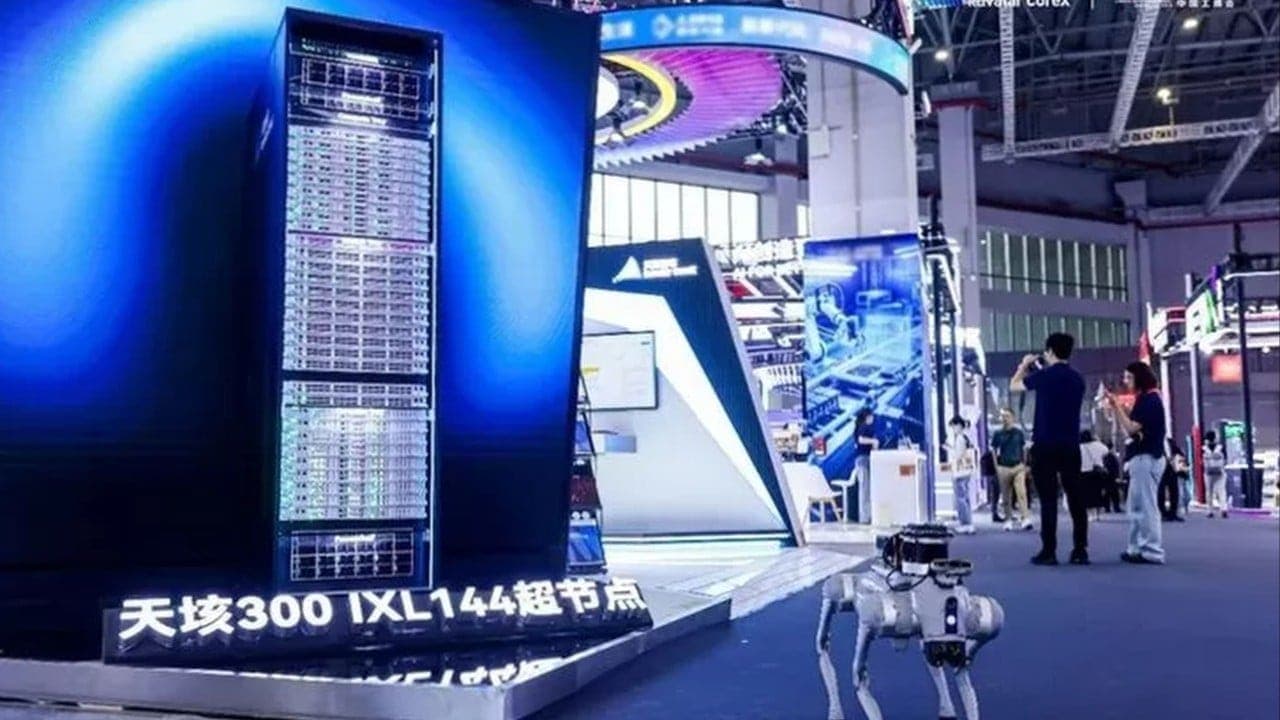
Iluvatar CoreX unveiled a computing system that crams 144 graphics processing units into one cabinet, a configuration the Shanghai-based chipmaker says sets a new density benchmark for AI infrastructure. The Tiangai 300 IXL144, shown at the China International Industry Fair on 13 October, is built for training and inference workloads that demand parallel compute at scale.
The cabinet holds 18 central processing units alongside the GPU array and delivers roughly 10.1 exaflops of performance under FP8 precision, a floating-point format optimised for neural network operations. For organisations running foundation models or multi-modal pipelines, the appeal is floor space: fewer racks to cool, fewer switches to configure, and a smaller data centre footprint per unit of throughput.
At Opentechwire, we have tracked the shift in Chinese AI hardware from discrete accelerator cards to integrated supernodes over the past eighteen months. Export restrictions on advanced packaging and high-bandwidth memory have made vertical integration a necessity, not a luxury. Iluvatar's design consolidates power delivery, interconnect fabric, and thermal management into a single enclosure, reducing dependency on imported subsystems.
Engineering Constraints
Packing 144 accelerators into roughly 42 rack units raises immediate questions about thermals and interconnect bandwidth. Each GPU in the Tiangai 300 array must exchange gradients and activations with its peers during distributed training, and latency between nodes can bottleneck model convergence. Iluvatar has not disclosed the topology of its intra-cabinet network or the bandwidth per link, leaving open whether the system uses a fat-tree, dragonfly, or custom mesh.
Power density is another variable. A cabinet drawing tens of kilowatts in a confined volume requires liquid cooling or high-velocity airflow, both of which add operational complexity. Data centre operators in tier-two Chinese cities, where power is cheaper but cooling infrastructure less mature, may find deployment challenging.
The choice of FP8 as the headline performance metric is telling. FP8 inference is standard in production deployments, but training at reduced precision demands careful gradient scaling and loss monitoring to avoid numerical instability. If the Tiangai 300 targets inference workloads primarily, its 10.1 exaflops figure is less comparable to training-focused clusters that report FP16 or bfloat16 throughput.
Market Position
Iluvatar CoreX competes in a domestic market segmented by access to foreign technology. Nvidia's H100 and H800 variants remain available to some Chinese buyers under licence, while Huawei's Ascend 910B has captured government and state-enterprise contracts. Iluvatar occupies a middle tier: less dominant than Huawei in strategic accounts, but more established than startups like Biren or Moore Threads, both of which have faced production delays.
The supernode form factor is a bid for differentiation. Hyperscalers and research labs that have already committed to a GPU architecture can buy the Tiangai 300 as a turnkey cluster, avoiding the integration work required when assembling servers from component vendors. This is particularly relevant for organisations without deep hardware engineering teams or those looking to deploy quickly in secondary markets across Southeast Asia, where Iluvatar has begun pilot programmes.
Pricing will determine adoption. Chinese AI accelerators typically undercut Nvidia on list price, but total cost of ownership includes software toolchains, driver stability, and ecosystem maturity. Iluvatar supports CUDA-compatible APIs through its CorEx software stack, yet compatibility does not guarantee performance parity. Models fine-tuned on Nvidia hardware often require kernel rewrites or quantisation adjustments when ported, adding hidden labour costs.
Inference Economics
The 144-GPU configuration makes economic sense if the workload is inference-bound rather than training-bound. Inference clusters benefit from high GPU density because individual requests are small and latency-sensitive. Packing more accelerators into one cabinet reduces the round-trip time for load balancers and minimises the number of network hops between the edge cache and the compute layer.
Chinese internet platforms running recommendation engines, content moderation, or real-time translation can amortise the capital cost of a Tiangai 300 cabinet across millions of queries per day. For these use cases, the supernode's density directly translates to lower cost per inference call, a metric that matters more than raw training throughput.
Training, by contrast, scales across hundreds or thousands of GPUs over days or weeks, and the limiting factor is often interconnect bandwidth between cabinets rather than density within a single rack. A 144-GPU supernode is still a building block in a larger cluster, and its value depends on how well Iluvatar's inter-cabinet fabric scales.
Supply Chain Implications
The Tiangai 300 launch comes as Chinese chipmakers navigate tighter controls on advanced lithography and packaging equipment. Iluvatar's GPUs are fabricated on mature process nodes, likely 12 nm or 7 nm, which remain accessible through domestic foundries. Performance per watt is lower than cutting-edge 5 nm or 3 nm designs, but the trade-off is supply chain resilience.
High-bandwidth memory remains a pinch point. HBM3 and HBM3E are controlled by Samsung, SK Hynix, and Micron, and export licences for China-bound shipments are subject to review. If Iluvatar is using HBM2E or an earlier generation, memory bandwidth becomes the bottleneck for large-batch training, particularly on transformer models with billion-scale parameter counts.
The cabinet's mechanical design and cooling subsystems are areas where Chinese vendors have made rapid progress. Domestic suppliers now produce liquid cold plates, heat exchangers, and rack-mount power distribution units that meet data centre standards. This vertical integration insulates Iluvatar from supply shocks but also limits access to best-in-class components from specialist manufacturers in Taiwan, Japan, or Europe.
Adoption Outlook
Iluvatar's success will depend on three factors: software maturity, reference customer wins, and sustained production volume. A supernode is only as useful as the frameworks and libraries that run on it. If Iluvatar can demonstrate stable PyTorch and TensorFlow support, along with optimised kernels for popular models like Llama, Qwen, or Baichuan, enterprise buyers will take the platform seriously.
Reference deployments matter. A public endorsement from a tier-one internet company or a state research institute would signal that the Tiangai 300 is production-ready, not a trade-show prototype. So far, Iluvatar has disclosed partnerships with regional cloud providers and universities, but no anchor tenant has announced a multi-cabinet order.
Volume production is the final hurdle. Supernodes require tight manufacturing tolerances and rigorous burn-in testing. Yields on complex assemblies can be low, especially in the first production runs. If Iluvatar can ship dozens of units per quarter, the Tiangai 300 becomes a credible option. If lead times stretch to six months and defect rates stay high, buyers will default to incumbents.
The 144-GPU density claim is a milestone, but density alone does not guarantee market traction. Chinese AI infrastructure is moving towards self-sufficiency by necessity, and Iluvatar's supernode is one more data point in that trajectory. Whether it becomes a platform or remains a niche product depends on execution in the next twelve months.