Google Labs Releases Playground, a Platform That Turns Text Prompts Into Playable Games
The browser-based tool lets users design 2D and 3D games without writing code, joining a wave of AI-assisted creation platforms from Roblox to YouTube Playables.
A Text-to-Game Experiment From Mountain View
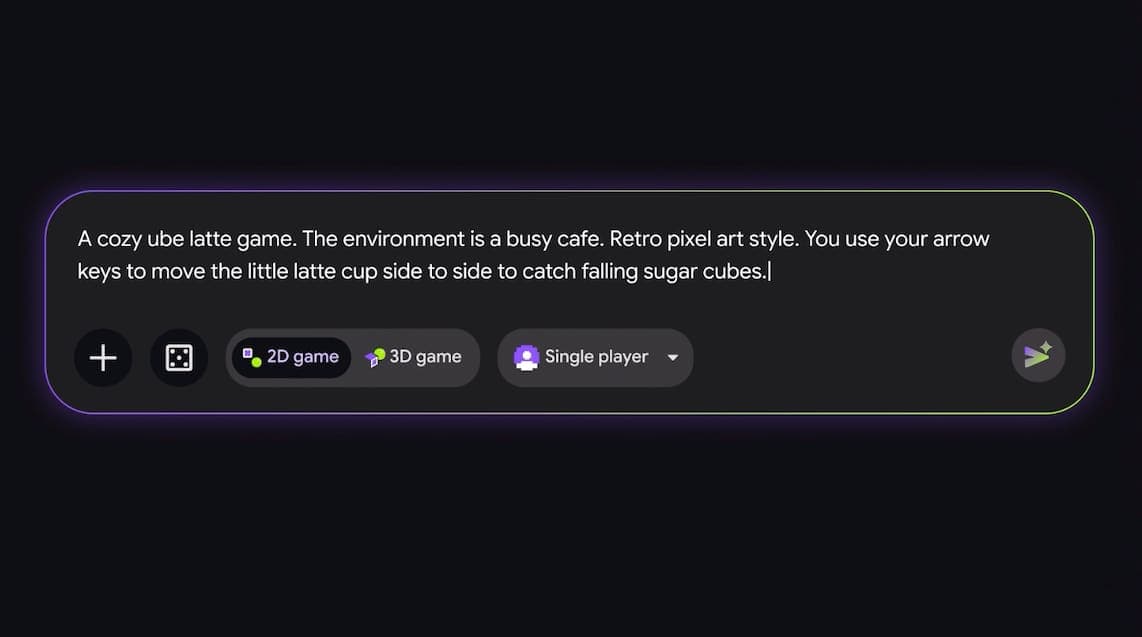
Google Labs introduced Playground on 7 October 2026, a public experiment that converts natural-language instructions into functioning browser games. Users select a genre - trivia, racing, or custom - then describe mechanics, visual style, and whether they want 2D or 3D environments. The platform handles asset generation, layout, and logic without requiring a single line of code from the creator.
At Opentechwire, we have tracked similar moves across the industry: Roblox announced its Build feature in July, which also relies on prompt-based creation, while Unity and Unreal have layered generative tools into their professional pipelines. Playground sits at the consumer end of that spectrum, targeting the 18-and-over demographic in the United States with a token-based free tier and higher quotas for Google One AI subscribers.
The platform allows creators to upload reference images that the underlying model transforms into assets matching the game's chosen art direction. Finished projects can remain private, be shared via link, or be published to the Explore gallery, where leaderboards and community features become available. Creators retain the ability to iterate on published games, a workflow more familiar to web-app deployment than traditional game releases.
Unity Spark Integration on the Roadmap
Google indicated that a forthcoming update will integrate Unity Spark, the lightweight runtime Unity released for web and mobile. That addition would bring access to a richer set of 3D primitives, physics solvers, and animation tools - capabilities that typically require a dedicated engine.
The integration suggests Google is positioning Playground not as a toy but as an on-ramp to more capable tooling. Whether creators graduate from Playground to full Unity projects or remain within the browser environment will depend on how much control the Spark layer exposes. Unity has historically guarded its professional feature set behind licensing tiers; how much of that transfers to a Google-hosted, prompt-driven interface remains to be seen.
The Economics of Tokenised Creation
Playground operates on a weekly token system. Browsing and playing games in the catalogue costs nothing; generating new games or editing existing ones consumes tokens. The free tier provides a baseline allotment; Google One AI subscribers - who already pay for expanded Gemini quotas and storage - receive higher limits.
This pricing mirrors the broader shift in generative-AI products: inference is the bottleneck, so platforms ration compute rather than charge per seat or per project. For Google, bundling game generation into the One AI subscription creates another reason to convert free users, especially if Playground gains traction among educators, hobbyists, or small studios prototyping concepts.
The model also insulates Google from the monetisation challenges that plagued Stadia, its cloud-gaming service that shut down in early 2023. Stadia required per-game purchases or a subscription, competing directly with console and PC storefronts. Playground sidesteps that by treating game creation - not distribution - as the paid service, while keeping playback free.
Google's Iterative Approach to Gaming
Playground is the latest in a series of gaming experiments that began with Stadia and continued through YouTube Playables, a hub of instant browser games embedded in the video platform. Stadia aimed to replace hardware; Playables aimed to capture idle attention between videos. Playground aims to turn that attention into creative output.
The common thread is Google's infrastructure advantage. The company operates data centres optimised for low-latency streaming and model inference, capabilities that underpin both Stadia's failed ambition and Playground's real-time asset generation. Where Stadia required convincing publishers to port AAA titles, Playground generates content on demand, shifting the supply-side risk to the model rather than to third-party studios.
That approach aligns with the broader industry pattern we have followed across Seoul, Shenzhen, and San Francisco: platform holders are moving up the stack from distribution to creation tools. Roblox, Epic, and now Google are betting that lowering the skill floor for game development expands the total addressable market faster than it cannibalises professional revenue.
What the Prompt-to-Game Wave Means for Developers
For professional studios, platforms like Playground represent both opportunity and compression. On one hand, rapid prototyping tools accelerate pre-production; on the other, they flood the market with amateur content that competes for attention if not for revenue. The question is whether AI-generated games remain a distinct category - like user-generated content on Roblox - or begin to encroach on the quality threshold that defines commercial releases.
Early evidence suggests segmentation will persist. The games emerging from prompt-based tools tend to be mechanically simple, visually coherent but generic, and limited in scope. They excel at trivia, endless runners, and score-attack formats - genres that dominated the Flash era and now populate mobile app stores. Complex narrative design, nuanced progression systems, and hand-tuned difficulty curves remain outside the reach of current models.
That may change as Google and its competitors refine their training data and expand the set of supported mechanics. Unity Spark integration would be one step in that direction, as would fine-tuning on successful indie titles or incorporating reinforcement learning to balance gameplay. For now, Playground is best understood as a tool for concept validation and casual creation, not as a replacement for Unreal Engine or proprietary engines at scale.
Regional Context and the Race for Generative Platforms
Google's decision to launch Playground in the United States first reflects both regulatory caution and market prioritisation. Generative-AI products face varying levels of scrutiny across jurisdictions, particularly around content moderation, intellectual-property liability, and age restrictions. Starting with users aged 18 and older in a single country allows Google to iterate on safety filters and community guidelines before expanding.
The phased rollout also mirrors patterns we have observed in Asia, where platforms like Tencent's Yuanbao and Alibaba's Tongyi Wanxiang launched domestically before seeking international distribution. The difference is that Google operates a global infrastructure and brand, so geographic expansion is a question of compliance rather than capability.
For developers in Singapore, Bengaluru, and Jakarta, Playground's arrival matters less for the tool itself than for the signal it sends: the major cloud providers are converging on generative creation as a core product category. That has implications for infrastructure demand, model licensing, and the talent market. Studios that currently employ junior artists for asset production may shift those roles towards prompt engineering and quality assurance, while engine vendors face pressure to integrate comparable features or risk obsolescence.
The Friction Points Ahead
Playground's success hinges on three variables: the quality of generated games, the stickiness of the token economy, and Google's willingness to sustain the experiment through its inevitable trough of disillusionment. Early generative-AI platforms have struggled with retention once the novelty fades, and game creation - unlike image or text generation - requires sustained effort to produce something worth sharing.
The platform also inherits the broader challenges facing generative gaming: inconsistent output quality, difficulty tuning difficulty, and limited support for complex state management. A racing game generated from a prompt may look correct but play poorly if the AI misjudges acceleration curves or collision detection. Playground will need robust editing tools and transparent model controls to bridge the gap between what users describe and what they actually want.
Finally, there is the question of community. Roblox succeeded not because its creation tools were technically superior but because it built a social ecosystem around user-generated content. Playground's Explore gallery is a start, but sustained engagement will require discovery algorithms, creator monetisation, and moderation at scale - capabilities that demand ongoing investment and institutional commitment.
Google Labs is designed for experiments that may not graduate to full products. Whether Playground follows YouTube Playables into a stable release or joins Stadia in the archive of discontinued projects will depend on usage data over the next twelve months and whether the company sees a path to integrating game creation into its broader AI and cloud strategy.