Genesis AI Secures $500 Million to Scale Force-Sensing Robot Production
The Carnegie Mellon spin-out is betting vertical integration and glove-based teleoperation data can solve manipulation challenges that have stalled warehouse automation
The Pitch: Force Data as the Missing Link
Genesis AI announced a $500 million Series A led by Khosla Ventures, Premji Invest, and Eclipse, fourteen months after disclosing a $105 million seed round in July 2025. The Silicon Valley start-up, co-founded by Zhou Xian and Théophile Gervet in 2024, is building humanoid robots designed to handle tasks requiring fine motor control - picking, scanning, folding, taping, labelling - that remain bottlenecks in logistics and light assembly.
The funding round reflects investor appetite for physical AI platforms that promise to move beyond the constrained, single-task automation that has defined industrial robotics for decades. Genesis is one of several well-capitalised entrants, alongside Figure and Agility, racing to deploy machines capable of generalised manipulation in unstructured environments. What distinguishes Genesis, according to Xian, is its focus on force feedback: the start-up gathers training data using sensor-equipped gloves worn by more than 100 workers around the world, capturing not just vision and motion but the pressure and torque applied during real-world tasks.
The company's robots wear identical gloves, and their mechanical hands are proportioned to match human dimensions. That design choice is deliberate. By maintaining fidelity between the human operator's hand and the robot's effector, Genesis aims to transfer learned behaviours with minimal domain shift - a persistent problem when training models in simulation and deploying them on hardware with different kinematics or sensing modalities.
Demonstration and Limits
At the company's Silicon Valley facility, a pair of off-the-shelf robotic arms demonstrated a packing workflow: lifting two small cardboard boxes, scanning them, placing them into a larger container, folding the flaps, applying tape, peeling an adhesive label from printer tape, and affixing it to the finished package. The sequence represents the kind of multi-step, contact-rich manipulation that has proven difficult for vision-only systems, which struggle to infer grip strength or detect slip without tactile input.
When Genesis repeated the demonstration, the robot fumbled one box and had difficulty separating the label from its backing. A Genesis executive characterised the error as "hiccup data" - edge cases that can be fed back into the training loop to improve robustness. The incident underscores the gap between controlled demonstrations and the reliability required for continuous industrial deployment, a gap that has contributed to previous cycles of inflated expectations and subsequent disillusionment in robotics.
Genesis would not permit independent testing of the system's adaptability - moving objects, changing orientations, or introducing novel items - so the extent to which the model generalises beyond rehearsed scenarios remains unclear.
Vertical Integration and Simulation
Genesis is pursuing end-to-end control of its stack: data collection, model training, and hardware design are all conducted in-house. Xian and Gervet, who met as graduate students at Carnegie Mellon University, argue that tight coupling between data provenance and robot morphology is necessary to achieve the dexterity they claim to have unlocked.
The company has also invested heavily in simulation. One of its advisers, Minchen Li, co-authored a physics algorithm that Genesis uses to generate millions of synthetic training examples. High-fidelity simulation allows the start-up to explore failure modes and edge cases without the time and cost of real-world data collection, though the transfer of those simulated experiences to physical hardware - known as the sim-to-real gap - remains an active research challenge across the field.
Xian downplayed architectural distinctions between vision-language-action models and world action models, asserting that the underlying machinery is transformers and attention mechanisms regardless of taxonomy. In his view, training infrastructure, data infrastructure, and data quality account for 90 per cent of performance, with model architecture contributing the remainder. He told the outlet that no fundamental scientific breakthrough is required - that the industry already possesses the necessary techniques and the challenge is execution.
Eno: The Product and Its Constraints
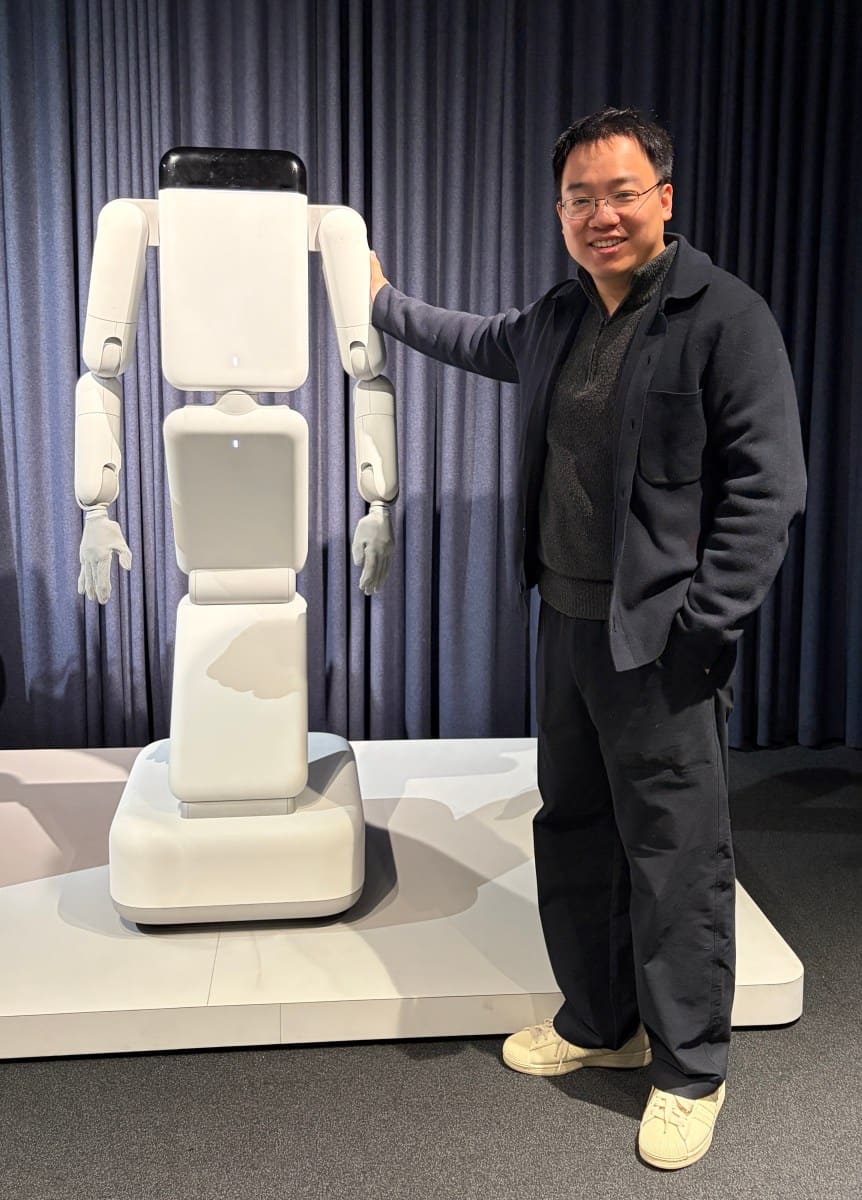
Genesis has designed a humanoid robot called Eno, which Xian described as more capable when paired with the company's model than the off-the-shelf arms used in the demonstration. Eno was not available for inspection during the facility visit. The machine's aesthetic - smooth surfaces, muted tones, a wheeled base - evokes consumer electronics rather than industrial machinery, a design language intended to convey approachability to customers wary of imposing metal frames.
Genesis has built between 30 and 40 units of Eno. The company has selected a mass-manufacturing contractor to begin production in the United States next year and has finalised the design for the mass-produced version, but it declined to specify production targets. A handful of undisclosed customers are piloting the robot.
The hardware remains a constraint. The dexterous hands, which incorporate the same sensors used in the data-collection gloves, can operate for only a few weeks of regular use before requiring replacement. That durability threshold is far below the uptime expectations of warehouse operators or contract manufacturers, who typically plan for machines to run multiple shifts across months or years between maintenance cycles.
Xian identified hardware capability - mechanical design and supply-chain maturity for industrial-grade components - as the primary bottleneck to scaling. The company is working to extend the operational lifespan of its hands, but the timeline for reaching commercial durability was not disclosed.
The Data Imperative and the Competitive Landscape
Genesis is not alone in pursuing humanoid form factors or generalist manipulation. Figure has raised substantial capital and is piloting robots with automotive partners. Agility has deployed its Digit robot in logistics trials. Both competitors have emphasised different data strategies: Figure has partnered with OpenAI to integrate large language models, while Agility has focused on bipedal locomotion and payload handling in semi-structured environments.
Genesis's glove-based teleoperation approach offers a potential advantage in tasks where force and tactile feedback are critical - wire routing, component insertion, delicate sorting - but it also introduces complexity. Recruiting, equipping, and coordinating a distributed workforce of over 100 glove-wearing operators requires logistics and quality control that vision-only data pipelines, which can scrape video or use off-the-shelf cameras, do not.
Xian argued that for truly generalised robotic intelligence, the company needs more data. The implication is that current datasets, even with force sensing, remain insufficient to cover the long tail of manipulation tasks encountered in real-world deployments. That aligns with broader trends in machine learning, where model performance often scales with dataset size, but it also raises questions about the marginal cost and time required to gather the next order of magnitude of training examples.
Regional Context: Asia's Role in Hardware and Deployment
While Genesis is headquartered in Silicon Valley and plans to manufacture in the United States, the broader robotics supply chain and deployment landscape is heavily weighted toward Asia. China, Japan, and South Korea together account for the majority of industrial robot installations worldwide, and Chinese firms have moved aggressively into humanoid robotics over the past two years, with companies such as Unitree and Fourier Intelligence shipping bipedal platforms at price points well below Western competitors.
Singapore and South Korea have both announced national strategies to accelerate robotics adoption in logistics, elder care, and manufacturing, creating potential early markets for platforms like Eno if Genesis can demonstrate reliability. Japan's labour shortage, driven by demographic decline, has made it one of the most receptive markets for automation, though Japanese integrators have historically favoured domestic suppliers and proven technologies over start-ups with limited deployment history.
Genesis's choice of a US-based manufacturing partner may reflect supply-chain risk considerations or customer preference, but it also means the company will compete on cost with Asian manufacturers that benefit from established component ecosystems and lower labour expenses. The durability constraints of Genesis's hands - requiring replacement every few weeks - will be particularly scrutinised in markets where maintenance overhead directly affects return on investment calculations.
The Execution Test
Genesis has raised $605 million across two rounds in less than eighteen months, a pace that reflects both the capital intensity of hardware development and investor conviction that physical AI is approaching an inflection point. The company's vertical integration strategy is expensive: building robots, training models, and operating a global data-collection network in parallel demands sustained funding and coordination across engineering disciplines.
The next twelve months will test whether Genesis can translate laboratory capabilities into field-ready products. Extending the lifespan of its dexterous hands, scaling production with its chosen contractor, and expanding pilot deployments beyond a handful of undisclosed customers are all necessary steps. The company's assertion that no fundamental scientific leap is required - that execution is the remaining challenge - will be validated or refuted by the reliability and economics of the robots it ships.
For now, Genesis has the capital and the technical narrative. Whether it can bridge the gap between demonstration and deployment will determine whether it joins the small number of robotics start-ups that have achieved durable commercial traction, or becomes another well-funded cautionary tale in a sector littered with them.