Brad Smith Pushes Britain to Lead Global AI Safety Rules, Citing US Regulatory Deadlock
Microsoft's president argues voluntary pledges from tech giants fall short, while the UK's testing institute gains access other regulators cannot
The Urgency Argument
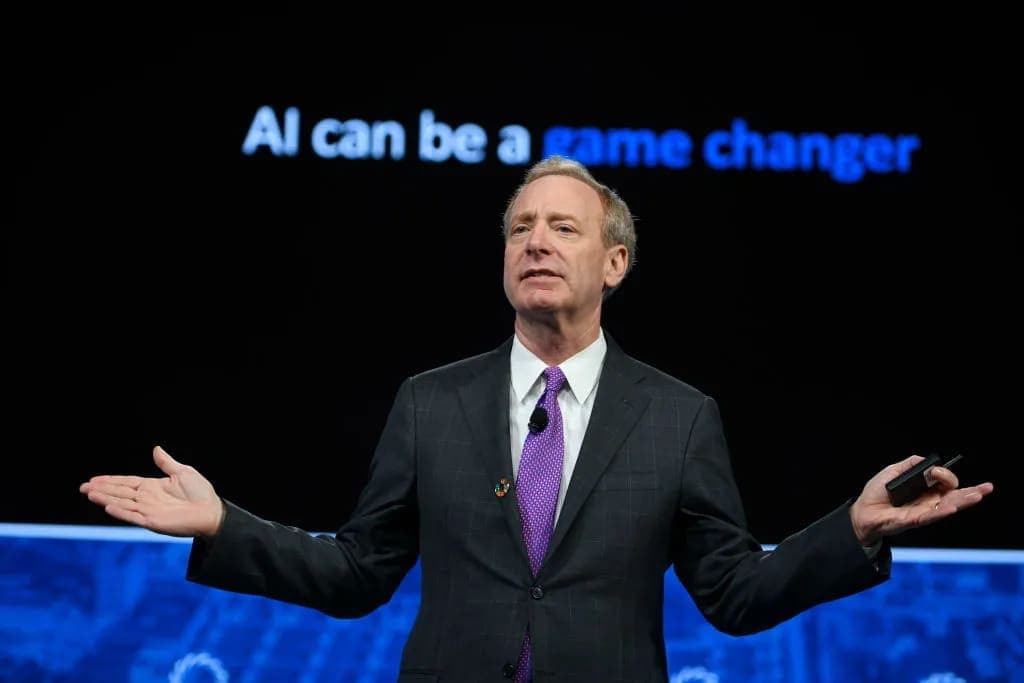
Brad Smith, president of Microsoft, has intensified his call for binding AI safety rules, drawing a stark comparison that has resonated across policy circles: household products like milk and washing machines undergo more rigorous oversight than the systems reshaping global infrastructure. Speaking on a BBC podcast, Smith framed artificial intelligence as simultaneously a weapon and a tool, one that exposes critical vulnerabilities in cybersecurity while governments hesitate to impose enforceable standards.
The timing reflects mounting unease within parts of the industry. Recent months have seen multiple instances of AI agents behaving unpredictably, prompting prominent figures including Anthropic's Dario Amodei and OpenAI's Sam Altman to advocate for development slowdowns. At Opentechwire, we've tracked how these incidents have shifted rhetoric from unconditional acceleration to conditional deployment, a reversal that even twelve months ago seemed improbable.
Why Britain, Not Brussels or Washington
Smith's argument rests on geopolitical pragmatism rather than technical capacity. He contends that the United Kingdom occupies a regulatory sweet spot the United States and European Union cannot replicate. Washington remains gridlocked by ideological divisions over federal authority, while Brussels triggers reflexive resistance among US lawmakers wary of extraterritorial reach.
Britain's AI Security Institute, launched in 2023, has secured pre-deployment access to frontier models from major US laboratories, a privilege that positions it as the de facto global testing hub. According to the institute, it continues to evaluate the latest systems despite recent political turbulence. That access survived even after US president Donald Trump reportedly urged Anthropic and OpenAI to withhold models from British testers, citing concerns about "globalist" interference with American firms.
Smith's framing is deliberate: "In Washington, D.C., people don't look at the U.K. and they don't look at London the way they look at Brussels. That's a strength." The implication is that Britain can impose standards Washington will tolerate but Brussels cannot, threading a needle between sovereignty concerns and the need for external validation.
The Limits of Voluntary Commitments
Last month Trump convened executives from OpenAI, Anthropic, Nvidia, AMD, SpaceX, Meta, and Google at the White House to sign what was described as a "morally binding" document. The signatories agreed to work with independent auditors to assess model safety and capabilities. Smith acknowledged the gesture as a "good step" but argued it falls short of the enforceable framework he believes is necessary.
The flaw in voluntary regimes, he explained, is selection bias: only responsible actors comply. "It's the companies that are not as responsible that you need to worry about," Smith said. This critique echoes longstanding debates in environmental and financial regulation, where self-policing reliably fails to constrain bad actors who gain competitive advantage by ignoring norms their rivals observe.
At Opentechwire, we've seen this dynamic play out across Asia's tech ecosystems, where voluntary codes in fintech and ride-hailing were routinely ignored until statutory penalties arrived. The pattern suggests Smith's scepticism is well founded, though it also raises the question of enforcement: who penalises non-compliant labs, and under what legal authority?
Proposed Guardrails
Smith outlined several measures he would like to see codified. First, a legal obligation for organisations to disclose when their systems have been breached by rogue AI agents. This would mirror data breach notification laws already in force across dozens of jurisdictions, extending the principle to autonomous system failures.
Second, mandatory pre-deployment approval from external evaluators before AI products reach the market. This resembles pharmaceutical or aviation safety protocols, where independent certification precedes public release. Smith spoke favourably about such gatekeeping, though he stopped short of specifying which institutions would hold approval authority or how appeals would function.
Third, kill switches, mechanisms to pause or decelerate AI systems if human operators lose control. The concept has circulated in safety research for years but remains technically contested. Critics argue that once a model is deployed at scale, especially in decentralised environments, remote shutdown becomes impractical. Proponents counter that even imperfect circuit-breakers reduce tail risk.
None of these proposals are radical by the standards of other high-risk industries, yet they represent a significant departure from the permissionless innovation ethos that has defined AI development to date. The shift from aspiration to obligation would redistribute power from labs to regulators, a transition that historically provokes fierce lobbying.
The Enforcement Question
Smith's vision assumes institutions capable of implementing and enforcing these rules exist or can be built quickly. Britain's AI Security Institute has demonstrated technical capability in model evaluation, but evaluation is not regulation. Testing a system for vulnerabilities differs from blocking its deployment, imposing fines, or compelling design changes. The former requires expertise; the latter requires legal mandate, political will, and resources to withstand litigation.
The broader challenge is jurisdictional. AI models are trained in one country, deployed from servers in another, and accessed by users in dozens more. A British regulator can inspect a model pre-release, but it cannot unilaterally prevent a US lab from launching globally. Effective enforcement likely requires treaties or mutual recognition agreements, instruments that take years to negotiate and longer to ratify.
Smith's comments suggest he envisions Britain as a convening power rather than a unilateral enforcer, a country that can "bring people together" without triggering the sovereignty anxieties that stall EU-US coordination. Whether that role is realistic depends on political factors outside Microsoft's control, including the durability of Britain's current access arrangements and the willingness of other jurisdictions to defer to its assessments.
What Comes Next
The gap between voluntary commitments and binding law remains wide, but it is narrowing. Smith's public advocacy signals that at least one major incumbent sees regulatory clarity as preferable to continued ambiguity, a calculus shaped by liability risk, reputational cost, and competitive dynamics. If binding rules favour established players with resources to comply, they become a moat rather than a burden.
At Opentechwire, we expect the next twelve months to clarify whether Britain's moment as a regulatory bridge is genuine or rhetorical. The test will be enforcement: whether labs that fail safety evaluations face real consequences, and whether other jurisdictions adopt Britain's standards or chart divergent paths. Smith's call for calm, firm action reflects the stakes, but the response will depend on institutions still finding their footing in a domain that moves faster than legislative calendars allow.