Baidu Built a Simulator That Teaches Robotaxis What Human Drivers Fear Most
Apollo Go's latest training platform confronts autonomous vehicles with edge-case hazards that remain vanishingly rare in real-world fleets but define the safety debate
The Edge-Case Problem That Haunts Autonomy
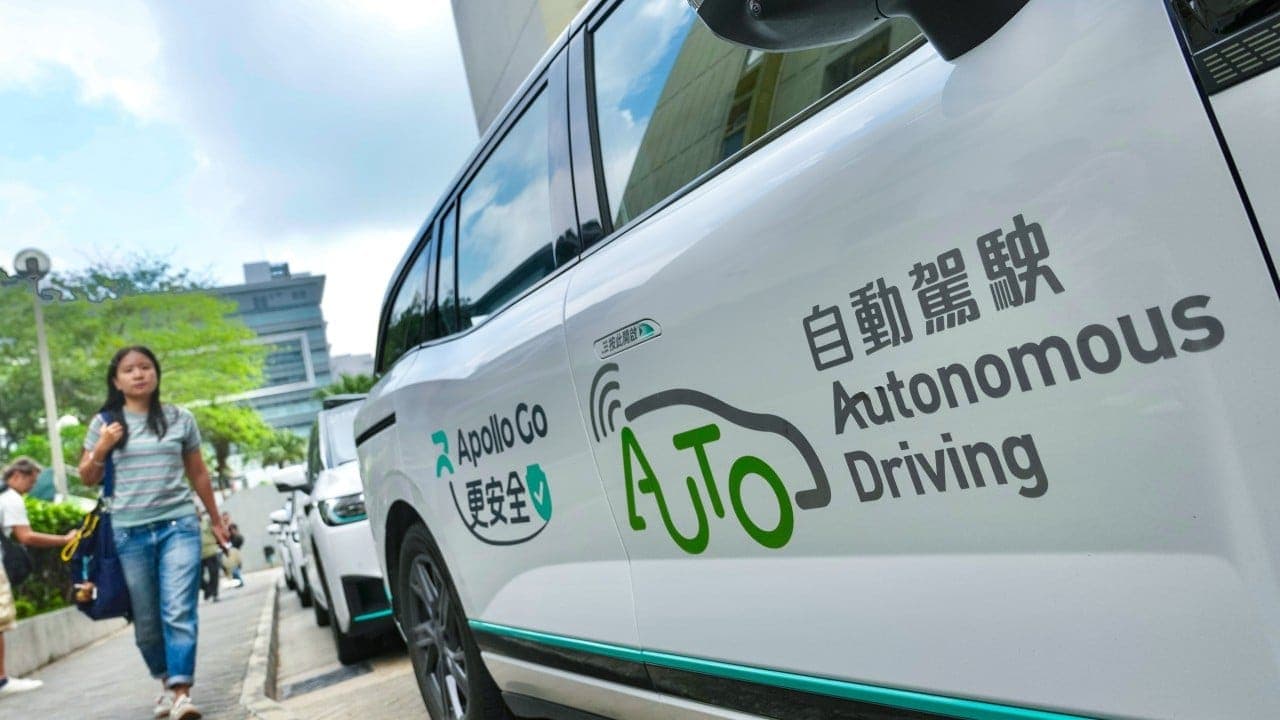
Every autonomous vehicle programme confronts the same arithmetic puzzle: millions of test kilometres yield vanishingly few encounters with the scenarios that matter most. A pedestrian stepping off a kerb mid-block, a motorcyclist ignoring a signal, a dog bounding from behind a parked van - these events occur too infrequently to fill a training dataset, yet they define public tolerance for self-driving technology. Baidu's Apollo division has built a simulator expressly to manufacture such moments at scale, compressing years of statistical rarity into weeks of synthetic exposure for its robotaxi fleet.
The platform leverages generative models to construct road environments populated by agents that behave unpredictably within plausible bounds. Rather than replay logged sensor data from real drives, the system invents new permutations: a cyclist executing an illegal turn under poor lighting, an animal emerging from an occluded sightline, a vehicle reversing without warning. Each scenario is parametrically varied - speed, angle of approach, ambient visibility - so that a single hazard archetype spawns thousands of training iterations.
At Opentechwire, we've tracked the shift from replay-based simulation to generative methods across the autonomy sector over the past eighteen months. The core motivation is efficiency. Capturing a single near-miss event on public roads might require a fleet to log a million kilometres; generating a thousand variations of that event in simulation requires only compute and a sufficiently robust world model. The question is whether synthetic data transfer to real-world performance without introducing artefacts that degrade decision-making under genuine uncertainty.
Why Rare Events Dominate the Safety Calculus
Autonomous vehicle safety is not measured by average performance across routine driving. It is adjudicated by tail-risk behaviour: how the system responds when its perception stack encounters something it has seen fewer than ten times, or never. Human drivers rely on intuition and decades of cultural heuristics - an unexpected movement in peripheral vision triggers a reflexive brake application. Machine learning systems, by contrast, interpolate from their training distribution. If the distribution is thin in a particular region of scenario space, the model's behaviour becomes less predictable.
This is why incumbents have invested heavily in scenario libraries. Waymo's structured testing programme, for instance, reportedly catalogues tens of thousands of edge cases drawn from incident reports, near-miss telemetry and adversarial design. Baidu's simulator represents a parallel approach: rather than curate a fixed library, generate an infinite library on demand, bounded only by the realism of the generative model.
The economic stakes are considerable. China's robotaxi market has expanded rapidly in tier-one cities, with Apollo Go operating commercial services in Wuhan, Shenzhen and Beijing. Regulatory approval hinges on demonstrated safety over defined test regimes, but public confidence hinges on zero high-profile failures. A single collision involving a vulnerable road user can stall expansion for quarters. Simulation offers a means to stress-test decision policies without exposing real passengers or pedestrians to risk during the learning phase.
Generative Models Meet Reinforcement Learning
Baidu's platform combines two AI paradigms. A generative model - likely a diffusion or transformer-based architecture, though the company has not published architectural specifics - produces the scenario content. A reinforcement learning loop then trains the vehicle's planning and control stack to navigate that content. The RL agent receives reward signals based on collision avoidance, adherence to traffic rules and passenger comfort metrics. Over successive episodes, the policy converges toward behaviour that minimises harm and regulatory violation even when confronted with behaviour outside the nominal traffic model.
This two-stage design mirrors patterns emerging in other domains where synthetic data augment scarce real-world labels. In drug discovery, generative chemistry models propose novel molecules; in chip design, RL agents optimise floorplans against synthetic workloads. The transfer challenge is identical: does the synthetic environment capture the true constraints and failure modes of the physical system?
For autonomous driving, the constraints are multidimensional. Physics must be accurate - tyre friction, sensor noise, occlusion geometry. Human behaviour must be plausible - pedestrians do jaywalk, but they also exhibit risk aversion and gaze direction that telegraphs intent. Adversarial behaviour must remain within bounds observed in reality; a simulator that produces only worst-case inputs can overtrain a system toward excessive caution, degrading throughput and passenger experience.
Baidu has not disclosed validation metrics that demonstrate sim-to-real transfer for the new platform. The critical test will be whether vehicles trained predominantly in simulation exhibit lower disengagement rates or fewer safety-driver interventions when operating in live traffic. If the simulator introduces distributional shift - training the system on hazards that differ subtly from their real-world analogues - it could degrade performance rather than enhance it.
The Competitive Context in China's Autonomy Race
Apollo Go is one of several Chinese operators competing for regulatory permission to scale robotaxi deployments beyond pilot zones. Pony.ai, WeRide and AutoX have each logged significant test mileage and secured manufacturing partnerships. Differentiation increasingly hinges on safety demonstration and the speed at which operators can expand their operational design domains - the set of road types, weather conditions and traffic densities a vehicle is certified to handle.
Simulation accelerates domain expansion by enabling training on scenarios that are impractical or unethical to stage in the real world. A robotaxi operator cannot deliberately place a child mannequin in the path of a moving vehicle on a public street; it can do so ten thousand times in simulation. Regulators in several Chinese cities have begun accepting simulation hours as partial substitutes for on-road test kilometres, provided the simulator meets fidelity benchmarks.
This regulatory acceptance creates a feedback loop. Operators with superior simulation infrastructure can iterate faster, demonstrate compliance sooner and secure earlier approval for commercial service. The resulting revenue funds further R&D investment, widening the gap between leaders and followers. Baidu's position as an incumbent internet platform gives it access to data centre capacity and AI talent that smaller autonomy startups struggle to match.
Yet simulation is not a panacea. It cannot replace the long tail of real-world integration issues: sensor degradation over time, software-hardware interaction bugs, map drift as road layouts change. The firms that ultimately scale autonomous fleets will be those that balance synthetic training with robust on-road validation and rapid incident-response loops when edge cases do occur in production.
What the Industry Still Needs to Solve
The broader autonomy sector remains pre-revenue at scale. No operator has demonstrated unit economics that support profitable operation without subsidy, and no jurisdiction has authorised fully driverless commercial service without geographic or operational restrictions. The path from supervised pilot to unsupervised citywide deployment requires solving not only the perception and planning challenges that simulation addresses, but also the liability, insurance and regulatory frameworks that govern when things go wrong.
Baidu's simulator is a tool for compressing one dimension of that problem - training data scarcity. It does not resolve the questions of who bears liability when an AI system makes a decision no human would make, or how insurers price risk for a technology whose failure modes are statistically novel. Those questions will be answered in boardrooms and legislatures, not in reinforcement learning loops.
For now, the competitive advantage accrues to operators that can demonstrate safety performance across the widest range of conditions in the shortest time. Generative simulation offers a lever to pull on that timeline, provided the synthetic data prove transferable. The next twelve months will reveal whether Apollo's training advantage in simulation translates to measurably safer behaviour in Wuhan's evening traffic or Shenzhen's rain.