Alibaba Chair Tsai Presses Open-Source AI as China's Path Around Export Controls
At Wuzhen, the tech giant's chairman frames openness as survival strategy, not just philosophy, as US restrictions tighten the noose on China's model-building ambitions.
The Wuzhen Argument
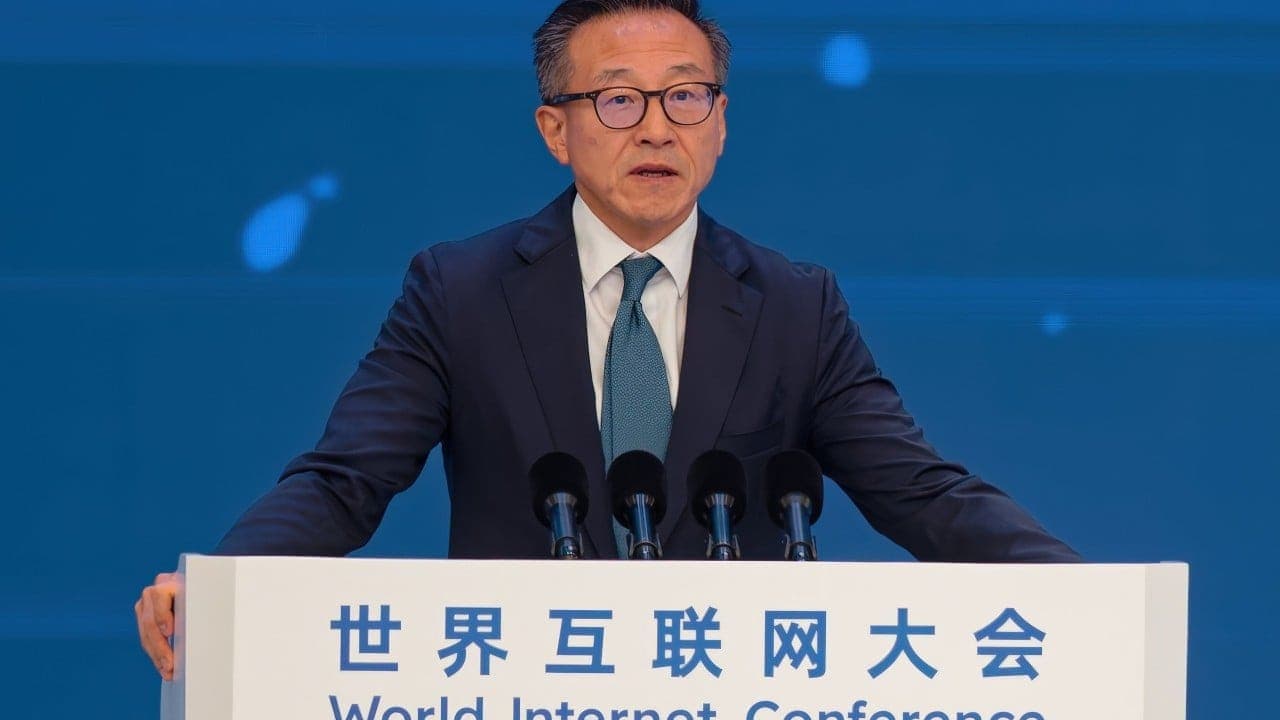
Joe Tsai stood before the World Internet Conference in Wuzhen on 3 November and made a case that sounded less like evangelism and more like industrial triage. Open-source artificial intelligence, Alibaba's chairman told the summit audience in Zhejiang province, is no longer a matter of developer preference or licensing philosophy. For China's technology sector, he argued, it has become the only viable architecture for a sustainable AI industry.
The framing is deliberate. At Opentechwire, we have tracked how Beijing's largest technology groups have reoriented their model development and deployment strategies over the past eighteen months, and Tsai's remarks at Wuzhen represent the clearest articulation yet of why that shift is accelerating. It is not ideological; it is structural. US export controls on advanced semiconductors, tightened iteratively since October 2022, have pushed Chinese firms towards architectural choices that reduce dependency on cutting-edge chips and closed ecosystems controlled by foreign entities.
Tsai pointed to what he described as a growing convergence among domestic technology companies around open ecosystems. That convergence is real, but it is also a response to constraint. When access to Nvidia's H100 and A100 accelerators is restricted, and when foundational models trained on those chips are withheld or licensed under terms that limit derivative work, openness becomes both a technical workaround and a competitive necessity.
Demand Meets Constraint
The tension Tsai addressed is straightforward. Demand for AI inference and fine-tuning capacity across China's enterprise and consumer markets has surged. According to data from the China Academy of Information and Communications Technology, enterprise adoption of generative AI tools grew by 140 per cent year-on-year in the first half of 2026. Meanwhile, the supply of high-end compute has not kept pace. Export restrictions mean that the most advanced chips available to Chinese data centres are often one or two generations behind what is deployed in facilities in Virginia or Oregon.
Open-source models offer a partial solution. They can be fine-tuned on smaller datasets, run on less powerful hardware, and adapted without negotiating access terms with a model provider whose supply chain is subject to US jurisdiction. Alibaba itself has invested heavily in this direction. The company's Qwen family of models, released under permissive licences, has become one of the most widely adopted open-source large language model families in China, with reported downloads exceeding eight million as of September 2026, according to Alibaba.
But open source is not a panacea. Fine-tuning still requires compute, and inference at scale still demands efficient silicon. What it does provide is flexibility in a landscape where flexibility has become scarce. If a firm cannot procure the chips it wants, it can at least choose the software stack it runs on them.
The US Angle
Tsai's remarks at Wuzhen arrive against a backdrop of intensifying regulatory friction. Washington has repeatedly expanded the scope of semiconductor export controls, most recently in August 2026, when the Bureau of Industry and Security added new restrictions on chip-design software and manufacturing equipment destined for Chinese fabs. The stated goal is to prevent Beijing from developing AI capabilities that could be applied to military or surveillance applications.
The practical effect has been to fragment the global AI development landscape. US-based labs, including OpenAI and Anthropic, have restricted access to their most capable models in China, either through direct blocking or by declining to offer API endpoints that can be reached from Chinese IP addresses. Google's Gemini models are unavailable. Meta's Llama family is open source, but the company has imposed licensing restrictions that complicate commercial use in certain jurisdictions.
In this environment, Chinese firms face a choice: build proprietary models with constrained hardware, or embrace open collaboration that distributes the compute burden and accelerates iteration. Alibaba, Baidu, and Tencent have all chosen variants of the latter. Tsai's speech at Wuzhen was, in effect, a public endorsement of that choice as industry-wide strategy.
Sustainability or Necessity
The word Tsai used was "sustainable". That carries two meanings. One is environmental and economic: open-source development, with its emphasis on shared infrastructure and modular components, can reduce redundant training runs and lower the aggregate cost of model development. The other meaning is strategic: in a world where access to proprietary models and cutting-edge hardware is uncertain, openness ensures continuity.
At Opentechwire, we have observed that sustainability arguments in AI often mask deeper anxieties about control. For Chinese firms, those anxieties are acute. Dependence on closed ecosystems controlled by US entities introduces single points of failure that can be activated by policy decisions in Washington. Open source, by contrast, is harder to embargo. Once a model is released under a permissive licence and mirrored across global repositories, restricting access becomes a game of whack-a-mole.
This is not to say that open source eliminates all vulnerabilities. Training new models from scratch still requires access to large datasets, significant compute, and the expertise to orchestrate both. But it does lower the threshold for entry and reduce the leverage that any single actor, corporate or governmental, can exert over the ecosystem.
Regional Implications
Tsai's framing at Wuzhen also signals to the broader Asian technology community. If China's largest internet conglomerate is betting on open source as the path forward, smaller firms and startups across the region are likely to follow. We have already seen increased adoption of open-source models in Southeast Asia, where cloud budgets are tighter and reliance on US-based API providers is viewed with caution.
Singapore-based AI labs have begun fine-tuning Qwen and other Chinese open-source models for local languages and regulatory contexts. Jakarta-based startups are layering proprietary data onto open foundations rather than paying per-token fees to foreign providers. Seoul's largest technology firms are hedging, maintaining partnerships with US labs while quietly building internal capabilities on open stacks.
The strategic calculus is similar across these markets: open source offers optionality. It does not preclude using proprietary models when they are available and cost-effective, but it ensures that those models are not the only option.
The Limits of Openness
Tsai's argument at Wuzhen is compelling, but it elides certain realities. Open-source models are improving rapidly, but they still lag the frontier capabilities of the most advanced proprietary systems. GPT-4 and its successors, for instance, demonstrate reasoning and multimodal performance that no open model has yet matched at equivalent scale. For applications where state-of-the-art performance is non-negotiable, such as high-stakes financial modelling or advanced drug discovery, closed models retain an edge.
Moreover, open source does not eliminate geopolitical risk; it redistributes it. If the US government decides that open-source model development itself constitutes a national security concern, it could impose restrictions on the publication of research, the export of training techniques, or the participation of US researchers in collaborative projects. Such measures would be difficult to enforce, but they would introduce friction.
There is also the question of talent. Training and fine-tuning large models requires expertise that is concentrated in a handful of research hubs, many of them in the United States. China has made significant investments in AI education and research, but the pipeline is still developing. Open-source code can be copied; tacit knowledge is harder to transfer.
What Comes Next
Tsai's speech at Wuzhen will not change US export policy, and it will not resolve the underlying tensions between Washington and Beijing over technology leadership. What it does is clarify the strategy that China's leading firms are pursuing in response to those tensions. Open source is being positioned not as a utopian ideal but as a pragmatic adaptation to a fragmented and adversarial global AI landscape.
For the rest of Asia, that strategy offers a template. In an environment where access to the best tools is uncertain and subject to political winds, building on open foundations provides a measure of insurance. It is not the only path, and it may not be the fastest, but it is the one that minimises dependency on actors whose interests may not align with yours.
At Opentechwire, we expect to see this logic ripple outward. The next twelve months will likely bring more open-source releases from Chinese labs, more fine-tuning frameworks optimised for constrained hardware, and more regional partnerships built around shared model repositories. Tsai's remarks at Wuzhen were not a prediction; they were a signal of where Alibaba, and much of the industry it anchors, is already headed.