Agibot Shifts From Robot Stunts to Practical Work Metrics
Shanghai-based firm proposes Worken standard to measure productive hours rather than hardware specs, as embodied AI moves from demos to deployment
The Demo Problem
Backflips make for compelling footage, but they do not pay back capital investment. At Agibot's Innovation Day on 29 October, the Shanghai Expo Centre walls displayed research papers instead of choreographed stunts. The choice reflects a broader reckoning in embodied AI: three years of viral videos have not yet translated into robots that can reliably execute complex tasks across eight-hour shifts.
The company's co-founder and CTO, Peng Zhihui, framed the challenge clearly. Agibot reported revenue approaching RMB 2 billion in the first half of 2026 and cumulative production of 20,000 general-purpose robots. "Getting 10,000 robots off the production line is a victory for manufacturing," Peng said. "Getting 10,000 robots into jobs is a victory for physical AI."
That distinction between manufacturing scale and deployment scale now defines the sector's next phase. Across Asia, from Shenzhen fab lines to Singapore logistics hubs, the question is no longer whether robots can perform isolated feats, but whether they can work.
Three Models for Three Problems
Consider a routine warehouse task: walk to a shelf, identify an object, grasp it, and deliver it to a packing station whilst avoiding a colleague who steps into your path. The robot must understand the instruction, predict the consequences of its actions, navigate dynamically, and respond if the human changes the request mid-task. Task execution, motion control, and interaction intelligence each present distinct technical barriers.
Agibot's Go-3 Preview addresses task planning through what the firm calls "predict first, act second" reasoning. Vision-language-action models have become standard in embodied AI, linking sensor input and natural-language commands to motor outputs. But knowing the next action is not the same as understanding its effects. Go-3 Preview synthesises multiple camera feeds with task context, evaluates possible outcomes internally, then commits to a motion command. The model ranked first on RoboDojo, RoboTwin, and RoboColiseum benchmarks, with full open-source release planned by the end of 2026.
AGILE, the company's motion intelligence framework, translates intent into physical response. It is designed to maintain coordination between perception and actuation as conditions shift. A robot carrying a tray must adjust joint torques in real time if someone brushes past; AGILE handles that continuous recalibration.
WITA-Omni manages interaction across modalities. At the event, Xiong Yan, Agibot partner and co-president overseeing central R&D, demonstrated an A3 unit that identified when it was being addressed amid venue noise, handled interruptions, and switched topics without requiring a wake word. The fastest on-site response clocked 400 milliseconds. WITA-Omni supports 73 languages and more than 20 emotional expressions, and led four benchmarks: Daily-Omni for multimodal understanding, TimeLens-Bench for temporal video localisation, EmbSpatial-Bench for embodied spatial reasoning, and MMAU for complex audio comprehension.
Three separate models solve three separate problems. The harder question is how to make them work together.
Integration as Bottleneck
A robot running task, motion, and interaction intelligence in parallel faces a synchronisation challenge. If the task planner issues a command but the motion controller is still processing the previous instruction, the robot may freeze or execute the wrong sequence. If interaction intelligence detects a voice command whilst the locomotion system is mid-stride, the update must reach the relevant subsystem within microseconds or the response will lag.
Agibot's third-generation AHA3 hardware architecture is designed as a unified control substrate. It consolidates compute, power distribution, and communication buses that would otherwise require separate controllers, each adding weight, heat, and latency. The company reported that AHA3 halves the control system's volume and nearly doubles response speed compared to its predecessor.
Hardware unification addresses only part of the problem. Sensors, actuators, and peripherals from different suppliers use incompatible protocols. If every new camera or gripper requires custom driver code, scaling deployment becomes prohibitively slow.
Link-U OS 1.0 provides a common software layer across hardware, communications, and application intelligence. Agibot positions it as the industry's first operating system built natively for embodied AI. The system's hardware interface standards accommodate more than 100 peripherals across 15 categories without requiring developers to write low-level drivers for each device. When a robot issues 1,000 motion commands per second, Link-U OS keeps timing variation below four microseconds, a tolerance necessary for stable high-speed movement.
Agibot has partnered with the OpenAtom Foundation to donate Link-U OS and establish an open-source community for humanoid robotics in China. The collaboration spans hardware standards, datasets, evaluation frameworks, operating systems, high-level intelligence, and motion control. Full open-source release is scheduled for the end of 2026, which would make approximately 200 million lines of production-validated code and more than 5,000 software packages publicly available.
Chuang Wang, Agibot partner, senior vice president, and president of the general-purpose humanoid business, described the rationale. "You can never imagine what surprises partners will bring. That is the appeal of an ecosystem. We have to build the foundation well and leave more opportunities to our partners."
Measuring Work, Not Watts
Industrial robots have straightforward return-on-investment calculations: parts produced per hour, multiplied by unit price, minus electricity and maintenance. General-purpose robots complicate the arithmetic because their tasks change. A unit tightening bolts on Monday might handle logistics on Tuesday and assembly on Wednesday. Depreciation schedules and utilisation rates stop making sense when the job description is fluid.
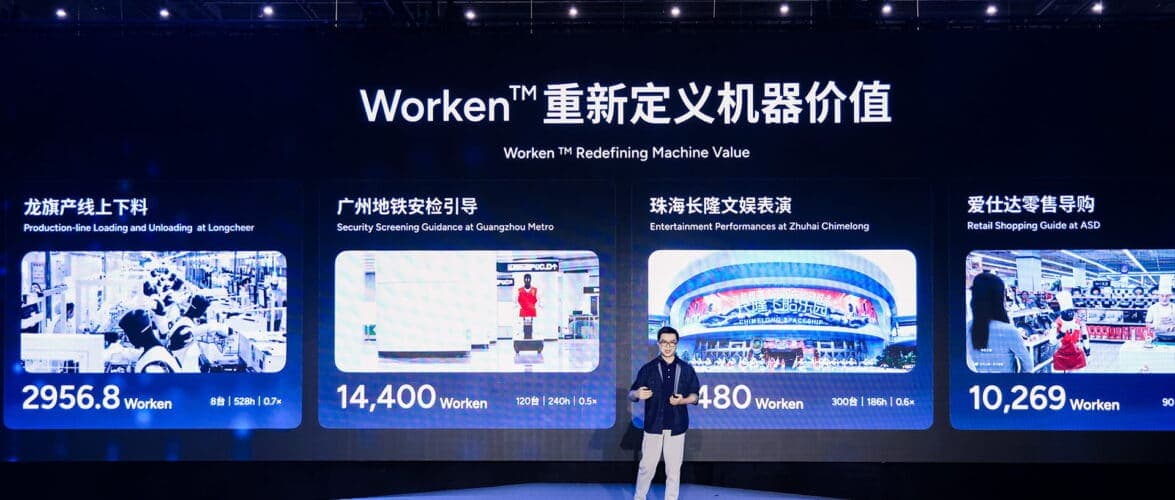
Agibot has proposed Worken, a metric for effective intelligent work hours. The name draws a deliberate parallel with tokens, the unit used to quantify output from large language models. Worken is intended to do the same for physical labour.
The calculation multiplies three factors: the number of active robots, their autonomous working hours, and an output efficiency ratio. Active robots are those online and capable of work during the measurement period. Autonomous working hours count time spent working without human supervision. The output efficiency ratio benchmarks a robot's productivity against a skilled human worker performing the same task with a standard method. Agibot sets that benchmark at 1.0; a robot achieving 1.2 exceeds the human baseline by 20 per cent, whilst 0.8 represents 80 per cent of human output.
The framework aims to make robot productivity comparable across industries and tasks. A procurement officer evaluating two models could compare Worken per dollar of capital expenditure over the expected service life, rather than comparing spec sheets.
Worken also implies a different depreciation model. Hardware loses value over time, but software and intelligence can be upgraded. If a fleet of robots learns collectively, their effective intelligence may increase even as their motors and joints wear down. The purchasing decision then hinges on cumulative intelligent work hours per unit of investment, not hardware cost alone.
From Pilots to Ecosystem
Agibot has reported three deployments that illustrate the shift from demonstration to operation. At Longcheer's Nanchang factory, eight G2 robots integrated into a tablet quality-inspection line handled more than 17,000 products over six days, with a reported success rate of 99.99 per cent. At Chimelong in Hengqin, more than 500 robots work across seven application types. At ASD stores, 100 X2 robots functioned as sales assistants and contributed to RMB 2.23 million in sales over three days.
These are early deployments, not proof of universal applicability. No single robotics firm is likely to serve every vertical on its own. The next phase requires turning pilot projects into repeatable applications that partners can deploy without Agibot engineers on site.
The company's ecosystem development programme commits more than RMB 2 billion over five years, with RMB 100 million allocated for 2026. The initiative gives developers, universities, and commercial partners access to Link-U OS, development tools, and models. The goal is to enable third parties to build applications on a shared technical foundation, rather than requiring each partner to solve integration challenges independently.
Peng described the strategy in a post-event interview. "Developing the full stack in-house is not optional. It is a requirement. The robot's body sets the floor, and the model sets the ceiling. Agibot must have models that generalise well enough, bodies that are reliable enough, and an integrated hardware and software system that meets the standard. Deployment requires embodied intelligence companies to work across the full stack."
He characterised Agibot as building that stack around practical applications. "Our thinking is simple: make the technology reusable and make the products competitive enough. That is our core value."
The Worken Gambit
If Worken gains traction, it could reshape procurement decisions. Customers would compare productive work delivered rather than the number of machines purchased. A robot that costs twice as much but produces three times the effective work hours over its lifetime becomes the better investment.
Chuang Wang suggested that adoption could eventually enable a shift from capital expenditure to operational expenditure. Instead of buying robots outright, customers might pay for productive work hours. That model would transfer upfront capital risk from the customer to the manufacturer, but it would also align incentives: the robot maker earns revenue only when the robot works.
At Opentechwire, we have tracked similar attempts to redefine value metrics in infrastructure and SaaS, where usage-based pricing has gradually displaced seat licences. The challenge is always the same: the new metric must be legible to finance teams and auditable in practice. Worken will face that test. If output efficiency ratios prove difficult to measure consistently across tasks, or if "autonomous working hours" becomes a negotiation rather than a fact, the standard will struggle.
But the underlying question is sound. As embodied AI moves from research labs to factory floors, the industry needs a language for productive work that transcends hardware specifications. Whether Worken becomes that language, or whether a competing standard emerges, the shift from counting machines to counting labour hours has begun.
Agibot's Innovation Day marked a transition: from demonstrations that impress to systems that operate, from isolated models to integrated platforms, from hardware sales to ecosystem partnerships. The robots are no longer performing backflips. They are clocking in.