Anthropic Launches Duet, a Proactive Agent That Works in the Background
The company's first autonomous assistant runs on virtual machines, checks in periodically, and will be available to Pro subscribers at $20 per month - undercutting OpenAI's pricing by a wide margin.
A New Entrant in Autonomous Assistants
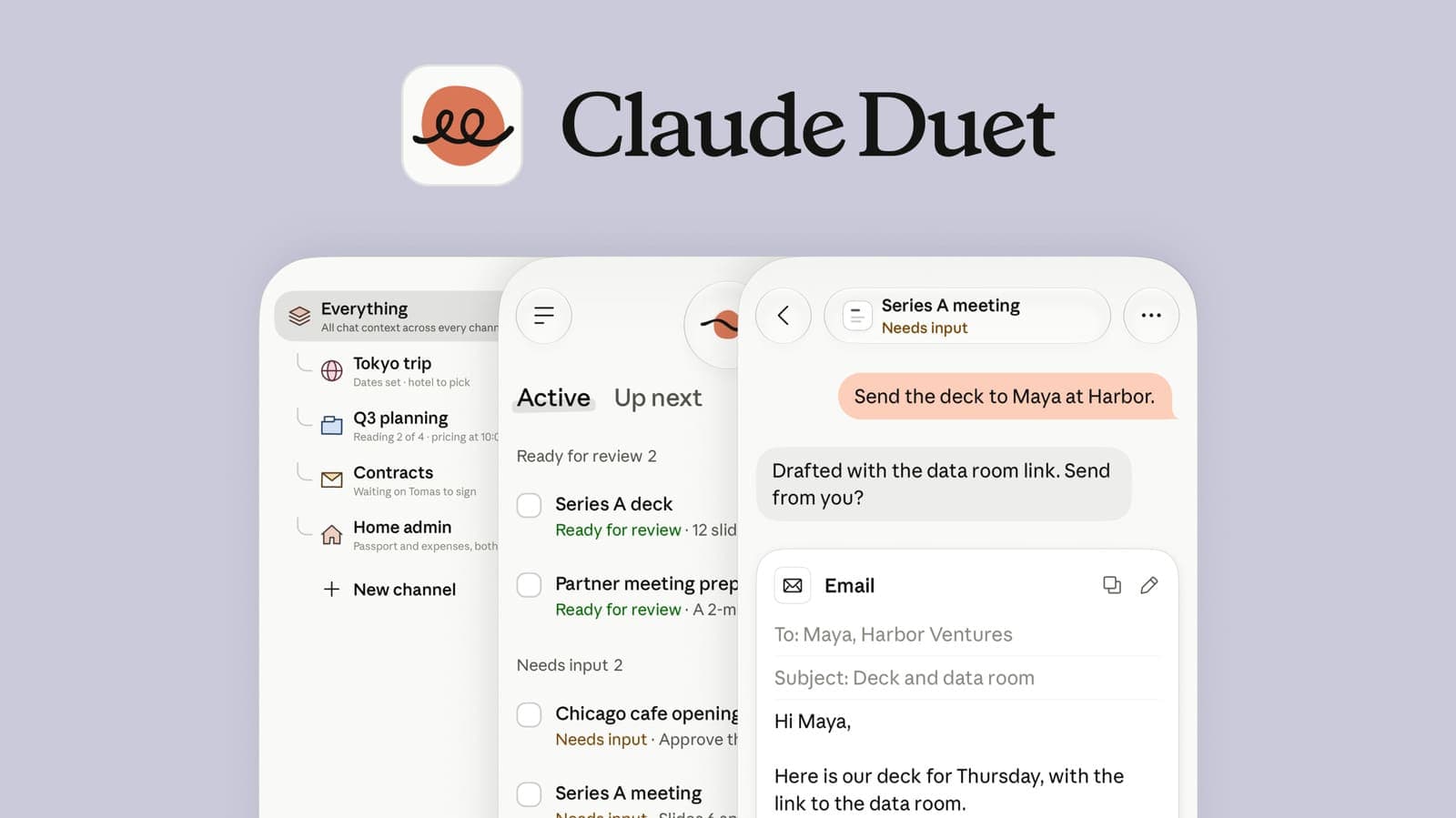
Anthropic unveiled Duet on 21 October, positioning the tool as an agent that operates continuously across connected applications without requiring an open browser session. The launch arrives months after similar offerings from competitors, yet the company is making a deliberate pricing bet: Duet will be available to subscribers of its $20 per month Pro plan once it exits research preview, rather than gating the feature behind higher-cost tiers.
At Opentechwire, we've tracked the evolution of proactive agents across the major labs - systems designed to monitor inboxes, calendars, and project tools, then surface actionable summaries or execute multi-step workflows. Duet fits that pattern but introduces architectural choices that hint at Anthropic's operational priorities: cost efficiency, persistent execution, and user control over interruption frequency.
The agent currently runs as a waitlist-only research preview, restricted to United States-based subscribers of Claude Pro. Standalone mobile applications for Android and iOS handle interaction, decoupling Duet from the main Claude web interface. This separation allows the agent to operate on its own virtual machine, completing tasks even when a user closes the app or powers down their device.
Task Scope and Execution Model
Duet generates a daily briefing that aggregates action items pulled from integrated services - email, calendar, document repositories, and collaboration platforms. Users can delegate administrative workflows such as meeting scheduling or more involved projects: building data dashboards, creating financial projections, prototyping applications, or assembling sales forecasts. Anthropic describes the agent as capable of working with "dozens of tools" simultaneously, though the company has not yet published a full list of supported integrations.
The agent runs on Opus 5.5, one of Anthropic's frontier models, and shares rate limits with other Claude services including Code. To prevent rapid exhaustion of monthly usage quotas, Duet polls connected accounts every few hours rather than continuously. The company acknowledges this pacing is still under evaluation and will be adjusted based on feedback from early testers. Users will be able to configure how often Duet sends notifications and which topics warrant an alert.
This polling cadence represents a trade-off: lower infrastructure costs and slower rate-limit consumption in exchange for delayed responsiveness. For workflows that demand sub-minute reaction times, the current architecture may prove insufficient. For periodic summarisation and overnight batch tasks, the model aligns well with usage patterns observed in enterprise automation.
Pricing and Market Positioning
The decision to make Duet available at the $20 per month tier - rather than a higher premium bracket - marks a notable divergence from OpenAI's approach. OpenAI's comparable offering, Dots, currently requires a Pro subscription starting at $100 per month. If Anthropic maintains this pricing structure through general availability, the company will have undercut the incumbent by 80 per cent on monthly cost, creating pressure across the segment.
Whether that pricing holds depends on infrastructure economics that remain opaque. Running a persistent agent with periodic polling, virtual machine overhead, and integration maintenance incurs non-trivial costs. Anthropic may be subsidising early adoption to build usage data and integration partnerships, or the company may have achieved efficiencies in inference and orchestration that allow sustainable operation at this price point.
For enterprises evaluating agent deployments, the $20 tier lowers the barrier to pilot programmes. Teams can test Duet across a wider cohort of employees without the budget approval required for $100 per seat per month plans. That accessibility could accelerate enterprise feedback loops and integration requests, shaping the product's roadmap in ways that higher-priced, narrower rollouts cannot.
Security Architecture and Data Handling
Anthropic has outlined several guardrails designed to limit exposure of sensitive information. A newly developed classifier and system prompt work in tandem to prevent Duet from inadvertently sharing credentials, health records, or financial details unless explicitly instructed. The agent does not receive direct access to passwords or authentication tokens; instead, it operates through OAuth flows or equivalent delegation mechanisms.
Information categorised as health-related or financial is filtered by default. If a user asks Duet to retrieve or share such data, the agent will request explicit confirmation before proceeding. The company has said it will release a more detailed technical description of these protections in the coming days, including evaluation results and adversarial testing outcomes.
These measures address a recurring concern in agent design: the risk that an autonomous system, given broad access to inboxes and file stores, might leak proprietary data through malformed queries or prompt injection. The effectiveness of the classifier will depend on its ability to generalise across edge cases - unusual phrasing, multi-lingual inputs, or indirect references to sensitive topics. Early testers will provide the first signal on whether the guardrails hold under real-world usage.
Adoption Constraints and Trust Requirements
The value proposition of any proactive agent hinges on the user's willingness to grant access to calendars, communications, and work artefacts. For some organisations, regulatory frameworks or internal policies prohibit such delegation. For individual users, comfort levels vary widely: executives accustomed to executive assistants may find the model familiar, while engineers or legal professionals may baulk at granting read access to repositories or contracts.
Anthropic's polling model mitigates one category of risk - continuous surveillance - but introduces latency. A user expecting immediate action on an urgent email arriving at 10:00 may not see Duet respond until 13:00 if the polling interval is three hours. This lag reduces the agent's utility for time-sensitive coordination, confining its strongest use cases to overnight synthesis, weekly reporting, and background research.
The company's research preview framing signals that current capabilities and reliability are not yet production-grade. Waitlist access allows Anthropic to gather telemetry on task success rates, false-positive notifications, and integration stability before committing to service-level expectations. Users joining the preview should anticipate incomplete task execution, occasional misinterpretation of instructions, and iterative changes to notification logic.
Implications for the Agent Layer
Duet's launch extends the competitive dynamic in autonomous assistants beyond model performance into pricing strategy, integration breadth, and user-control affordances. The $20 price point, if sustained, redefines the market's centre of gravity and forces rivals to justify premium tiers with differentiated reliability or exclusive integrations.
The architecture - persistent virtual machines, configurable polling, standalone mobile clients - suggests Anthropic is optimising for long-running tasks rather than conversational fluency. This contrasts with agents built atop chat interfaces, where responsiveness and context retention within a session take precedence. The trade-off may attract users who treat agents as background automation rather than interactive collaborators.
As the waitlist expands and usage data accumulates, the industry will gain visibility into which task categories benefit most from autonomous execution and which remain better suited to human-initiated workflows. Duet's success or failure will hinge less on the underlying model's capabilities and more on whether Anthropic can deliver consistent, non-intrusive utility across the messy realities of email overload, calendar conflicts, and fragmented tool stacks.