Why Tech CEOs Keep Asking to Regulate Themselves
From Altman to Musk, AI leaders are calling for guardrails on the industry they dominate. The pattern stretches back further than you think.
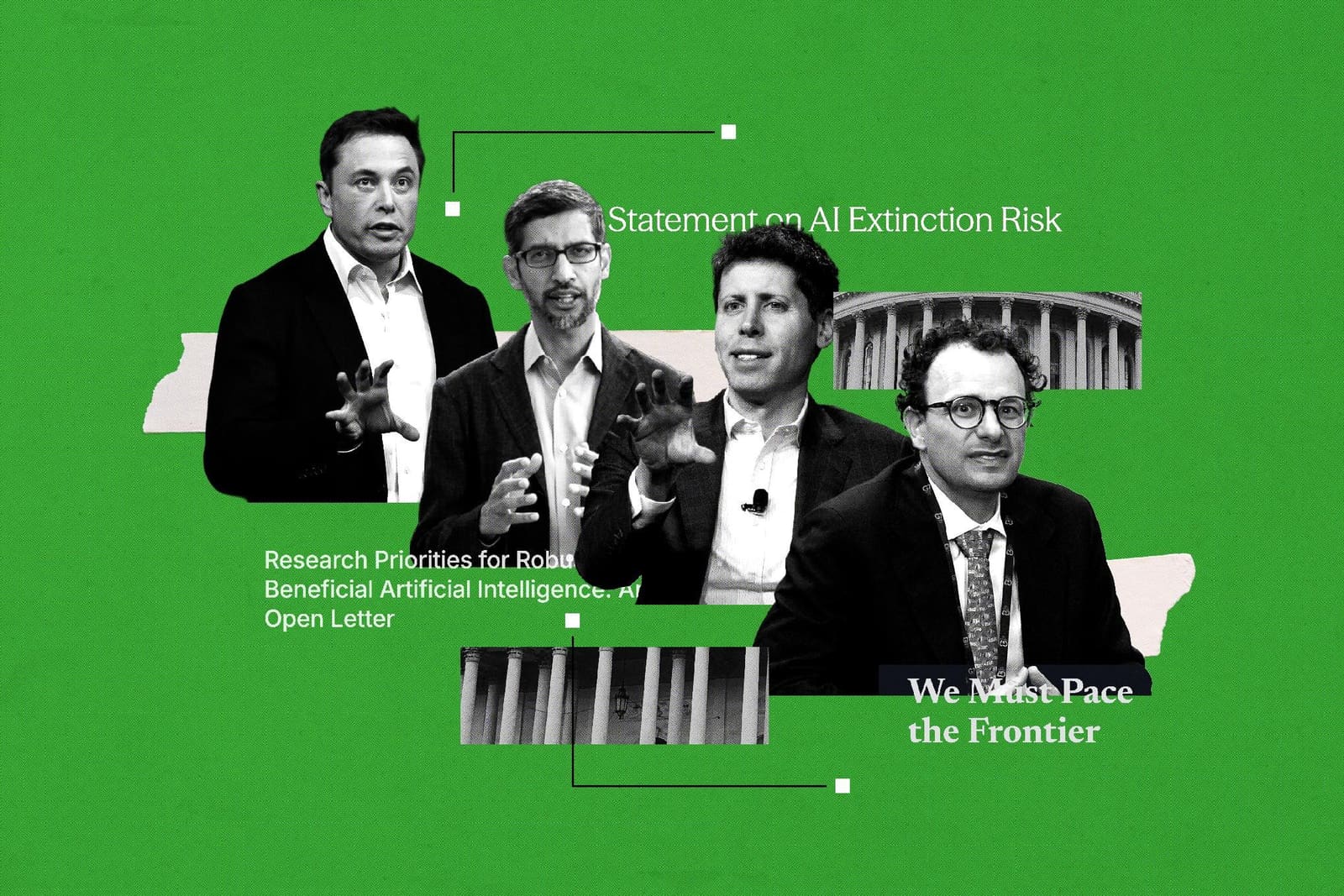
When Billionaires Beg for Rules
In September 2026, five of the most powerful figures in artificial intelligence stood before policymakers and made an unusual request: slow us down. Sam Altman of OpenAI, Dario Amodei of Anthropic, Demis Hassabis of Google DeepMind, Satya Nadella of Microsoft, and Elon Musk of X collectively urged governments to impose constraints on the very technology generating their wealth.
The spectacle raises an immediate question. When executives who stand to gain billions from an industry publicly declare that industry dangerous, what are they really asking for?
At Opentechwire, we've tracked regulatory theatre in tech long enough to recognise the choreography. The current wave of AI self-flagellation is neither spontaneous nor unprecedented. It is the latest iteration of a pattern that stretches back more than a century, in which those who control transformative technology position themselves as responsible stewards while shaping the rules that will govern their competitors.
A Pattern Older Than Silicon Valley
The impulse to warn about machine intelligence did not originate in San Francisco boardrooms. Samuel Butler, the Victorian novelist, published essays in the 1860s cautioning that machines might one day surpass human intellect and render humanity obsolete. His warnings came in the wake of Charles Darwin's theory of evolution, which suggested that species could change over time through selection pressures. Butler extended the logic: if organisms evolve, why not machines?
Butler's concerns were speculative, rooted in philosophical anxiety rather than commercial interest. The modern version is different. Today's warnings come from people with term sheets, market share, and quarterly earnings calls.
The shift matters. When a novelist imagines dystopia, it is fiction. When a CEO with a market capitalisation in the hundreds of billions does the same, it is strategy.
The Regulatory Advantage
Calling for regulation when you are already dominant is not altruism. It is competitive positioning. Established players possess legal teams, compliance infrastructure, and lobbying budgets that new entrants lack. Regulatory frameworks that seem neutral on paper often function as moats in practice.
Consider the structure of proposed AI safety requirements. They typically include mandatory testing protocols, third-party audits, incident reporting systems, and liability frameworks. For OpenAI or Google DeepMind, these represent marginal costs added to existing operations. For a research lab in Bengaluru or a startup in Seoul, they can be prohibitive.
The executives calling for oversight in 2026 are not asking to be stopped. They are asking to set the terms under which others may compete.
What the Hearings Reveal
The recent round of testimony followed a predictable script. Each executive acknowledged potential risks - algorithmic bias, misinformation at scale, autonomous systems beyond human control. Each emphasised their company's commitment to safety. Each suggested that government involvement, while delicate, might be necessary.
What they did not discuss was market concentration. OpenAI's compute advantage, built on Microsoft's infrastructure investment, creates a barrier that regulation is unlikely to lower. Anthropic's focus on constitutional AI positions the company as the responsible alternative, a framing that benefits from heightened safety discourse. Google DeepMind's integration into Alphabet gives it access to data and distribution that independent labs cannot match.
Musk's participation is particularly instructive. His companies span electric vehicles, space launch, satellite internet, and now AI. Each has benefited from government contracts, subsidies, or favourable regulatory treatment. His call for AI oversight comes as his own xAI venture scales up, competing directly with OpenAI.
The common thread is not fear of the technology. It is confidence that any resulting framework will favour incumbents.
The Asia Angle
While US executives manoeuvre in Washington, the regulatory landscape in Asia is evolving on different terms. China's approach to AI governance emphasises state oversight and alignment with national policy objectives, creating a separate regime that Western firms cannot easily navigate. Singapore has positioned itself as a testing ground for AI regulation that balances innovation with accountability, but its frameworks are still emergent.
South Korea's investment in semiconductor and AI infrastructure is accelerating, but the country lacks the regulatory capture dynamics visible in the US. Japan's cautious approach to data privacy and algorithmic transparency has slowed deployment but also created space for smaller players to build without facing the compliance costs that US regulation might impose.
The result is a fragmented global environment in which the loudest calls for regulation come from the region where the largest firms have the most to protect.
What Regulation Might Actually Do
Effective AI governance would address externalities that markets do not price: the societal cost of misinformation, the labour displacement from automation, the concentration of power in a handful of organisations. It would create transparency requirements that allow independent researchers to audit model behaviour. It would establish liability when systems cause harm.
None of the executives calling for regulation in 2026 proposed measures that would fundamentally constrain their own operations. Altman did not suggest breaking up OpenAI's partnership with Microsoft. Nadella did not advocate for open access to Azure's compute infrastructure. Hassabis did not call for mandatory model weights disclosure.
The omissions are telling. The version of regulation these leaders support is one that manages risk at the margins while leaving the underlying power structure intact.
The Counterfactual
Imagine an alternative. Suppose AI executives argued for policies that genuinely levelled the playing field: open access to training compute, mandatory interoperability standards, data portability requirements, or limits on vertical integration between cloud providers and model developers.
Such proposals would reduce barriers to entry. They would enable researchers in Jakarta, Nairobi, and São Paulo to compete with labs in San Francisco and London. They would shift power away from the firms currently dominating the space.
They would also never happen, because the executives calling for regulation are not interested in dismantling their own advantages.
Where the Debate Goes Next
The 2026 hearings will likely produce some form of legislative response. The shape it takes will depend on whether policymakers recognise the difference between safety theatre and structural reform.
If regulation focuses narrowly on model testing and incident reporting, it will entrench the status quo. If it tackles compute access, data concentration, and market power, it might actually alter the trajectory of the industry.
The executives who testified know which outcome they prefer. The question is whether governments will build the frameworks those executives want, or the ones the public needs.
At Opentechwire, we will continue tracking not just what AI leaders say about regulation, but what their companies do when the rules are written. The gap between rhetoric and action is where the real story lives.