When Robots Enter the Factory Floor: The Safety Calculus of Industrial Autonomy
As foundation models and physical AI converge in industrial settings, the question is no longer what machines can do, but what safeguards determine where they should act alone.
The Shift to Physical Consequence
Industrial AI has existed for decades in forms like predictive maintenance and process optimisation. What distinguishes the current wave is not sophistication alone, but physical reach. Foundation models, agentic systems, and robotics capable of autonomous operation are converging in environments where software decisions translate directly into mechanical action. A miscalculation in a digital assistant might irritate a user; the same error in a power grid or chemical plant can endanger lives and infrastructure.
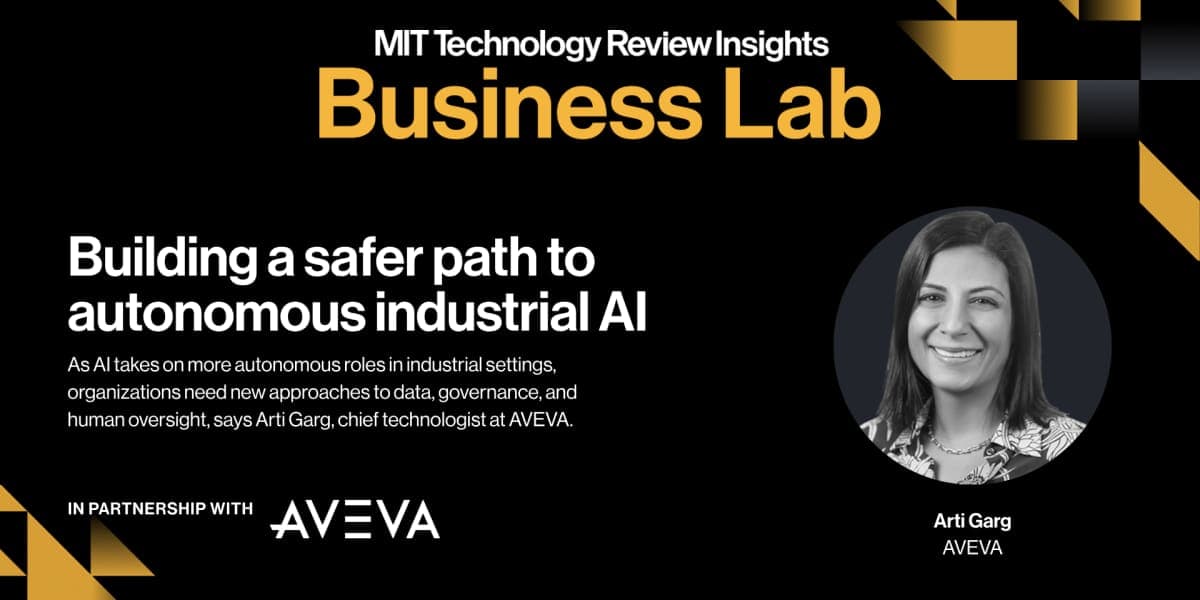
Arti Garg, chief technologist at AVEVA, frames the challenge as one of leverage under constraint. Organisations want the efficiency gains these systems promise. Yet many operate facilities where equipment runs at high temperature, under pressure, or near workers. The central tension is not whether to adopt autonomy, but how to deploy it without sacrificing the reliability that industrial operations demand. Early AI applications in this sector leaned toward narrow, explainable models whose behaviour could be mapped in advance. Newer architectures, particularly large language models and vision-based robotics, do not always afford that predictability.
Data as the Enabling Layer
One reason industrial AI has historically lagged consumer applications is fragmentation. Telemetry from sensors, maintenance logs, engineering drawings, and equipment manuals often sit in separate systems. An operator diagnosing a fault might spend significant time correlating a pressure reading with service history and original design specifications. This delay compounds when the problem is urgent.
Graph databases and retrieval-augmented generation are narrowing that gap. Instead of manual cross-referencing, an AI agent can pull relevant data from multiple sources in seconds and present it to a technician on a mobile device. The operator still makes the call, but the diagnostic process accelerates. Garg describes this as augmentation rather than replacement: the human remains in the decision loop, but with better information at hand.
The next step involves physical presence. Autonomous robots and drones can gather data in hazardous zones, high-temperature areas, or confined spaces where sending a worker carries risk. Equipped with cameras, thermal sensors, and connectivity to cloud inference, these machines can inspect equipment and relay findings without requiring human entry. The appeal is clear, particularly in mining, offshore energy, and heavy manufacturing. The challenge lies in ensuring the robot's actions, whether navigating a space or interacting with machinery, remain within safe parameters.
A Triple Mandate for Governance
AVEVA's framework for responsible AI rests on three pillars: security, efficiency (including environmental impact), and human safety with oversight. Security here means both cybersecurity, guarding against adversarial input or system compromise, and operational security, ensuring AI does not introduce unpredictable behaviour into critical processes. Efficiency encompasses not only throughput but also the energy and resource footprint of AI itself, a consideration as inference workloads grow.
Human oversight is the binding constraint. Garg argues that in high-stakes environments, AI should augment rather than replace people in critical decision loops. This means defining boundaries: where an autonomous system can act on its own, where it must flag a human supervisor, and where it is prohibited from acting altogether. Those boundaries are not universal. A robot inspecting a pipeline may operate autonomously within a defined route, but any decision to shut down equipment or alter a process parameter would require human authorisation.
The governance model extends beyond individual deployments. AVEVA applies a joint framework internally for how the company uses AI and how it embeds AI into products sold to customers. This dual approach ensures consistency: the same principles that govern internal tooling also shape what industrial operators receive. It also reflects a recognition that industrial customers, many of whom manage mission-critical infrastructure, will demand clarity on how AI behaves before they deploy it at scale.
Measuring the Environmental Cost
Sustainability sits at the intersection of AI's promise and its overhead. On one hand, AI can optimise power distribution as renewable generation becomes more variable, balancing supply and demand across grids in real time. On the other, training and running large models consumes electricity, water for cooling, and hardware resources. Industrial adopters need a way to account for both sides of the ledger.
Garg participates in an IEEE working group developing a standard methodology for measuring AI's environmental impact. The framework considers electricity use, total energy consumption, material resources, water, and carbon emissions. The goal is a consistent basis for comparison, so organisations can evaluate whether a given AI deployment delivers a net environmental benefit or simply shifts the burden. As industrial AI scales, this accounting will matter not only for corporate reporting but also for regulatory compliance in jurisdictions with carbon pricing or emissions caps.
Autonomy in Motion
The next phase of industrial AI involves greater physical autonomy. Autonomous mobile robots and drones are already in limited deployment for inspection and logistics within plants, mines, and energy sites. Garg anticipates these systems will expand their roles, moving from data collection to more active tasks such as valve operation, sample retrieval, or even collaborative work alongside human technicians.
Another frontier is AI-assisted software development for domain experts. Engineers and operators who understand processes but lack formal coding skills could use natural language interfaces to build custom monitoring or control applications. This democratisation of tooling could accelerate innovation, but it also raises questions about quality control and unintended behaviour when non-specialists deploy code in production environments.
Both trajectories, physical autonomy and software accessibility, hinge on the same principle: guardrails that constrain where and how AI can act. An autonomous drone inspecting a turbine needs collision avoidance, geofencing, and fail-safe protocols. An AI code generator used by a plant engineer needs output validation, version control, and rollback mechanisms. The technology enables new capabilities; the governance determines whether those capabilities can be trusted.
Rethinking Processes, Not Just Tools
Garg emphasises that realising the potential of industrial AI requires more than purchasing new hardware or licensing models. Organisations must rethink business processes, establish appropriate safeguards, and give experienced workers new ways to apply their expertise. This is not a technology substitution problem but a redesign challenge. Operators who once performed manual inspections might instead supervise fleets of autonomous robots, interpreting data and making decisions at a higher level of abstraction.
That shift demands investment in training and cultural change. Workers need to understand what AI can and cannot do, how to interpret its outputs, and when to override its recommendations. Management must set clear policies on accountability: if an autonomous system makes a mistake, who is responsible? These questions have legal, ethical, and practical dimensions, and they do not have universal answers. Different industries, regulatory regimes, and organisational cultures will arrive at different solutions.
What remains constant is the need for a model of automation that balances capability with control. Industrial environments operate on thin margins for error. The equipment is expensive, the processes are complex, and the consequences of failure extend beyond the plant gate. AI that delivers efficiency gains while respecting those constraints will find adoption. AI that promises autonomy without accountability will not.
The Path Forward
Industrial AI is moving from prediction to action. Foundation models, physical robotics, and agentic systems are converging in settings where decisions have weight. The opportunity is substantial: safer working conditions, faster diagnostics, more efficient operations, and better resource management. The risk is equally real: autonomous systems that behave unpredictably in environments where physical consequences matter.
Responsible deployment is not a brake on innovation but a condition for its success. Organisations that define clear governance, invest in data infrastructure, measure both benefits and costs, and keep human judgment in the loop will be positioned to capture the gains. Those that rush to autonomy without those foundations may find that the margin for error in industrial settings is narrower than the models they deploy can accommodate.