Microsoft Grants Copilot OS-Level Control and Local File Access
Redmond's "Hybrid Intelligence" strategy blends on-device and cloud AI to let the assistant act across Windows, not just chat.
A New Layer of Agency
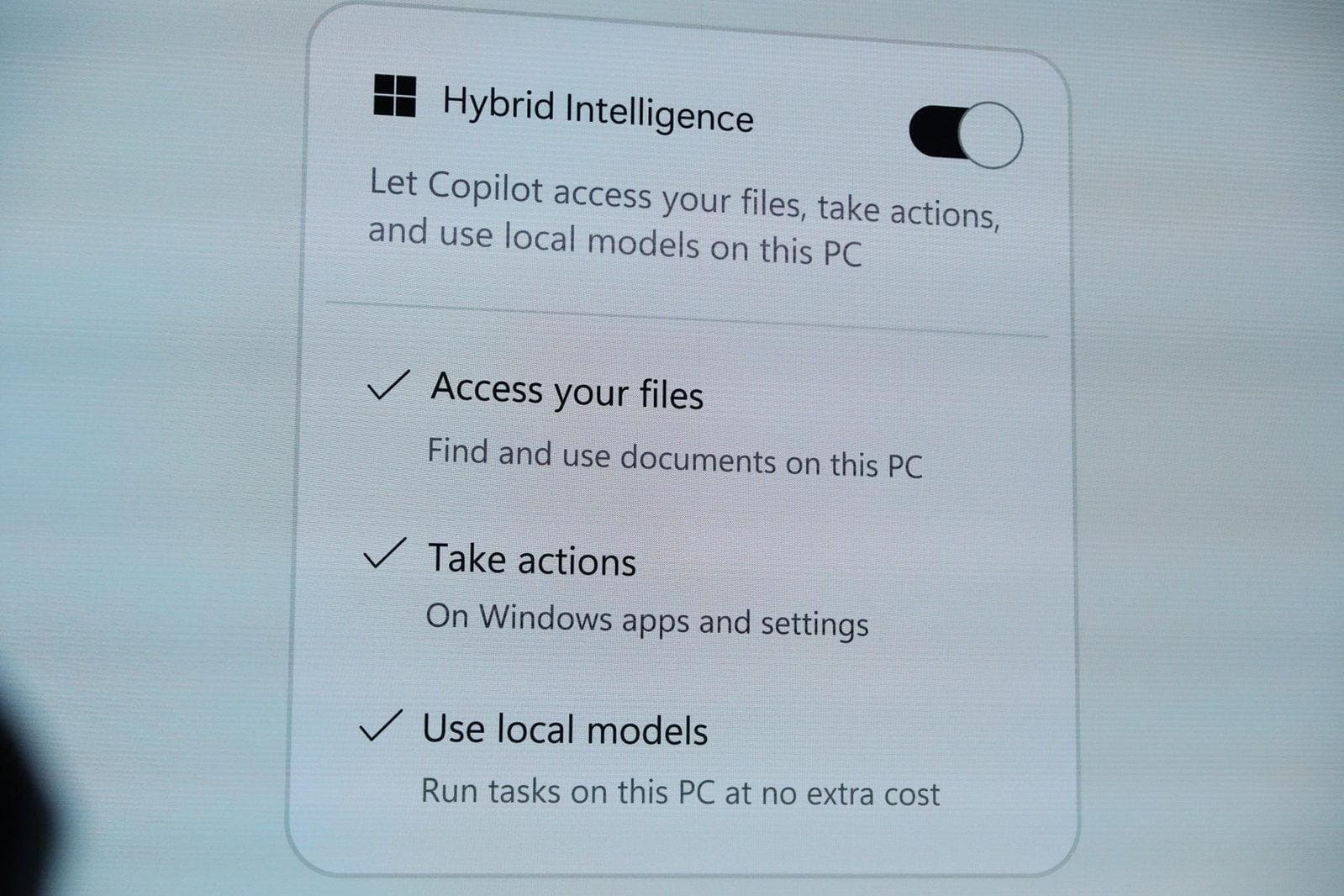
Microsoft unveiled an expanded role for its Copilot assistant at a recent Windows and Surface presentation, introducing capabilities that push the tool beyond conversational queries into the realm of autonomous operating-system tasks. The upgrade grants Copilot permission to read local files stored on a user's machine and to perform actions across Windows itself, a departure from the chat-first model that has defined consumer AI tools over the past two years.
Jacob Andreou, Microsoft's executive vice president for Copilot, demonstrated the system onstage through a scenario centred on tax preparation. In the demo, Andreou instructed an agent called Autopilot to locate information requested by his accountant after receiving an email, then to gather and organise the relevant documents without further prompting. The exchange illustrated a workflow in which the assistant interprets intent, searches the file system, and assembles a response autonomously, a sequence that requires both understanding context and executing multi-step processes.
The demonstration signals Microsoft's intent to position Copilot not as a peripheral feature but as a core interface layer, one that mediates between user goals and the scattered data and applications that sit on a typical Windows installation. For enterprises managing fleets of PCs, the implications are immediate: workflows that today require manual file retrieval, cross-application copying, and email composition could collapse into single natural-language commands, assuming the underlying accuracy holds.
Hybrid Intelligence as Architectural Bet
Microsoft is framing this evolution under the banner of "Hybrid Intelligence," a term that describes workloads split between local, on-device models and remote cloud inference. The rationale is straightforward: latency-sensitive tasks such as file indexing, document parsing, and lightweight classification can run on the client's silicon, while complex reasoning, large-context summarisation, and multi-modal generation are offloaded to Azure-hosted models with greater parameter counts and compute headroom.
This hybrid architecture addresses two constraints that have limited the practicality of AI assistants in production environments. First, sending every query to the cloud introduces round-trip delays that disrupt interactive use, particularly on networks with variable bandwidth or in regions distant from data centres. Second, uploading all local files to remote servers for processing raises data-residency and privacy concerns that many regulated industries cannot accommodate, regardless of encryption in transit.
By keeping file metadata and initial query processing on the device, Microsoft can index and search without moving sensitive documents off the machine. Only the distilled query or a curated subset of data travels to the cloud for final reasoning, a compromise that balances performance with compliance requirements. At Opentechwire, we have tracked similar hybrid designs emerging from Alibaba Cloud's Tongyi assistant and Samsung's on-device Gauss models, both of which partition inference to keep personally identifiable information local while tapping remote capacity for generative tasks.
The technical challenge lies in orchestration: deciding which layer handles which subtask, managing state across the boundary, and ensuring that failures in one tier do not cascade. Microsoft has not disclosed the heuristics or APIs that govern this split, but the presence of dedicated neural processing units in recent Qualcomm Snapdragon X and Intel Core Ultra chips suggests that Windows is beginning to treat local AI acceleration as a standard platform capability, much as it has with graphics processing over the past decade.
File Access and the Trust Boundary
Granting an AI assistant read access to the file system represents a significant expansion of the trust boundary. Until now, Copilot has operated primarily within the confines of Microsoft 365 cloud services - summarising emails in Outlook, generating slides in PowerPoint, drafting replies in Teams. Those interactions occur within applications that already hold the user's data; the assistant is, in effect, reading what the user has already chosen to store in Microsoft's ecosystem.
Local file access is a different proposition. A Windows PC typically contains years of accumulated documents, browser downloads, configuration files, and application caches, much of which has never been indexed or curated. Allowing an agent to traverse this landscape means exposing data that may include tax returns, medical records, legal contracts, and credentials stored in plain text by legacy software. The assistant's effectiveness depends on its ability to interpret file names, folder structures, and content semantics, but that same capability creates risk if the model misclassifies intent or if an adversary crafts prompts designed to exfiltrate sensitive information.
Microsoft has not detailed the permission model or sandboxing mechanisms that will govern Copilot's file-system interactions. Industry precedent suggests several possible approaches: explicit user consent per folder or file type, a whitelist of indexable directories, or runtime prompts that ask for confirmation before opening documents outside well-known paths such as the user's Documents or Downloads folders. The demo did not show these safeguards, leaving open questions about how the system handles edge cases, such as files with misleading extensions or archives that contain nested sensitive data.
Privacy advocates have already raised concerns about similar features in other platforms. Apple's Intelligence framework, which indexes on-device messages and photos for Siri, has faced scrutiny over the potential for unintended data leakage, even though Apple emphasises that processing remains local. Microsoft's hybrid model, by design, involves cloud transmission for certain tasks, which compounds the scrutiny. Enterprises will likely demand granular policy controls, audit logs, and the ability to disable cloud offload entirely for high-sensitivity workloads.
Implications for the Windows Ecosystem
The shift toward agentic AI has consequences that extend beyond individual productivity. If Copilot becomes a default interface for common tasks, the design assumptions that have governed Windows software for three decades begin to erode. Applications have traditionally exposed functionality through menus, toolbars, and keyboard shortcuts, interfaces optimised for direct manipulation by a human operator. An AI agent operating on the user's behalf requires a different contract: structured APIs, semantic metadata, and predictable state management that allow the agent to invoke actions without navigating user-interface chrome.
Microsoft has been building this foundation through its Graph API and the integration of OpenAI's function-calling capabilities into Azure OpenAI Service. Third-party developers who adopt these standards can make their applications "Copilot-ready," enabling the assistant to perform tasks such as scheduling meetings in a project-management tool or updating records in a customer-relationship-management system. The incentive structure is clear: applications that integrate deeply with Copilot gain visibility and usage, while those that remain opaque risk being bypassed as users delegate more workflows to the agent.
This dynamic mirrors the shift that occurred with mobile app stores, where discoverability and engagement became tied to platform-level search and recommendation algorithms. In the AI-mediated desktop, the platform holder's assistant effectively becomes a gatekeeper, shaping which applications users interact with based on the agent's ability to understand and invoke them. For independent software vendors, the cost of integration - both technical and in terms of data sharing - becomes a necessary investment to remain competitive.
At the same time, the expansion of Copilot into OS-level control raises questions about Microsoft's own product strategy. Windows has long been a platform that supports diverse workflows and third-party tools, a neutrality that has allowed the ecosystem to flourish. As Microsoft's own AI assistant gains privileged access to system functions and user data, the line between platform and service blurs. Competitors building alternative assistants, such as Anthropic or Google, will need equivalent access to deliver comparable functionality, and the terms of that access - whether through public APIs or partnership agreements - will shape the competitive landscape.
The Broader Context of Agentic AI
Microsoft's move fits within a broader industry progression toward agents that act rather than merely respond. OpenAI's upcoming Operator tool, Google's Project Mariner for browser automation, and Anthropic's computer-use capability all reflect a shared conviction that the next phase of AI value lies in delegation: users describe outcomes, and models execute the steps to achieve them.
The technical challenges are formidable. Agents must handle ambiguity, recover from errors, and operate across environments that were never designed for machine interpretation. A tax-filing workflow, for instance, might require logging into a web portal, downloading a PDF statement, extracting specific line items, copying them into a spreadsheet, and attaching the result to an email. Each step involves different modalities - web navigation, document parsing, spreadsheet formulas, email composition - and brittle integrations that can fail if a website redesigns its layout or if a PDF uses an unexpected format.
The demos that companies show onstage are curated to succeed, and the gap between demo and daily reliability remains wide. Early enterprise pilots of agentic tools have reported accuracy rates in the range of sixty to seventy per cent for multi-step workflows, acceptable for experimental use but insufficient for tasks with compliance or financial consequences. Microsoft's hybrid approach, by keeping some processing local and deterministic, may improve reliability for well-defined subtasks, but the overall system's dependence on cloud-based reasoning means that errors in the generative layer will propagate.
Regulatory scrutiny is also intensifying. The European Union's AI Act classifies systems with autonomous decision-making in high-risk domains, and agents that access financial or health data on a user's PC could fall within that scope. Microsoft will need to demonstrate auditability, explainability, and user control to satisfy regulators in markets where the company operates. The hybrid-intelligence model, if implemented with transparent logs and user override mechanisms, could provide the documentation needed for compliance, but the details remain to be seen.
What Lies Ahead
The trajectory Microsoft is pursuing suggests a Windows environment in which the AI assistant is not an optional add-on but a fundamental mode of interaction, as integral to the experience as the Start menu or the taskbar. For users comfortable delegating routine tasks and willing to trust the system's judgement, the productivity gains could be substantial. For those wary of opaque automation or protective of their data, the same capabilities may feel intrusive, particularly if opting out requires navigating buried settings or sacrificing access to new features.
The success of this vision depends on execution. If Copilot proves reliable, transparent, and respectful of user intent, it may indeed become the interface layer that Microsoft envisions. If it falters, exposing private data through misinterpretation or frustrating users with brittle automation, the backlash could stall adoption and invite regulatory intervention. The company's decision to brand the initiative as Hybrid Intelligence reflects an awareness that trust, not just capability, will determine whether users grant an AI assistant the keys to their operating system.