Wabi Secures $55 Million as Investors Chase the Personal Agent Wave
Eugenia Kuyda's startup pivots from app-building tool to AI messenger, reaching unicorn territory amid a crowded race for consumer attention.
A Pivot Under Pressure
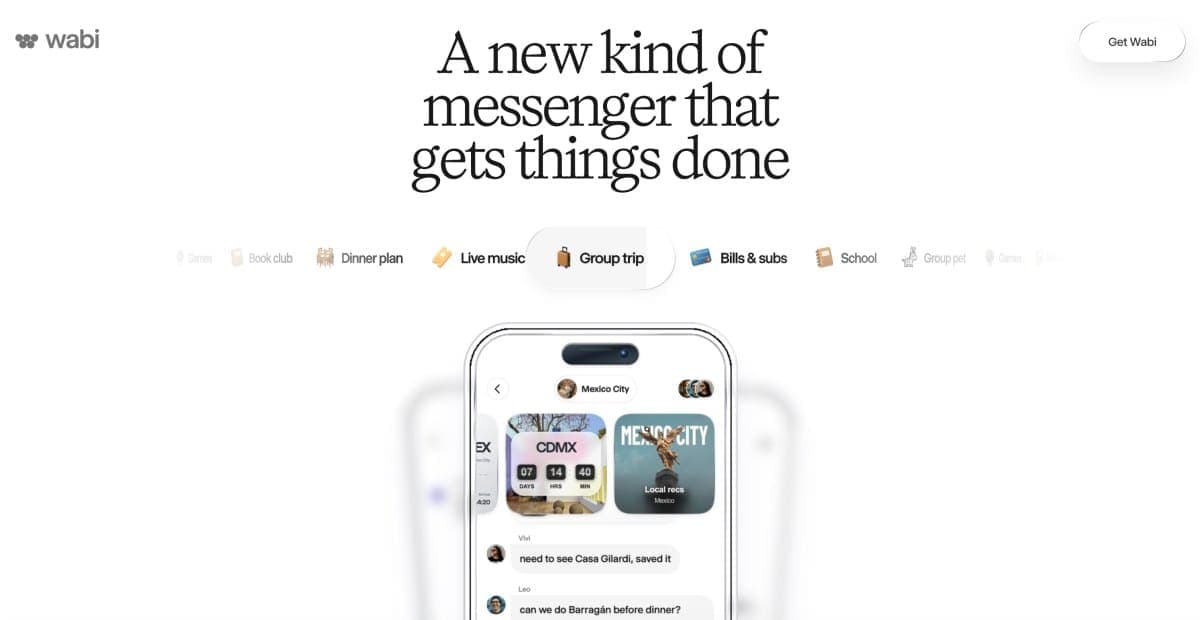
Wabi announced on Thursday that it has closed a $55 million funding round, pushing its valuation to $1.25 billion. The startup, led by Eugenia Kuyda, has shifted its core proposition over the past month: what began as a platform for building applications through natural language prompts has become an AI messenger designed to generate task-specific interfaces on the fly.
Kuyda previously founded Replika, an AI companion service that attracted millions of users seeking conversational interaction. Her latest venture initially offered a different promise - allowing non-technical users to create functional apps by describing what they wanted in plain language. That model, however, has given way to what the company now calls Wabi 2.0, a personal agent architecture that constructs mini applications as needed rather than storing a library of pre-built tools.
The distinction matters in a market where the boundaries between chatbot, assistant, and agent remain fluid. Wabi's current approach generates ephemeral interfaces - meal planners, restaurant trackers, fitness schedules, trivia games - that exist only as long as the user requires them. The company positions this as a departure from the fixed menus and command structures that define most AI assistants today.
Capital Follows the Agent Narrative
The new round was led by IVP, with participation from Andreessen Horowitz, Forerunner, and the Amazon Alexa Fund. A roster of individual backers joined as well, including Shopify's Tobi Lütke, Salesforce's Marc Benioff, Marissa Mayer, Dick Costolo, and Alex Pall of The Chainsmokers.
Alex Lim, general partner at IVP, framed the investment around Kuyda's design sensibility and her willingness to look beyond text-based interaction. At Opentechwire, we have tracked similar language across venture announcements this year - investors repeatedly cite "taste" and "vision" when backing consumer AI plays, often as a hedge against the technical commoditisation that open models and API layers have introduced. The argument runs that if the underlying inference becomes a utility, differentiation will hinge on interface design and user retention mechanics.
Wabi is entering a market segment that has seen rapid capital deployment in recent months. Instinct, a viral AI agent, secured funding at a $10 billion valuation in September. Tolan, which pairs AI assistance with a physical companion device, raised $30 million shortly after. The common thread is a bet that consumers will adopt AI tools that feel less like software and more like persistent presences - whether that takes the form of a messenger, a device, or a dynamically generated interface.
What Mini Apps Actually Mean
The mini app concept is not new. WeChat popularised the format in China, allowing third-party services to run inside its messenger without requiring separate installations. Telegram and other platforms have since adopted variations. Wabi's version differs in that the apps are not pre-built by developers or brands; they are generated by the AI in response to user requests.
This raises practical questions. An app that plans meals or tracks restaurants must pull data from somewhere - menu inventories, opening hours, dietary preferences, perhaps even reservation systems. Wabi has not publicly detailed the integrations or data pipelines that underpin these mini apps, nor the extent to which they rely on external APIs, web scraping, or user-provided information. The quality and reliability of dynamically generated tools will depend heavily on those backend choices.
There is also the question of retention. Apps built through prompts may solve immediate problems, but they lack the persistent identity and accumulated state that keep users returning to dedicated services. A fitness plan generated on demand may be useful once; whether it can compete with established platforms that store workout history, sync with wearables, and offer social features is less clear.
The Replika Precedent
Kuyda's track record with Replika offers both encouragement and caution. Replika succeeded in building a loyal user base by offering emotional connection rather than utility - a design choice that insulated it from direct comparison with productivity tools but also limited its addressable market. Wabi represents a different wager: that users want AI to be functionally generative, constructing tools as needed rather than conversing for its own sake.
The pivot from app builder to personal agent suggests that the original value proposition did not gain the traction Wabi anticipated. Pivots are common in early-stage startups, but they carry risk when they happen after significant capital has been deployed and a narrative has been established. Investors in this round are effectively backing a second product strategy within the same corporate shell.
A Crowded Field with Unclear Winners
The personal agent category is attracting capital faster than it is producing revenue models. Most consumer AI startups have yet to demonstrate sustainable monetisation beyond subscription tiers, and the unit economics of inference-heavy applications remain challenging. Wabi will need to show that dynamically generated mini apps can drive daily engagement at a scale that justifies the infrastructure costs and the valuation multiple.
The funding environment for AI consumer plays has been forgiving so far, with investors willing to underwrite experimentation in the hope of capturing a breakout platform. That patience is not infinite. The startups that raised large rounds in 2024 and early 2025 are now under pressure to show user growth, retention, and a credible path to profitability. Wabi will face the same scrutiny as it scales beyond early adopters.
For now, the $1.25 billion valuation reflects investor confidence in Kuyda's ability to iterate and in the broader thesis that AI will reshape how people interact with software. Whether that thesis translates into a durable product - and a durable business - remains to be demonstrated.