Anthropic Rolls Out Spending Analytics to Prove AI's ROI
The Claude maker's new reporting suite gives enterprise teams granular insight into token costs and workflow efficiency, betting that transparency will lock in customers as AI budgets balloon.
The Transparency Play
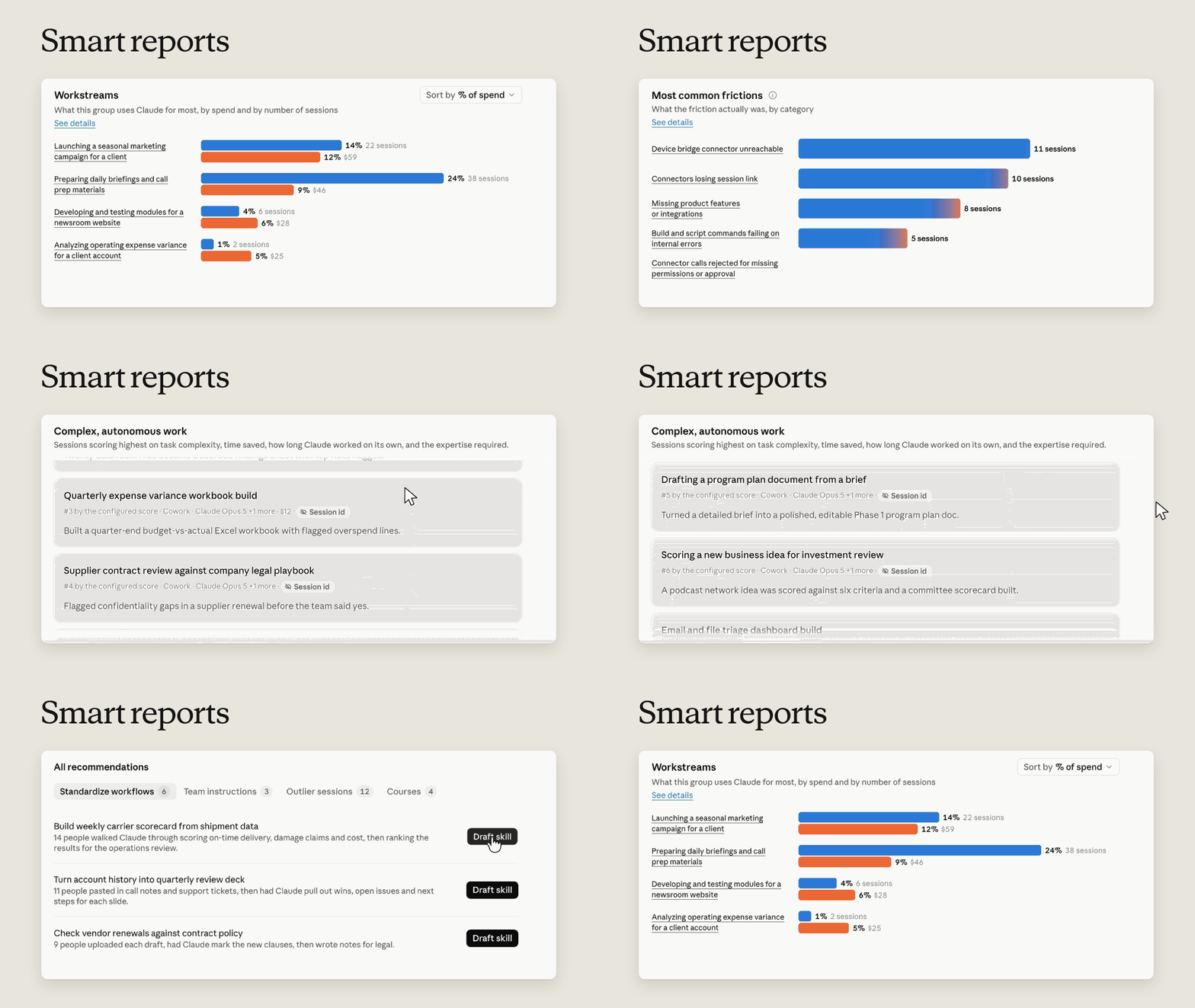
Anthropic has released a set of reporting tools designed to answer a question that keeps enterprise CFOs awake: what exactly are we buying with this ballooning AI budget? The new suite allows managers to track team output, token expenditure, and workflow bottlenecks over custom date ranges, combining internal analytics with employee surveys to map value against cost.
The move follows financial disclosures to investors showing that Anthropic recorded an operating profit in the second quarter, with net revenue retention hitting 900 per cent. That metric, which measures spending growth from existing customers, means the same cohort of clients spent nine times more in Q3 2026 than they did a year earlier. The company's AI coding tool, Claude Code, has been central to that expansion.
Anthropic says it will not use data from these reports for model training by default. The tools also generate recommendations on how to improve results, a feature that doubles as both customer service and product stickiness.
Token Budgets Meet Corporate Reality
At Opentechwire, we've tracked the widening gap between AI adoption at venture-backed startups and the slower, more sceptical rollout at Fortune 500 firms. While the former group drives token spend upward, most large enterprises have yet to see material productivity gains from deploying generative AI. Anthropic's reporting suite is a direct response to that hesitation.
The company is also introducing pooled group budgets, allowing teams to manage token allocations collectively rather than individually. It's a small operational detail that signals a larger shift: AI is moving from experimental line item to managed infrastructure cost, and enterprises want the same financial controls they apply to cloud compute or SaaS licences.
Data from Jellyfish, which builds developer productivity tools, underscores the urgency. A study of 276,000 users found that spending on agentic coding tools has grown ten-fold since the start of 2026, now representing roughly 2 per cent of total engineering cost. Claude Code and other Anthropic-powered tools account for nearly a third of all code changes submitted for review in the survey.
Nicholas Arcolano, chief scientist at Jellyfish, framed the inflection point plainly: even if 2 per cent sounds modest, ten-fold growth is growth most finance teams did not budget for. The industry has reached the stage where simply spending on AI is no longer enough. Optimisation and accountability are now table stakes.
Incumbent Advantage in a Model Arms Race
Anthropic holds a lead among enterprise customers, but the dynamics of what makes an agentic coding tool genuinely sticky remain opaque. OpenAI's Astra model, released over the northern hemisphere summer, appeared on paper to pose a competitive threat. In practice, adoption patterns have barely shifted.
Nikolas Albarran, AI product lead at Jellyfish, noted that OpenAI's earlier Codex model took a long time to register in usage data, and Astra has shown up more clearly. Yet the narrative on social platforms, particularly X, suggests a more heated contest than the data reflects. The Valley consensus favours Codex, but enterprise behaviour tells a different story.
Anthropic arrived early with enterprise-grade workflows and support infrastructure, and many organisations have standardised around it. The switching cost is not zero. Once a team has invested in configuring agent files, tuning prompts, and embedding Claude Code into CI/CD pipelines, migrating to a competitor requires re-engineering effort that most managers are reluctant to approve without a compelling reason.
Forward-Deployed Engineering, Scaled Down
The stickiness also stems from how frontier labs engage with customers. All the major AI companies now run forward-deployed engineering organisations, small teams of consultants who embed inside client companies to accelerate onboarding and integration. These FDE units are expensive and do not scale well, but they create lock-in.
Anthropic's new reporting tools can be understood as a lighter, scalable version of that hands-on support. They automate some of the guidance that an embedded consultant would provide, surfacing inefficiencies and recommending workflow changes without requiring a human on-site. For Anthropic, it's a way to extend the benefits of FDE to a broader customer base without proportional headcount growth.
Albarran argues the market has matured to the point where switching costs are meaningful. Even if the leading models are functionally similar, each has its own quirks in how it handles configuration files, interprets instructions, and structures output. The effort required to retrain teams and rewrite tooling is a friction that benefits incumbents.
The ROI Question Enterprises Cannot Ignore
The broader context is one of mounting pressure on AI vendors to justify their pricing. Token costs have dropped dramatically over the past two years, but usage has grown faster, and the absolute dollars flowing to frontier labs have climbed steeply. Enterprises that initially experimented with small pilot programmes are now running AI tools across entire engineering organisations, and finance leaders want proof of impact.
Anthropic's reporting suite is a bet that transparency will build trust. If managers can see exactly which teams are using Claude Code, what they're producing, and how much it costs, they can make informed decisions about where to expand usage and where to pull back. The tools also create a feedback loop: recommendations on workflow improvement train customers to use Anthropic's products more effectively, which in turn increases satisfaction and retention.
It's a pragmatic move in a market where hype is giving way to scrutiny. The companies that can demonstrate measurable value, not just impressive demos, will be the ones that hold onto enterprise customers as budgets tighten and alternatives proliferate.
What Comes Next
The risk for Anthropic is that competitors will quickly match these features. Reporting and analytics are not proprietary moats; they are operational hygiene. If OpenAI, Google, or Mistral roll out similar tools in the coming quarters, Anthropic's current advantage will narrow.
But for now, the company has moved first in giving enterprises the financial visibility they are demanding. The 900 per cent net revenue retention figure suggests that customers are not just staying, they are deepening their investment. Whether that growth can be sustained as the market matures will depend on whether Anthropic can continue to demonstrate that its tools deliver returns that justify the cost.
At Opentechwire, we expect other frontier labs to follow with their own versions of spend analytics and ROI reporting. The question is no longer whether AI can write code or generate text, it's whether the productivity gains are large enough to offset the expense. Anthropic is betting that the answer is yes, and that showing customers the numbers will keep them from looking elsewhere.