Unitree Bets on Autonomous Learning to Bring Robots Into Living Rooms
The Hangzhou firm is building AI that upgrades itself while incubating a 200-company partner network to scale physical intelligence beyond labs.
The Self-Improving Machine Thesis
Unitree Robotics is engineering an artificial intelligence architecture that learns and refines its own performance without human intervention, a technical approach the company believes will separate practical home robots from research prototypes. Founder Wang Xingxing told attendees at the World Physical AI Conference in Hangzhou on 22 October that ordinary households could see Unitree robots operating inside their homes before 2027 closes, a timeline that hinges on whether the firm's autonomous learning stack can handle the variability of domestic environments.
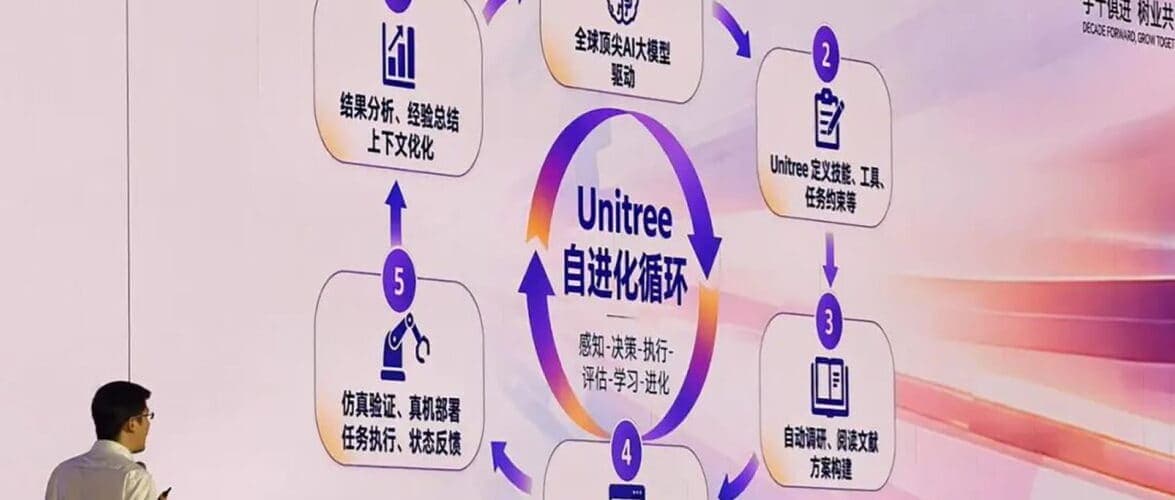
At Opentechwire, we've tracked dozens of robotics ventures across Shenzhen, Shanghai and Hangzhou over the past three years. Most still rely on periodic model updates pushed by engineering teams. Unitree's claim to continuous, self-directed improvement represents a departure: the system is designed to identify performance gaps, generate training scenarios and integrate new behaviours into production models without waiting for a software release cycle. If the architecture works at scale, it compresses the iteration loop from months to days.
A Partner Ecosystem for Physical Intelligence
Unitree announced plans to incubate more than 200 partner companies over the next five years, a strategy that distributes application development across a network rather than concentrating it inside a single corporate lab. The partner summit held in Hangzhou marked the first such gathering in the company's ten-year history, signalling a shift from hardware-focused product launches to platform thinking.
The incubation model is straightforward: partners receive access to Unitree's robot platforms and the self-improving AI stack, then build vertical applications for logistics, hospitality, healthcare or domestic tasks. Unitree retains the foundational control layer while partners optimise for domain-specific edge cases. This division of labour mirrors how Nvidia distributes CUDA across thousands of developers, except the output is physical behaviour rather than rendered pixels or language tokens.
China's robotics sector has seen similar ecosystem plays from companies including Agile Robots and UBTECH, but most partnerships remain transactional, limited to hardware supply agreements. Unitree's incubation commitment, if executed, implies deeper integration: shared roadmaps, co-investment and joint liability for field performance. The risk is fragmentation; the upside is faster coverage of use cases than any single team could achieve.
Why Homes Remain the Hardest Deployment
Wang's target of household deployment by late 2026 or 2027 is ambitious because domestic environments present the widest variance in layout, objects, lighting and human behaviour. Industrial robots operate in structured spaces with known object libraries and predictable workflows. Warehouses deploy autonomous mobile robots on marked lanes with centralised traffic control. Homes offer none of that structure.
At Opentechwire, we've observed that the companies making progress in home robotics share three technical bets: multimodal perception that fuses vision, touch and audio; reinforcement learning loops that run locally rather than in the cloud to reduce latency; and graceful failure modes that prioritise safety over task completion. Unitree's self-improving AI must handle all three, and the system must do so without requiring every household to become a supervised training ground.
The economic case for home robots also remains unproven. Consumers tolerate robot vacuum cleaners because the task is narrow and the failure mode is benign. A general-purpose robot that folds laundry, retrieves objects and assists with meal preparation crosses into a higher expectation band, where a single clumsy mistake can erode trust. Unitree's timeline implies confidence that its AI can cross that threshold within 14 months.
The Conference Signal
The World Physical AI Conference and Unitree Partner Ecosystem Summit brought together hardware developers, AI researchers and application builders in Hangzhou, a city that has emerged as a centre for robotics manufacturing alongside Shenzhen. The conference format itself indicates where the industry believes value will accrue: not in proprietary hardware alone, but in the orchestration layer that connects sensors, actuators, models and external partners.
Wang's public assertion that artificial intelligence remains underestimated is notable given the scale of capital already flowing into AI infrastructure across Asia and North America. His argument appears to rest on a distinction between statistical models that generate text or images and embodied systems that manipulate the physical world under real-time constraints. The former has seen rapid commoditisation; the latter still lacks a dominant architecture.
Unitree's approach, centred on autonomous learning and distributed application development, tests whether a regional player can establish a platform standard before larger technology conglomerates converge on the home robotics market. The next 14 months will clarify whether the firm's timeline is realistic or whether household deployment requires another iteration cycle beyond 2027.
What Continuous Learning Demands
Building an AI system that improves itself in production raises a set of engineering challenges distinct from training a fixed model in a data centre. The system must log edge cases, generate synthetic training data that captures the failure mode, retrain a model subset without destabilising existing behaviours, validate the updated model in simulation, then deploy it to hardware, all while the robot continues operating.
This pipeline requires on-device compute sufficient for inference and lightweight training, robust telemetry to capture context around failures, and a simulation environment accurate enough that behaviours learned in software transfer reliably to hardware. Unitree has not disclosed the specifics of its compute stack or simulation fidelity, but the timeline implies that much of this infrastructure is already operational.
The regulatory dimension also looms. A robot that modifies its own behaviour in the field without explicit human approval introduces questions about liability when something goes wrong. If a self-improved model causes property damage or injury, responsibility could fall on the manufacturer, the operator or the AI system itself, depending on jurisdiction. China's draft regulations on algorithmic accountability and the European Union's AI Act both touch on autonomous systems, but neither provides clear guidance for embodied AI that learns continuously in private spaces.
Platform Economics and the Race to Volume
Unitree's partner incubation strategy reflects a broader calculation: that the first company to achieve meaningful deployment volume in home robotics will set the de facto standard for APIs, sensor suites and actuator interfaces. This dynamic played out in mobile operating systems, cloud infrastructure and, more recently, large language model APIs. Physical AI platforms are likely to follow the same path, where early volume creates network effects that make it costly for developers to switch.
The 200-company target over five years translates to roughly 40 new partners per year, a pace that requires a streamlined onboarding process, comprehensive documentation and responsive technical support. It also requires that Unitree's hardware and AI stack are stable enough that partners can build on them without constant breaking changes. Achieving that balance between rapid internal iteration and external API stability is a recurring challenge for platform companies.
If Unitree reaches household deployment at scale, it will join a small group of robotics firms that have moved beyond pilot programmes and research demonstrations into sustained consumer or enterprise use. That group currently includes iRobot in floor care, a handful of warehouse automation providers, and a growing number of delivery robots operating in defined urban zones. Expanding that list to include general-purpose home robots would mark a significant shift in the embodied AI landscape, one that other firms across Seoul, Tokyo, Beijing and Silicon Valley are racing to achieve.