Chinese Humanoid Makers Push Into South Korean Factories
As Seoul commits fresh capital to physical AI, manufacturers from across the border are moving past pilot stages into commercial trials on production floors.
From Show Floor to Factory Floor
A wave of humanoid platforms built in Shenzhen, Shanghai and Hong Kong is arriving on South Korean production lines, no longer content with trade-show appearances. UBTech Robotics, Anyverse Dynamics and a cluster of mainland start-ups have begun pitching factory operators in Seoul, Incheon and Ulsan on machines that walk upright, manipulate objects with articulated hands, and promise flexibility conventional industrial arms cannot match.
At Opentechwire, we have tracked the rhetoric around humanoid robotics for three years. What marks this moment is the shift from choreographed demonstrations to environments where downtime costs money. South Korean manufacturers, facing labour shortages in welding, assembly and logistics roles, are running trials that will determine whether bipedal form factors justify their premium over wheeled autonomous mobile robots or collaborative arms already deployed at scale.
The timing reflects Seoul's policy pivot. South Korea's Ministry of Trade, Industry and Energy allocated 560 billion won in the current fiscal year for physical AI infrastructure, a category that includes humanoid platforms, embodied vision systems and edge inference hardware. That budget sits alongside 1.2 trillion won in tax incentives for firms adopting advanced automation, creating a pull strong enough to attract vendors who six months ago were still refining gait stability in laboratory settings.
Why Chinese Vendors See an Opening
South Korea operates one of the world's highest robot densities, with 932 units per 10,000 manufacturing employees according to the International Federation of Robotics. Yet the installed base skews heavily towards fixed-position industrial robots from ABB, Fanuc and Yaskawa. Humanoid makers argue that bipedal designs can navigate facilities built for human workers without costly retrofits, a pitch that resonates in older plants where floor space is constrained and conveyor layouts cannot easily be redesigned.
Chinese manufacturers bring two advantages: aggressive pricing and iterative development cycles honed in the Pearl River Delta and Yangtze River corridors. UBTech's Walker S model, which stands 170 centimetres tall and carries a 15-kilogramme payload, entered mass production in Shenzhen earlier this year with a price point below 200,000 US dollars per unit. That undercuts the cost of reconfiguring a production cell around a traditional six-axis arm when factoring in integration labour and downtime.
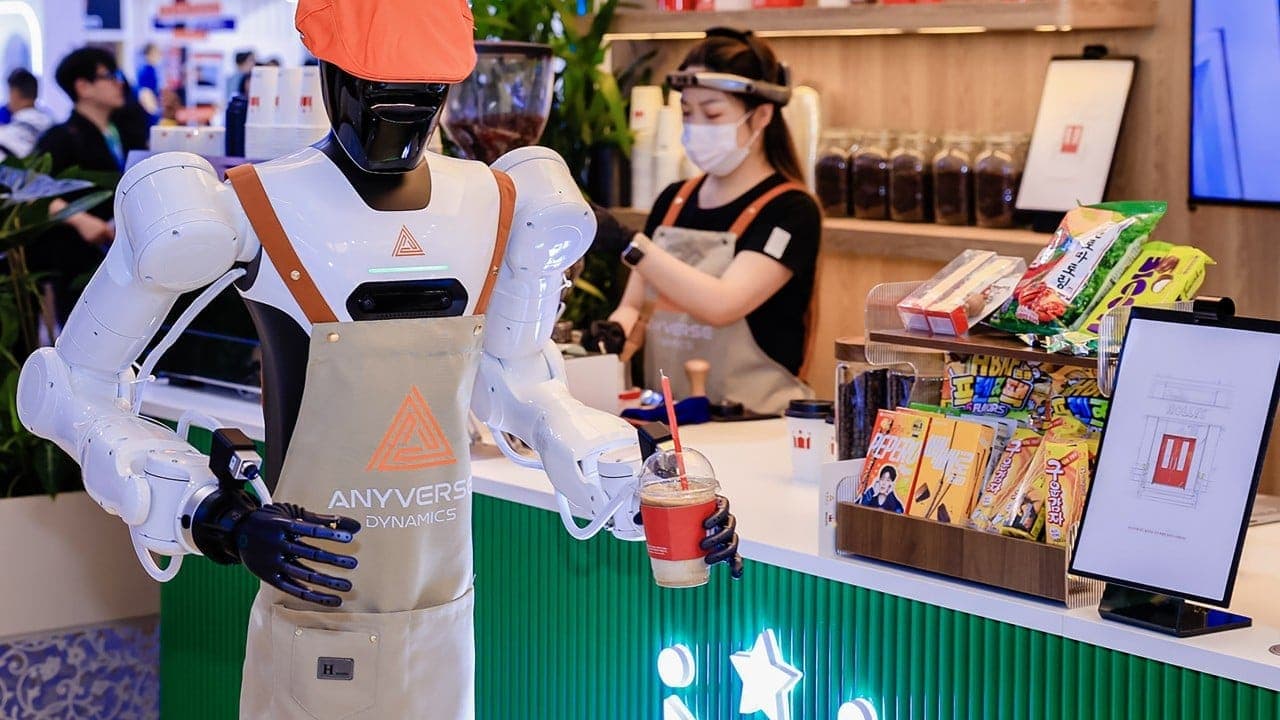
Anyverse Dynamics, a two-year-old firm headquartered in Hangzhou, has adopted a different model: leasing humanoid units on monthly contracts that include over-the-air software updates and predictive maintenance telemetry. The company's H1 platform uses a modular torso architecture, allowing operators to swap gripper assemblies or vision modules between shifts. Three South Korean automotive suppliers are currently testing H1 units in sub-assembly roles, handling tasks such as cable routing and snap-fit connector installation that require dexterity but not the precision of a robotic arm.
The Technical Hurdles That Remain
Despite the momentum, humanoid platforms in factory environments still confront limitations that wheeled robots and fixed arms do not. Battery endurance remains a binding constraint: most bipedal models operate for four to six hours under load before requiring a recharge cycle, compared with eight-hour or longer shifts for autonomous mobile robots. Gait stability on uneven surfaces or oil-slicked floors, common in machining and metalworking plants, is another area where performance lags marketing claims.
Latency in real-time decision-making is a third challenge. Humanoid robots rely on vision transformers and multi-modal models to interpret unstructured environments, but inference at the edge introduces delays that can exceed 200 milliseconds when processing high-resolution depth maps. For pick-and-place operations in controlled settings that latency is tolerable; for tasks requiring reactive adjustments, such as handling moving conveyor belts or collaborating with human workers in shared spaces, it creates safety and throughput risks.
South Korean integrators we have spoken with note that Chinese vendors often arrive with impressive laboratory benchmarks but underestimate the reliability standards required in continuous production. A humanoid unit that achieves 98 per cent uptime in a pilot trial may still fall short of the 99.5 per cent threshold many manufacturers demand, particularly in high-mix, low-volume assembly where changeovers are frequent and margins are thin.
Seoul's Broader Embodied AI Strategy
The South Korean government's interest in humanoid robotics extends beyond manufacturing. The Ministry of Science and ICT has earmarked funding for deployments in logistics warehouses, construction sites and eldercare facilities, sectors where labour shortages are acute and the cost of automation has historically been prohibitive. Physical AI, a term that encompasses robots capable of learning from demonstration and adapting to novel tasks without reprogramming, is framed in policy documents as a national competitiveness priority alongside semiconductor fabrication and battery technology.
This policy environment has opened doors for Chinese vendors who might otherwise face regulatory friction. South Korea's foreign direct investment screening process, tightened in recent years for semiconductor and telecommunications deals, remains more permissive for robotics. UBTech and Anyverse Dynamics have established Seoul-based subsidiaries, hired local engineering talent, and partnered with South Korean universities on joint research programmes, moves that position them as regional operators rather than purely external suppliers.
Yet the same policy framework imposes constraints. Export control measures introduced by the United States on advanced AI accelerators have indirect effects on humanoid development, as training large vision-language models and running inference at scale require access to high-performance compute. Chinese robotics firms have increasingly turned to domestic chip designs from vendors such as Cambricon and Horizon Robotics, but performance per watt still trails Nvidia's latest embedded platforms, a gap that matters when power budgets are tight and thermal envelopes are constrained.
What the Trials Will Reveal
The next twelve months will test whether humanoid form factors can move beyond niche applications into volume deployments. South Korean manufacturers are pragmatic buyers; they will assess total cost of ownership, not just unit price, and compare humanoid platforms against proven alternatives such as collaborative robot arms from Universal Robots or autonomous mobile robots from companies including Geek+ and MiR.
For Chinese vendors, success in South Korea offers validation in a market known for demanding standards and sophisticated buyers. A reference installation at a Hyundai or Samsung supplier carries weight in sales conversations across Southeast Asia and Europe. Conversely, high-profile failures, such as units that cannot meet cycle time requirements or that introduce safety incidents, will reinforce scepticism that humanoid robots remain a solution in search of a problem.
At Opentechwire, we see this chapter as part of a broader pattern: hardware companies from China leveraging manufacturing scale and iterative speed to enter markets where incumbents have grown complacent or where greenfield opportunities exist. Whether that pattern holds for humanoid robotics will depend less on the elegance of bipedal locomotion and more on whether these machines can perform reliably, day after day, in environments where novelty is a liability and uptime is everything.