Nvidia's Board Structure Under Scrutiny as Succession Questions Mount
The chip maker's unusual governance model and long-tenured directors highlight the absence of a clear path beyond its founder-CEO
An Outlier in Corporate Governance
Nvidia stands alone among the hundred largest US companies by market capitalisation in operating without a designated board chair. Data compiled by law firm Fenwick in 2025 identified only one S&P 100 constituent lacking this role, and Nvidia's own regulatory disclosures confirm it is that company.
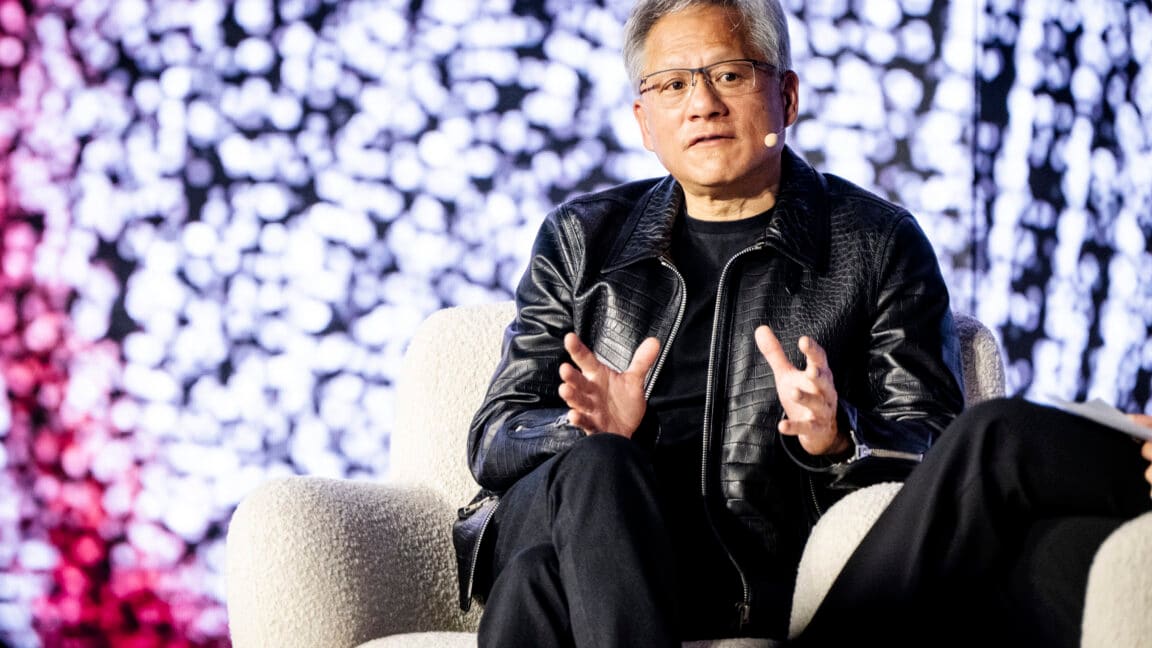
The structure centres authority around Jensen Huang, who serves as chief executive and sits among ten board members with no formal hierarchy above him. In proxy statements filed with regulators, Nvidia defends the arrangement as one that "ensures that each member has an equal voice in the affairs and management" of the organisation. Yet the absence of a chair concentrates decision-making power in ways uncommon at firms of comparable scale and strategic importance.
The question of what happens when Huang eventually steps aside has become more pressing as the company's valuation has climbed past two trillion US dollars on the strength of its AI accelerator sales. Succession planning at technology firms often stumbles when founders remain deeply embedded in product strategy and customer relationships, and Nvidia's board composition offers few signals about a transition path.
A Board Shaped by Longevity and Loyalty
Beyond Huang, the board comprises nine outside directors. Four of them have served since the 1990s, a tenure that predates the company's pivot into AI infrastructure and its emergence as the dominant supplier of training hardware for large language models. Continuity can preserve institutional knowledge, but decades-long service can also insulate boards from fresh perspectives on risk and strategy.
The roster includes Diana Neal, who joined in 2019 and previously led law firm Cooley as chief executive from 2001 to 2008; she now holds the title of chair emeritus and senior counsel at that firm. Other directors include a former Taco Bell executive, a professor specialising in aeronautics, and a former Goldman Sachs executive who joined the board only in 2026. The blend of backgrounds is eclectic, and it is unclear which member possesses the technical fluency or operational experience to guide Nvidia through a leadership handover in the fast-evolving semiconductor sector.
Observers in Silicon Valley have noted that the board's public communications tend to emphasise confidence in Huang rather than articulating contingency plans. Following a recent controversy involving the chief executive, the board issued a statement expressing "confidence in Jensen and his leadership team" and asserting it had "no reason to believe that either national security or Nvidia secrets were compromised." The phrasing focused on reassurance rather than governance process, a pattern that reflects the board's reactive posture.
The Fiduciary Frame and Delaware Law
Nvidia is incorporated in Delaware, the US state whose corporate law sets the standard for fiduciary obligations. Directors and officers owe duties of care and loyalty to the company, requiring them to act in its best interests and avoid conflicts that could compromise judgement. Nvidia's own code of conduct instructs executives to "conduct themselves with the highest degree of integrity, ethics and honesty," noting that "credibility and reputation depend upon their good judgment, ethical standards and personal integrity."
The legal framework is clear, but enforcement depends on shareholder action or board initiative. In practice, boards at founder-led technology companies often defer to the chief executive, especially when financial performance remains strong. Nvidia's revenue growth and gross margins have insulated leadership from the scrutiny that might accompany stagnation or competitive erosion.
Some venture investors have argued publicly that Huang's strategic value to Nvidia outweighs governance concerns. Doug Maguire, a partner at Sequoia Capital, commented that while missteps warrant criticism, the industry should not "nuke our AI industry" over incidents that may involve geopolitical intelligence operations. The framing casts governance questions as secondary to national and sectoral interests, a view that prioritises continuity over accountability.
Succession in the Semiconductor Industry
Nvidia's predicament mirrors challenges faced by other semiconductor firms where technical founders have remained at the helm for decades. Advanced Micro Devices transitioned from Jerry Sanders to Hector Ruiz in 2002, then to Rory Read in 2011, and finally to Lisa Su in 2014, a sequence that involved multiple false starts and market-share losses. Intel's repeated leadership changes since the departure of Paul Otellini in 2013 have coincided with manufacturing delays and strategic drift.
Successful handovers in the sector often involve years of grooming an internal successor with deep product knowledge and customer credibility. Taiwan Semiconductor Manufacturing Company structured a gradual transition from Morris Chang to C.C. Wei, with Wei serving in senior operational roles for more than a decade before assuming the chief executive position in 2018. Nvidia has not publicly identified an heir apparent, and the board's composition suggests limited urgency in preparing for that eventuality.
Madison Huang, Jensen Huang's daughter, holds a senior director role in product marketing and has appeared at company conferences in recent quarters. Her increased visibility has prompted speculation about family succession, though Nvidia has made no formal announcements and such a path would be uncommon among publicly traded US technology firms. She cancelled a scheduled appearance at a company event in South Korea following the recent controversy, a move that underscored the overlap between corporate and personal dynamics at the firm.
The Risk of Concentration
Nvidia's reliance on a single executive for strategic vision, customer relationships, and technological direction creates fragility. Hyperscale cloud providers and AI labs have built their infrastructure roadmaps around Nvidia's product cycles, and any uncertainty about leadership continuity could prompt customers to diversify supplier relationships or accelerate internal chip development.
Competitors including AMD and new entrants backed by cloud giants are investing heavily in AI accelerators designed to challenge Nvidia's architectural dominance. A protracted succession struggle or an abrupt departure could hand those rivals an opening to gain design wins that prove difficult to reverse.
The board's current structure offers no clear mechanism for managing such a transition. Without a chair to coordinate director input or a visible succession committee, the process would likely unfold in reactive mode, shaped by external pressure rather than deliberate planning. For a company whose market capitalisation exceeds the GDP of most nations, that gap represents a governance risk that institutional investors are beginning to scrutinise more closely.
Nvidia's next proxy filing, expected in early 2027, will offer a window into whether the board intends to address these questions or continue to rely on the assumption that Huang's tenure is indefinite.