Meta's Muse Spark Open Brings 816-Billion-Parameter Inference to Desktop
The open-weight model targets local Mac deployment with multimodal capabilities, but demands 1 TB of RAM and reflects Meta's bet on edge inference for agentic workflows.

A Frontier Model Built for the Desktop
Meta unveiled Muse Spark Open on Thursday, positioning it as the most capable open-weight model currently available in the United States. The release is notable not just for its scale - 816 billion parameters and a 1 million token context window - but for its explicit design around local deployment on Apple hardware, according to Meta.
The move reflects a broader industry tension: as frontier models grow larger and more capable, their computational demands threaten to keep them locked inside data centres. Meta's approach with Muse Spark Open tests whether parameter-efficient architectures and hardware-specific optimisation can push that boundary back toward the edge, at least for organisations willing to invest in high-end workstations.
The model is natively multimodal, handling text, code, and visual inputs without needing separate processing pipelines. Meta claims it outperforms other open-weight models across coding benchmarks and agentic task completion, though the company has not yet published independent third-party evaluations.
The Hardware Hurdle
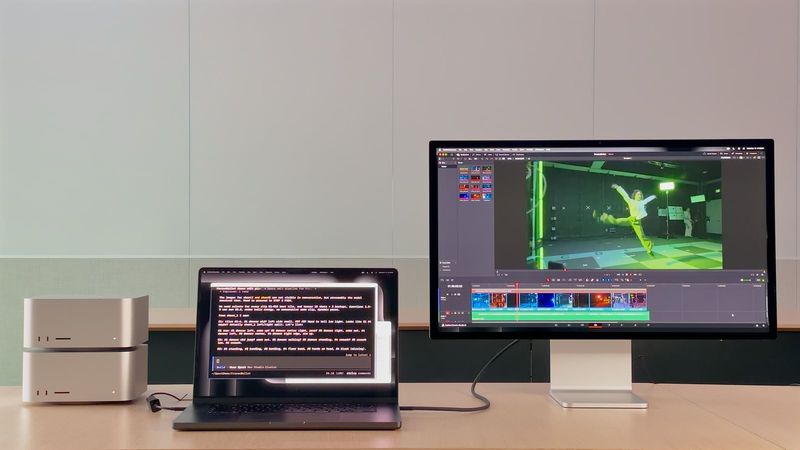
Local deployment comes with a steep entry cost. Muse Spark Open requires at least 1 terabyte of RAM to run, a specification that limits its use to a narrow slice of Apple's product range. Meta recommends the Mac Studio equipped with the M5 Ultra chip, which supports the necessary memory configuration.
That hardware threshold places Muse Spark Open out of reach for individual developers or smaller studios operating on standard laptop configurations. The 1 TB requirement suggests the model's weights and inference overhead push well beyond what current consumer-grade unified memory architectures can comfortably handle, even with quantisation or other compression techniques.
For enterprises already invested in Apple's professional workstation ecosystem, the proposition is different. Studios handling video production, software engineering teams running complex build environments, or design shops needing multimodal reasoning locally may find the trade-off worthwhile - particularly if data residency or latency constraints make cloud inference unworkable.
Agentic Workflows in Practice
Meta paired Muse Spark Open with Muse Code, its AI-assisted coding terminal, to demonstrate agentic capabilities. The company deployed the model in workflows that included debugging and feature development for a Mastodon client, completing tasks that spanned bug fixes, new feature implementation, and full build processes, according to Meta.
In another test case, Meta used the model to control DaVinci Resolve, the professional video editing suite. The model reviewed footage and executed cropping operations, tasks that require understanding both visual content and the software's command structure.
These examples signal Meta's intended use case: long-running, multi-step workflows where the model acts semi-autonomously within a desktop environment, rather than serving single-turn queries. The 1 million token context window supports this pattern, allowing the model to retain substantial project state across extended sessions.
At Opentechwire, we have tracked a growing interest in agentic systems that operate outside centralised cloud environments, particularly in jurisdictions with strict data localisation rules or industries handling sensitive intellectual property. Muse Spark Open's architecture appears designed for exactly those scenarios, though its hardware demands may limit adoption velocity.
Open Weight, Closed Ecosystem
Meta is releasing Muse Spark Open under an open-weight licence, meaning developers can download the model's parameters and run inference locally or via third-party infrastructure. The company is making it available through multiple API platforms, though it has not specified which providers will host the model or what pricing structures will apply.
Open-weight models offer cost advantages over proprietary alternatives, especially at scale. Organisations running high-volume inference workloads can avoid per-token pricing by self-hosting, and they gain the ability to fine-tune models on proprietary datasets without exposing that data to external vendors.
Transparency is another cited benefit: developers can inspect model behaviour, audit outputs, and modify architectures in ways closed systems prohibit. For industries operating under regulatory scrutiny - finance, healthcare, legal - this auditability can be a prerequisite for deployment.
Yet the open-weight designation does not eliminate lock-in. Muse Spark Open's optimisation for Apple silicon creates a dependency on a single hardware vendor, and its memory requirements restrict deployment to a narrow product tier. The model's multimodal capabilities and agentic design also assume integration with Meta's own tooling, such as Muse Code, which may not be fully interoperable with competing development environments.
The Edge Inference Wager
Meta's release follows a pattern visible across the AI infrastructure landscape: major labs are experimenting with models designed for specific hardware platforms rather than generic cloud deployment. Google has pursued similar strategies with TPU-optimised models, and Anthropic has explored edge inference for latency-sensitive applications.
The rationale is partly economic. Cloud inference margins are under pressure as compute costs rise and competition intensifies. If Meta can shift a portion of inference workloads to customer-owned hardware, it reduces its own infrastructure burden while potentially expanding the addressable market to users unwilling to send data off-premises.
The strategy also hedges against regulatory fragmentation. As data sovereignty rules tighten across Asia and Europe, models that can run locally without transmitting data to US-based servers gain a compliance advantage. Meta's emphasis on desktop deployment may be as much about navigating those constraints as it is about performance.
But the approach carries risks. High hardware requirements slow adoption, and the install base for 1 TB Mac Studios remains small. If developers cannot access the model without significant capital expenditure, Meta's open-weight strategy may fail to generate the ecosystem momentum that made earlier Llama releases influential.
What the Benchmarks Do Not Show
Meta claims Muse Spark Open delivers superior performance compared to other open-weight models, citing internal evaluations released alongside the announcement. The company has not yet shared results from independent benchmarking organisations, nor has it disclosed which specific models it compared against or which tasks were included in the evaluation suite.
Industry observers have grown cautious about vendor-provided benchmarks, particularly for agentic and multimodal tasks where evaluation methodologies remain contested. A model may excel at synthetic coding problems while struggling with real-world debugging sessions that involve incomplete specifications or legacy codebases. Video editing benchmarks may test narrow operations - cropping, colour correction - without capturing the reasoning required to assemble a coherent narrative edit.
Muse Spark Open's true capabilities will become clearer as third-party developers begin stress-testing the model in production environments. Until then, Meta's performance claims remain unverified outside its own labs.
The Broader Open-Weight Calculus
Meta's investment in open-weight models represents a strategic divergence from competitors pursuing closed, API-only distribution. OpenAI, Anthropic, and Google's DeepMind unit have largely kept their frontier models proprietary, arguing that safety considerations and competitive dynamics justify restricted access.
Meta's counter-argument - articulated through multiple Llama releases and now Muse Spark Open - is that openness accelerates innovation, distributes AI capabilities more equitably, and reduces concentration risk. The company benefits from this stance by positioning itself as the infrastructure provider for developers unwilling to lock into closed ecosystems.
Yet the open-weight framing obscures certain realities. Training data, fine-tuning methodologies, and reinforcement learning processes remain opaque. The hardware optimisations that make Muse Spark Open viable on Mac Studios are presumably proprietary, limiting reproducibility. And Meta retains control over future model versions, updates, and licence terms.
The result is a hybrid model: more open than GPT-4 or Claude, but less open than truly community-governed projects. For developers prioritising flexibility and cost control, that may be open enough. For those seeking full transparency or independence from corporate roadmaps, it may not.
Deployment Realities
Organisations evaluating Muse Spark Open will need to weigh several trade-offs. The model's local deployment eliminates recurring API costs and data transmission risks, but front-loads capital expenditure and operational complexity. Running inference on-premises requires expertise in model serving, memory management, and hardware maintenance - capabilities not all teams possess.
The Mac-specific optimisation also creates platform risk. If Apple's silicon roadmap shifts, or if competing hardware vendors offer better price-performance, early adopters may find themselves stranded on an architecture that no longer receives priority support. Meta has not indicated whether it plans to release versions optimised for other platforms, such as Nvidia GPUs or custom AI accelerators.
For now, Muse Spark Open occupies a narrow but potentially valuable niche: teams with the budget for high-end Apple workstations, workflows that benefit from agentic multimodal reasoning, and constraints that make cloud inference untenable. Whether that niche is large enough to justify Meta's investment remains an open question.