Maven Robotics Closes $100M to Scale Warehouse Automation Without the Research Lab Mystique
A startup founded by Apple special-projects veterans is betting that industrial pragmatism, not model innovation, will win the physical AI race in logistics
The Pitch That Beat Four Rivals With a Cartoon
In early 2024, Maven Robotics existed as little more than a concept sketch and a founding team. When co-founder Hamza Derbas learnt that a large consumer goods company was in town evaluating four established robotics vendors for a warehouse automation contract, he secured a last-minute meeting. Instead of presenting technical specifications or demonstrating hardware that did not yet exist, Derbas proposed factory visits. The team spent time observing material flows, labour bottlenecks, and the reality of how goods moved from inbound pallets to outbound trucks. Maven won the contract, displacing competitors with shipping products.
That origin story captures the operational philosophy Maven is now scaling with a $100 million funding round led by RoboStrategy, LocalGlobe, Vine Ventures, and XTX Markets Ventures. The capital will fund production of 250 third-generation robots and design work on a fourth platform. At Opentechwire, we have tracked similar deployment-first strategies among Asia-Pacific robotics startups, but Maven's trajectory stands out for its deliberate avoidance of the research lab narrative that dominates physical AI discourse in Silicon Valley and Shenzhen alike.
After two years of operation with that initial customer and a handful of other partners, Maven now runs as many as eight robots in live facilities, each working 16-hour shifts with uptime exceeding 99 per cent. The company has emerged from stealth with a clear thesis: industrial robotics will be won not by the team with the most sophisticated foundation model, but by the one that solves specific, high-value workflows reliably enough to justify capital expenditure.
A Wheeled Platform Built for Mixed Palletisation
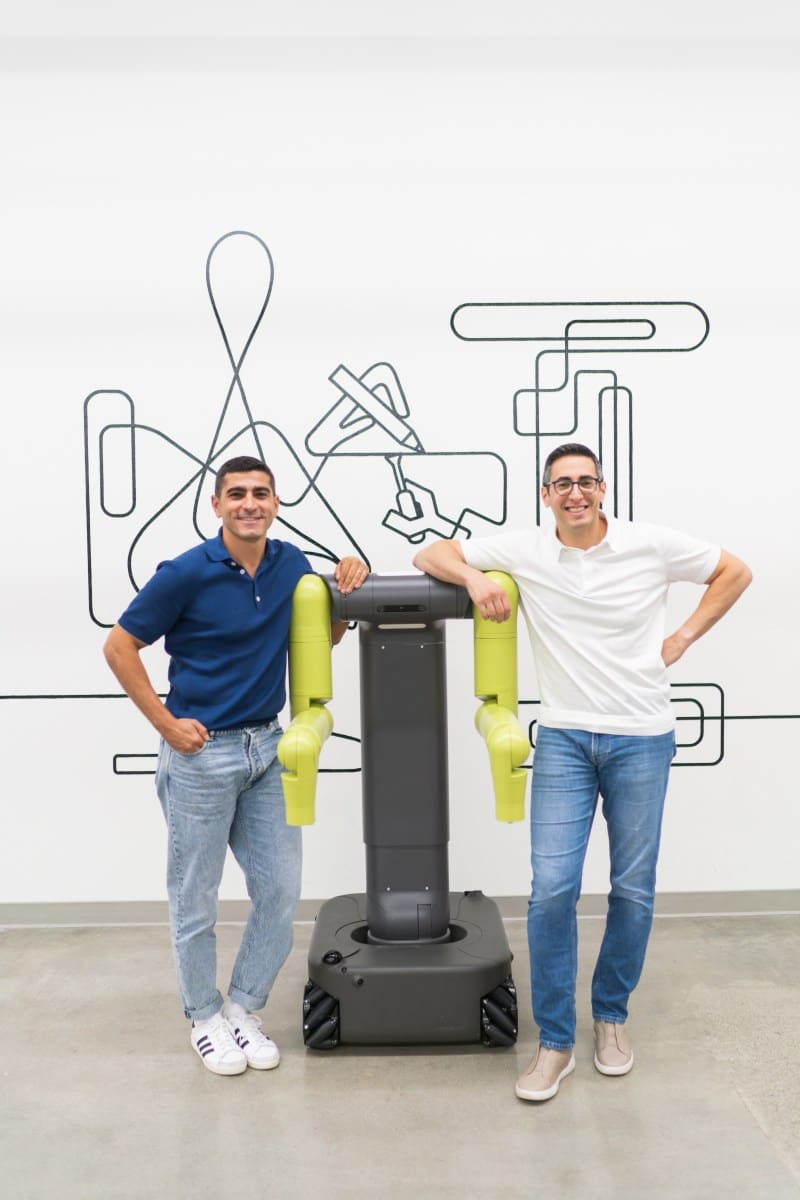
Maven's current hardware sits on a wheeled base capable of moving at 10 miles per hour, fitted with two articulated arms that can each lift 30 kilograms. The primary application is mixed palletisation, a logistics task that remains almost entirely manual across the consumer goods supply chain. Pallets carrying uniform product loads arrive at distribution centres from factories; Maven's robots disassemble and recombine them into mixed pallets tailored to individual retail locations based on near-real-time demand signals.
The workflow requires speed, precision, and adaptability. Retail demand forecasts shift within 48-hour windows, and distribution centres must respond by assembling orders that reflect current inventory priorities. Today, warehouse workers walk aisles pulling individual boxes to build these mixed loads. Maven's robots use vacuum suction to pick and place boxed goods, rearranging them on pallets at a pace that matches human throughput without fatigue or variability.
At Maven's Santa Clara facility, the training area demonstrates the platform in operation. A live video feed shows two robots working in a customer warehouse while employees move around them, a detail that underscores the startup's focus on safety and integration into existing labour environments. The robots are designed to coexist with human workers, not replace entire shifts overnight.
Automotive Pedigree and the Self-Driving Data Loop
Hamza Derbas spent most of his career in automotive engineering, with a concentration on electric vehicles, before joining Apple's special projects group. He worked there for nine years on initiatives widely understood to include the company's autonomous vehicle programme, which was disbanded in 2024. His brother Khalid, Maven's chief financial officer, comes from private equity. The combination of operational automotive experience and capital discipline shapes Maven's approach.
Like other physical AI companies emerging from stealth in 2025 and 2026, Maven draws heavily on talent and methods developed in the autonomous vehicle sector. Self-driving car programmes produced the most mature frameworks for training autonomous hardware from real-world data at scale. Maven has built data pipelines that return telemetry and performance logs from deployed robots within minutes to hours. Engineers retrain models, run ablation studies, adjust weights, and redeploy updated software in tight iteration loops.
This operational cadence mirrors the development cycles at Waymo, Cruise, and Chinese autonomous vehicle leaders such as Pony.ai and WeRide. The difference is application domain: Maven is applying those methods to structured indoor environments with defined material flows, rather than open roads with infinite edge cases. The result is faster convergence on reliable performance, though the trade-off is narrower generalisation.
Industrial Pragmatism Versus Research Culture
Jack Pearson, an investor at RoboStrategy who backed Maven's round, argues that the company's competitive edge lies in its industrial systems background rather than a research culture optimised for publication or architectural novelty. Maven's team prioritises return on investment, uptime, and integration with existing warehouse management systems. Those priorities shape hardware decisions, software architecture, and go-to-market sequencing.
The most directly comparable company in the market may be Agility Robotics, which is pursuing a $2.5 billion SPAC transaction this autumn. Agility also emphasises safety and specific industrial workflows, but its humanoid platform stands on two legs. Derbas is blunt in his assessment: bipedal robots introduce mechanical complexity, reliability risk, and cost without functional advantage for warehouse tasks. He stresses respect for Agility's engineering, but argues that return on investment determines adoption, and wheeled platforms with dual arms offer a better cost-to-capability ratio for mixed palletisation.
This is a live debate across the physical AI sector. Humanoid form factors are attracting significant venture capital in the United States, China, and South Korea, driven by the hypothesis that human-shaped robots can navigate environments designed for human workers without facility modification. Maven's position is that task-specific morphology, optimised for throughput and durability, will win in industrial settings where return on investment is measured in months, not years.
An $80 Billion Wedge, Then the Hard Problems
Mixed palletisation represents an estimated $80 billion addressable market globally, concentrated in consumer goods, food and beverage, and e-commerce logistics. Maven is treating it as a wedge, a large enough opportunity to build a sustainable business while accumulating the data and operational knowledge required to expand into adjacent tasks.
The next set of workflows the company is targeting will require manipulation capabilities that do not yet exist in production robotics. Maven plans to move from rigid boxed goods to deformable materials, then into assembly and light fabrication. Each step demands new perception models, grasp planning algorithms, and force control strategies. The company is building proprietary datasets, licensing third-party data, and experimenting with novel data collection methods, including a pair of pincer-shaped gloves that allow human operators to perform tasks using the same form factor Maven intends to deploy in robotic grippers.
This incremental, task-by-task strategy contrasts with the general-purpose robotics narrative that dominates fundraising decks and conference keynotes. Maven positions itself as a general-purpose platform, but the path to generality runs through a sequence of high-value, well-defined problems. Each solved workflow generates revenue, operational data, and customer relationships that fund the next stage of capability development.
The risk is that a frontier lab, whether in San Francisco, Beijing, or London, releases a physical foundation model that achieves broad manipulation competence without task-specific training. In that scenario, Maven's operational lead and customer base may not be defensible. Derbas acknowledges the possibility but frames Maven's strategy as orthogonal: the company is not competing to build the best model, but to solve industrial labour shortages at the scale and reliability industrial customers require.
What the Funding Round Signals
The $100 million raise is substantial for a robotics startup emerging from stealth, particularly one without a published research track record or high-profile academic founders. The investor base, RoboStrategy, LocalGlobe, Vine Ventures, and XTX Markets Ventures, reflects a mix of sector specialists and quantitative capital. The round's structure suggests confidence in Maven's operational metrics: uptime, throughput, and customer retention.
Maven plans to manufacture 250 third-generation robots, a volume that implies multiple customer deployments and the beginnings of economies of scale in hardware production. The company is also funding design work on a fourth-generation platform, indicating that hardware iteration remains central to its roadmap. This is a capital-intensive path, more aligned with automotive or industrial equipment businesses than software-driven AI companies.
The funding environment for robotics has been uneven across 2025 and 2026. Humanoid robotics companies have attracted significant attention, but deployment milestones have been sparse. Investors are beginning to differentiate between companies with compelling demonstrations and those with repeatable, revenue-generating operations. Maven's emphasis on uptime, return on investment, and integration with enterprise systems positions it in the latter category, a distinction that may matter more as the sector matures.
The Deployment-First Wager
Maven's strategy rests on a wager: that the path to general-purpose physical AI runs through specific, economically valuable tasks, not through research programmes aimed at broad capabilities from the outset. This mirrors the evolution of software AI, where large language models emerged from companies solving specific problems at scale, accumulating data and compute infrastructure along the way, rather than from pure research labs.
The counterargument is that physical AI is different. Manipulation, navigation, and force control in unstructured environments may require breakthroughs in perception and planning that only emerge from research programmes with broad mandates. If that proves true, Maven's operational lead may be transient, overtaken by a team that solves the generalisation problem directly.
For now, Maven is executing on the deployment-first thesis. The company has live robots, paying customers, and a funding base that supports scaling production. The next 18 months will test whether that operational foundation translates into defensible advantages as competition intensifies and model capabilities improve. At Opentechwire, we will be watching how Maven's data accumulation and customer relationships interact with the broader trajectory of physical foundation models, a dynamic that will shape not only warehouse automation but the structure of the physical AI sector across Asia and beyond.