Enflame's 188 Per Cent Trading Debut Highlights Investor Hunger for China AI Chip Plays
The Tencent-backed challenger to Nvidia completes a quartet of Chinese AI silicon makers to reach public markets, drawing intense retail and institutional backing despite US export restrictions.
A Tencent-Backed Chip Maker Joins the Public Arena
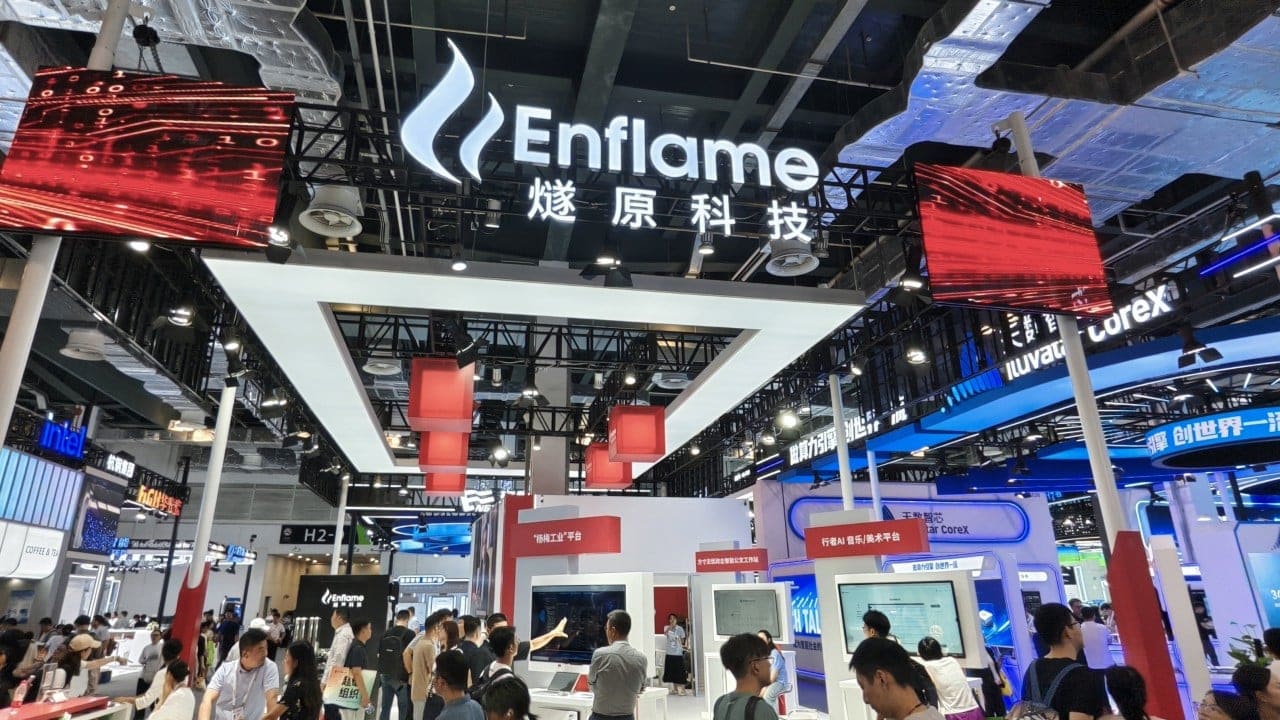
Enflame Technology opened trading on the Shanghai Stock Exchange on 11 September at 410 yuan per share, a 188 per cent premium over its initial public offering price of 142.18 yuan. By the close of the first session, the company carried a market capitalisation of 176.4 billion yuan (approximately 26.3 billion US dollars), cementing its position as the fourth major Chinese AI accelerator developer to go public in the past eighteen months.
The Shanghai-based firm, which counts Tencent Holdings among its strategic backers, had priced its offering at the top of the indicative range. Retail subscription was oversubscribed by a factor of more than 200 times, while institutional tranches closed nearly 90 times covered. That level of demand mirrors the reception afforded to Cambricon Technologies, Horizon Robotics, and Moore Threads when each debuted on mainland or Hong Kong boards between early 2025 and mid-2026.
At Opentechwire, we have tracked the capital flows into Chinese semiconductor ventures since Washington tightened export controls on advanced logic chips and fabrication equipment in October 2022. What began as a policy shock has evolved into a structural tailwind for domestic players: institutional allocators, both state-guided funds and commercial venture arms, now treat AI silicon as a strategic imperative rather than a speculative bet.
The Four Pillars of China's AI Silicon Landscape
Enflame's listing completes a cohort that Chinese industry observers informally call the "four pillars" of homegrown AI inference and training acceleration. Cambricon, founded in 2016 and listed on Shanghai's STAR Market since 2020, pioneered the category with its focus on data-centre training clusters. Horizon Robotics, which went public in Hong Kong in March 2025, carved out automotive and edge inference. Moore Threads, listed in Shenzhen in November 2025, straddles GPU computing for both graphics and machine-learning workloads.
Enflame occupies the middle ground. The company's flagship product line, the GCU (General Computing Unit) architecture, targets cloud inference at scale, competing directly with Nvidia's T4 and L4 generations in scenarios where model sizes remain under 70 billion parameters and latency budgets sit in the tens of milliseconds. According to Enflame's prospectus filed with the China Securities Regulatory Commission, the firm shipped approximately 14,000 accelerator cards in the twelve months ending June 2026, generating revenue of 1.87 billion yuan, up 112 per cent year on year.
That growth rate, while impressive, still leaves Enflame's unit volume an order of magnitude below Nvidia's China-compliant A800 and H800 shipments before those parts were themselves restricted in late 2023. The gap underscores a recurring theme across the four pillars: rapid improvement in design capability and ecosystem maturity, set against an installed base and software toolchain that remain narrow compared to the incumbent.
Capital as a Substitute for Time
The valuation that public-market investors assigned to Enflame on day one implies a forward price-to-sales multiple north of 140 times, assuming the company can sustain its recent revenue trajectory. By contrast, Nvidia trades at roughly 20 times forward sales, even after its own share price doubled over the past year.
The divergence reflects two distinct investor logics. Nvidia's multiple is anchored in proven profitability, manufacturing partnerships with TSMC at the three-nanometre node, and a CUDA software moat spanning fifteen years. Enflame's multiple is a wager on substitution: the belief that policy-driven demand, government procurement mandates, and Tencent-led cloud deployments will compress the natural adoption curve.
In practice, that substitution is already visible. Tencent Cloud has publicly committed to deploying Enflame GCU clusters for its Hunyuan large-language-model inference, a workload previously handled by Nvidia A100 and V100 cards. ByteDance, Alibaba Cloud, and Baidu have each run pilot programmes with one or more of the four pillars, though none has disclosed the scale or performance characteristics in detail.
What remains opaque is margin structure. Enflame's prospectus shows a gross margin of 38 per cent for the first half of 2026, down from 42 per cent a year earlier. The compression is attributed to higher wafer costs at SMIC's 14-nanometre process and price competition as the four players chase the same hyperscaler accounts. Operating margin sat at negative 12 per cent, a function of research-and-development spending that consumed 52 per cent of revenue.
That burn rate is sustainable only so long as equity and debt markets remain open. The 11 September listing raised 8.6 billion yuan in primary capital, giving Enflame a runway of roughly three years at current spend, assuming no further top-line growth. If revenue doubles again by 2027, the breakeven horizon shortens to late 2028. If it does not, the company will return to the market or seek strategic investment from one of its anchor customers.
The Policy Context: Export Controls as Industrial Policy
Enflame's trajectory is inseparable from the US Commerce Department's October 2022 rule restricting exports of chips with interconnect bandwidth above 600 gigabytes per second and certain computational-density thresholds. The rule, updated in October 2023 and again in December 2025, effectively closed off Nvidia's H100, H800, and subsequent Hopper and Blackwell generations from the Chinese market.
The immediate effect was a supply shock. Chinese hyperscalers, which had been stockpiling H100 cards through distributors in Singapore and Hong Kong, faced a choice: bid up prices on the grey market or accelerate qualification of domestic alternatives. Most chose both. By mid-2024, Enflame, Cambricon, and Horizon had each secured design wins at one or more of the top-five cloud providers. Moore Threads, with its GPU heritage, found traction in rendering farms and hybrid AI-graphics workloads.
The longer-term effect has been to shift the competitive bottleneck from hardware performance to software compatibility. Nvidia's CUDA remains the de facto standard for model training and fine-tuning; PyTorch and TensorFlow operators are written with CUDA intrinsics in mind. Enflame and its peers have invested heavily in compatibility layers - Enflame's TopsRider SDK, Cambricon's BANG, Horizon's Horizon AI - but coverage remains incomplete. Models that rely on custom kernels or low-level memory optimisations often require non-trivial porting effort, a friction that slows adoption among research teams and independent developers.
For Tencent, Alibaba, and ByteDance, that friction is manageable because they control both the infrastructure and the application layer. For smaller model builders and enterprise AI teams, it remains a meaningful hurdle. The result is a bifurcated ecosystem: large, vertically integrated players can absorb the switching cost, while the long tail of developers defaults to whatever hardware supports the least-friction workflow.
What the Debut Signals About Risk Appetite
The 188 per cent first-day pop is not, by itself, evidence of irrational exuberance. Chinese equity markets have a structural tendency toward day-one volatility because allocations in initial public offerings are capped and retail investors have limited access to pre-IPO pricing. When a stock is seen as strategically important - AI chips, electric-vehicle batteries, renewable-energy storage - the cap becomes a ceiling that price discovery breaks through immediately.
Still, the magnitude of the move, and the fact that it occurred in a week when the Shanghai Composite Index fell 1.2 per cent, suggests that investors are treating Enflame less as a semiconductor company and more as a proxy for two macro themes: China's drive toward technological self-reliance and the belief that AI infrastructure spending will remain elevated regardless of broader economic conditions.
Both themes carry risks. Self-reliance is a policy goal, not a commercial moat; if US export controls were relaxed, the price umbrella that shelters Enflame would collapse. AI infrastructure spending, while robust today, is heavily concentrated among a handful of hyperscalers whose own capital-expenditure budgets are sensitive to revenue growth in cloud services and advertising. A slowdown in either would ripple directly into accelerator demand.
Enflame's management, in its prospectus, acknowledges both dependencies. The company describes its customer concentration - Tencent, Alibaba, and Baidu together accounted for 68 per cent of 2025 revenue - as a near-term risk and pledges to expand into financial services, telecommunications, and autonomous-vehicle inference. Whether those verticals can absorb meaningful volume at similar margins remains to be seen.
The Competitive Dynamics Among the Four
The listing also sharpens the competitive picture within the four-pillar cohort. Cambricon, as the earliest mover, has the most mature software stack and the deepest relationships with research institutions and government labs. Horizon has carved out automotive, a segment with long design cycles but high switching costs once qualified. Moore Threads has GPU-native architecture, which gives it an edge in mixed workloads but limits differentiation in pure inference.
Enflame's pitch is balance: GCU architecture that is flexible enough to handle both training and inference, a software layer that prioritises PyTorch compatibility, and Tencent as both investor and anchor customer. That balance is also a vulnerability. The company is not the fastest in training, not the most efficient in edge inference, and not the most compatible in software. It is competitive in all three, but领先 in none.
In a market with unlimited demand, that would be sufficient. In a market where hyperscaler budgets are finite and performance per watt matters, the middle position is precarious. Enflame's ability to sustain its valuation will depend on its ability to either dominate a specific workload category or achieve cost parity with Nvidia's older generations while maintaining software compatibility.
Neither is assured. SMIC's 14-nanometre process, while adequate for current designs, lags TSMC's three-nanometre and five-nanometre nodes in both performance and power efficiency. Moving to seven nanometre, which SMIC has in pilot production, would narrow the gap but introduce yield and cost uncertainties. Software compatibility, meanwhile, is a moving target; every new release of PyTorch or TensorFlow introduces operators and optimisations that require corresponding updates in Enflame's SDK.
Looking Ahead: A Market Shaped by Policy, Not Just Technology
The Enflame debut is a milestone, but not an endpoint. The company now faces the quarterly scrutiny of public markets, where revenue growth, margin expansion, and customer diversification will be tracked with the same intensity that drove the first-day rally.
For the broader Chinese AI silicon sector, the listing completes a chapter. The four pillars are now all public, all capitalised, and all under pressure to prove that policy support can translate into durable commercial advantage. The next chapter will be written not in prospectuses or trading floors, but in data centres, where performance, power, and software maturity determine which cards get deployed at scale and which remain on the qualification roadmap.