IBM Bets on Dual-Chip Architecture to Scale Quantum Computing Beyond 500 Qubits
The US computing giant is abandoning its 2026 multi-processor target while doubling down on reset hardware that accelerates gate operations nineteen-fold, signalling a pivot from qubit count to operational throughput.
A Strategy Shift in Quantum Hardware Development
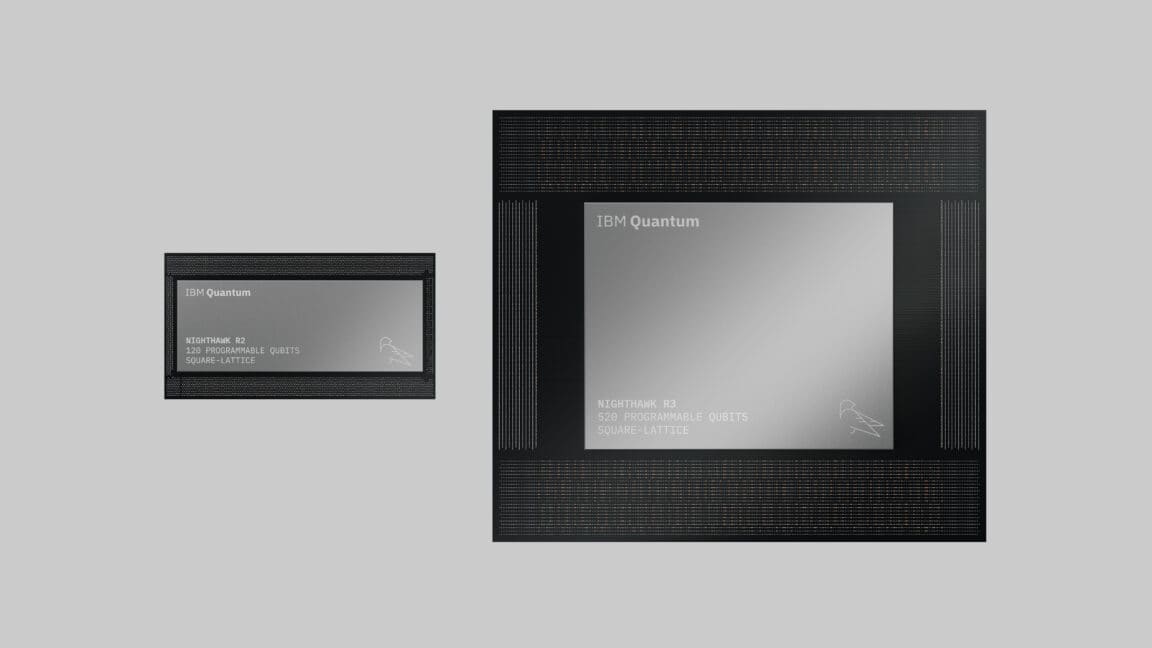
IBM has quietly revised its quantum computing roadmap, postponing plans to link multiple processors whilst investing heavily in hardware that resets qubits between operations. The company's latest Nighthawk r2 system, deployed in September, delivers what IBM describes as a substantial performance improvement despite maintaining the same 120 programmable qubit configuration as its predecessor. The acceleration comes not from adding computational capacity but from dedicating 458 physical qubit-like structures on each chip to manage energy dissipation and state preparation.
The approach reflects a broader recalibration in the industry. Where previous roadmaps emphasised scaling qubit counts through interconnected processors, IBM now appears focused on extracting maximum throughput from single chips before attempting the technically demanding work of chaining them together. The company had originally projected a 360-qubit machine for 2026, built by linking three Nighthawk processors. That milestone has been deferred, with no public timeline offered for when multi-chip systems will become available to customers.
Why Speed Matters More Than Qubit Count
Quantum algorithms impose strict time constraints. Qubits are fragile: they lose coherence within microseconds or milliseconds, depending on the technology. Every operation that takes longer eats into the window during which computation remains valid. For years, the race focused on adding more qubits to tackle larger problems. Yet without faster gate operations, those additional qubits remain underutilised, their states decaying before algorithms can complete.
IBM's engineering response has been to embed what the company internally calls dissipative reset gadgets alongside every programmable qubit. Oliver Dial, a vice-president overseeing quantum systems at IBM, explained that these auxiliary structures rapidly extract energy from computational qubits, returning them to the ground state. The process is not required after every gate, but when invoked it can accelerate certain sequences by a factor of up to nineteen, according to IBM's internal benchmarks.
The trade-off is stark. The Nighthawk r2 chip contains 458 physical qubit structures, yet only 120 are programmable. The remainder serve purely as reset mechanisms, occupying silicon real estate and fabrication complexity without contributing directly to computational power. It is an engineering bet that throughput, not raw qubit count, will determine which quantum systems prove useful first.
The 2027 Target and What It Reveals
IBM's roadmap for Nighthawk r3, expected in 2027, calls for 520 programmable qubits whilst retaining the reset architecture. If the ratio of programmable qubits to auxiliary devices holds constant, the chip will house approximately 2,000 individual qubit-like structures. That would make it the largest quantum processor IBM has fabricated to date, roughly double the physical scale of anything the company has shipped.
The timeline is revealing. IBM had previously indicated that each generation would increase the number of gate operations executable before error rates became prohibitive, with a target of 10,000 operations for 2027. The company has not published updated figures, but the continued investment in reset hardware suggests that operational depth remains the priority. Error correction, the long-term goal that will eventually require chaining many chips together, remains a future phase.
The deferral of multi-chip integration also hints at unresolved technical challenges. Linking quantum processors requires maintaining coherence across physical boundaries, synchronising control signals, and managing entanglement between chips. These are well-understood problems in principle, but executing them at the fidelity required for useful computation has proven difficult. By concentrating on single-chip performance, IBM buys time to refine those techniques without committing to a product that might underdeliver.
Regional Implications for Quantum Access
IBM's quantum systems are accessible via cloud infrastructure, and usage patterns have increasingly shifted toward Asia-Pacific research institutions and enterprises. Universities in South Korea, Japan, and Singapore have published work using IBM's Quantum Network, often focusing on optimisation problems relevant to logistics, materials science, and financial modelling. The shift toward faster gate operations rather than larger qubit counts may influence which algorithms those groups prioritise.
For example, variational algorithms, which iterate many times between quantum and classical processors, benefit directly from faster reset times. Each iteration completes sooner, allowing researchers to explore more parameter configurations within fixed budgets of lab time or cloud credits. Conversely, algorithms that rely on deep circuits with many sequential gates may see less immediate benefit if error rates per gate do not also decline.
The absence of a multi-chip system in 2026 also affects competitive positioning. China's state-backed quantum research programmes have demonstrated processors exceeding 100 qubits, and while direct performance comparisons are complicated by differences in architecture and error rates, headline qubit counts still shape funding decisions and policy attention. IBM's pivot toward speed over scale may be technically sound, yet it cedes a certain narrative advantage in a domain where government investment often follows perceived leadership.
What the Reset Architecture Costs and Delivers
Dedicating nearly four times as many physical devices to reset as to computation carries implications beyond chip size. Fabrication yield, already a challenge for superconducting qubit systems, becomes more sensitive when the total device count approaches 2,000. Each additional qubit-like structure introduces another potential failure point. If even a handful of reset gadgets malfunction, the performance gains they promise evaporate, and the chip may perform worse than a simpler design.
Thermal management also becomes more complex. Superconducting qubits operate at millikelvin temperatures, maintained by dilution refrigerators. Adding hundreds of auxiliary devices increases the thermal load and the density of control wiring. IBM has not disclosed whether the Nighthawk r3 will require new cryogenic infrastructure, but scaling to 2,000 devices on a single chip pushes the limits of existing refrigeration technology.
The performance gain, however, is substantial enough to justify the complexity for certain workloads. A nineteen-fold acceleration in reset-dependent operations translates directly into increased algorithm throughput. For cloud customers paying per job or per unit of quantum time, faster execution reduces costs and makes previously impractical experiments feasible. It also allows researchers to gather more data points within the coherence window, improving statistical confidence in results.
The Path Toward Error Correction Remains Distant
IBM's long-term vision for quantum computing rests on error correction, a technique that uses multiple physical qubits to encode a single logical qubit protected against noise. Achieving this at scale will require thousands or tens of thousands of physical qubits, almost certainly distributed across multiple chips. The company has not updated its timeline for when such systems might become available, but the focus on single-chip performance in 2026 and 2027 suggests that multi-chip error-corrected systems remain years away.
Error correction imposes its own demands on reset hardware. Syndrome extraction, the process of detecting errors without collapsing quantum states, must be repeated many times per algorithm. Faster reset times reduce the overhead of this repetition, making error correction more practical. In that sense, the investment in dissipative reset gadgets is not a detour from error correction but a prerequisite for it.
Yet the gap between today's systems and fault-tolerant quantum computers remains wide. Even with 520 qubits and improved gate speeds, the Nighthawk r3 will still be a noisy intermediate-scale quantum device, unable to sustain the deep, error-free computations required for the most ambitious applications. The industry has grown more cautious about predicting when that threshold will be crossed, and IBM's revised roadmap reflects that caution.
What Comes After 2027
IBM has not disclosed plans beyond the Nighthawk r3. The company's earlier roadmaps sketched a progression toward modular quantum systems, with multiple chips linked by couplers that preserve entanglement. That vision has not been abandoned, but the timeline has clearly stretched. Whether IBM will attempt a dual-processor system in 2028, or continue refining single-chip performance further, remains an open question.
The competitive landscape will also shape IBM's decisions. Google, IonQ, and a cohort of well-funded start-ups are pursuing alternative architectures, from trapped ions to neutral atoms, each with different trade-offs in qubit count, gate speed, and error rates. If one of those approaches demonstrates a clear advantage in a commercially relevant application, IBM may accelerate its multi-chip programme or shift resources toward different qubit modalities.
For now, the company's strategy is clear: wring maximum performance from single chips, even if that means dedicating most of the silicon to tasks other than computation. It is a pragmatic choice in an industry where the path to useful quantum advantage remains uncertain, and where every engineering decision involves trade-offs that will not be fully understood for years.