Anthropic Embeds AI Assistant Inside Video Calls, Spreadsheets and Whiteboards
Claude Meetings, Sheets and Whiteboards mark the company's latest attempt to compete with Microsoft, Google and OpenAI in enterprise productivity software.
Real-Time AI Participation in Video Conferences
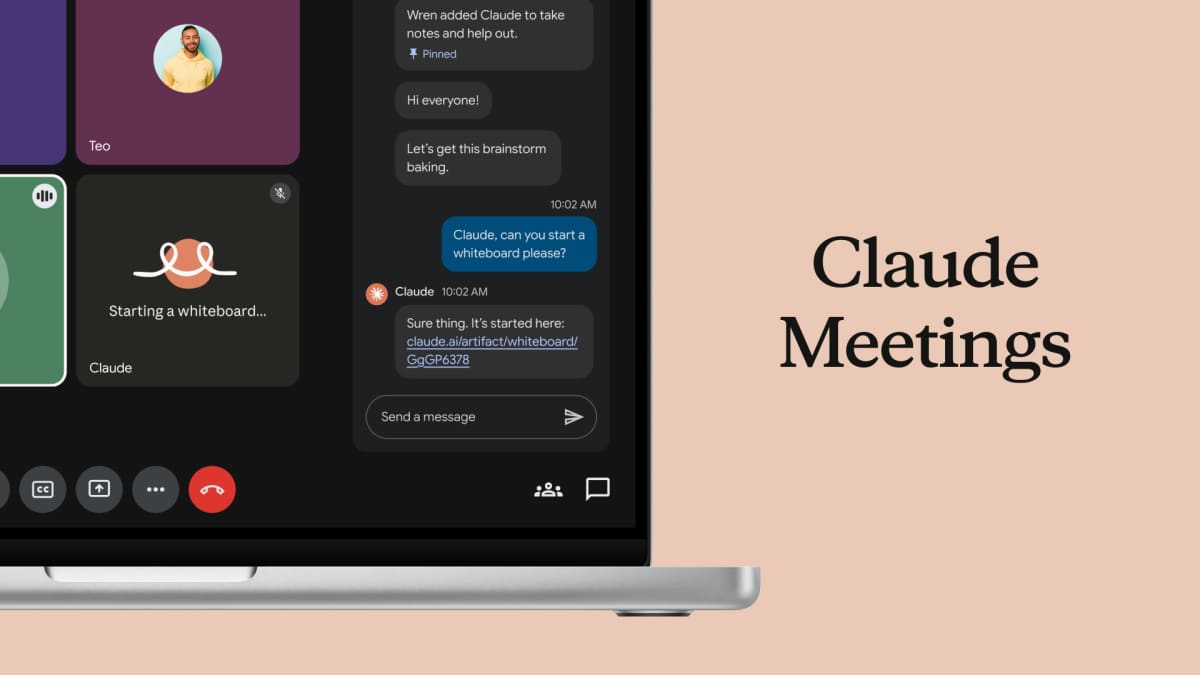
Anthropic has introduced a suite of collaborative tools designed to embed its AI assistant directly into workplace workflows, beginning with Claude Meetings, which joins video conferences as a visible participant. The feature allows the assistant to listen to conversations, draft documents, respond to queries in chat and retrieve data from connected applications whilst team members are still speaking. After the call concludes, all materials generated during the session, including notes and action items, become accessible through the claude.ai platform.
The assistant identifies itself when entering a conference and posts a notification in the meeting chat. For organisations concerned about confidentiality, administrators can configure the system to block the assistant from calls that include external guests. If an unauthorised external participant joins, the assistant automatically exits the session. The beta release supports Google Meet, with additional video conferencing platforms expected in subsequent updates. Access is limited to Team and Enterprise subscription tiers.
The timing of this launch is significant. Anthropic's move follows OpenAI's recent unveiling of workplace collaboration features that enable users to visualise company data and assemble presentations with ChatGPT. Meta has entered the same arena with Muse, an AI agent that constructs mini-applications on demand. The convergence of these efforts signals a broader industry shift: foundation model developers are no longer content to provide standalone chat interfaces. Instead, they are building integrated productivity environments that challenge the incumbents, Microsoft and Google, on their home turf.
Collaborative Canvas and Spreadsheet Editing
Anthropic has also released Claude Whiteboards, a shared visual workspace where teams can discuss ideas and watch the assistant organise those discussions into structured diagrams, timelines and task lists in real time. Previously, users who brainstormed with Claude had to copy results into separate applications to share them with colleagues. The new feature eliminates that step by enabling multiple team members to work on the same board simultaneously. Once the brainstorming session ends, the assistant can convert the board into a text document or a slide presentation.
Whiteboards integrate with Claude Meetings, meaning a visual board can populate itself as participants talk during a video call. This integration reflects a design philosophy that prioritises continuity across modalities: spoken conversation, visual mapping and written output flow into one another without manual handoffs. The feature is available in beta on web, desktop and mobile platforms for all paid subscription plans.
Claude Sheets extends the collaborative model to spreadsheets. Teams can request a campaign tracker, hiring budget or project timeline, and the assistant generates a working spreadsheet complete with multiple tabs, formulas, formatting and dropdown menus. The assistant edits cells directly alongside human collaborators and highlights each change, providing transparency into its modifications. The feature is designed to handle initial setup, whilst allowing teams to refine and update the spreadsheet over time. Like Whiteboards, Sheets is available in beta on web, desktop and mobile for paid plans.
Data Connectors and Embedded Applications
Anthropic announced that Claude Data, previously called Claude Dashboards, has reached general availability. The feature connects the assistant to enterprise systems such as data warehouses and customer relationship management platforms. Users can pose questions and receive responses in the form of dashboards, written data narratives or narrated videos. This capability addresses a persistent challenge in enterprise AI adoption: making large language models useful for business intelligence tasks that require access to proprietary, structured data rather than general knowledge.
The company has also introduced interactive connectors that open full versions of third-party applications, including Adobe, Atlassian and HubSpot, directly within the Claude interface. Teams can now ask the assistant to perform tasks inside these applications without switching contexts. For example, a user might ask the assistant to update a HubSpot record, draft a document in Atlassian Confluence or adjust an Adobe file, all whilst remaining in the same workspace. This approach represents a departure from the traditional API-based integration model, where AI tools operate in the background and pass data through structured calls. Instead, Anthropic is embedding the assistant into the user interface of existing software, blurring the boundary between the AI and the application.
Strategic Implications for the Enterprise AI Market
The rapid succession of productivity-focused launches from Anthropic, OpenAI and Meta reveals a shared strategic calculation: capturing enterprise users requires more than a capable language model. It requires a suite of tools that fit into established workflows and reduce the friction of adoption. Microsoft and Google have long dominated this space by bundling their productivity applications with cloud infrastructure and enterprise services. Both companies have moved quickly to integrate generative AI into their existing suites: Microsoft through Copilot across Office 365, and Google through Duet AI in Workspace. The challenger companies are now attempting to reverse-engineer that advantage by building productivity features directly into their AI platforms.
For enterprises in Asia, where digital transformation initiatives often prioritise interoperability and vendor flexibility, the emergence of multiple AI-powered productivity suites presents both opportunity and complexity. Organisations that have standardised on Microsoft or Google infrastructure may find it easier to adopt those companies' AI features, given the seamless integration with existing authentication, storage and compliance systems. However, companies that prefer best-of-breed approaches or wish to avoid vendor lock-in may view Anthropic's offerings as a viable alternative, particularly if they already use third-party collaboration tools that integrate with Claude.
The competitive dynamics are further complicated by pricing and access models. Anthropic's new features are restricted to paid plans, with Claude Meetings available only on Team and Enterprise tiers. This positions the company's offerings as premium tools for organisations willing to commit to higher-tier subscriptions, rather than features accessible to individual users or small teams on free plans. OpenAI has adopted a similar strategy, reserving its most advanced collaboration features for ChatGPT Team and Enterprise customers. Meta's approach with Muse remains less clear, but the company's history suggests it may pursue a broader distribution strategy to maximise reach and data collection.
Privacy, Control and the Future of Workplace AI
The introduction of AI participants in video calls raises questions about consent, data governance and organisational control. Anthropic has addressed some of these concerns by requiring administrative authorisation for the assistant to join calls with external guests and by automatically removing it if an unauthorised external participant enters. However, the broader implications of persistent AI observation in workplace communication are still unfolding. Employees may adjust their behaviour if they know an AI assistant is listening, documenting and summarising their words. Organisations will need to establish clear policies about when the assistant should be present, what data it can access and how long it retains information.
The transparency measures Anthropic has built into Claude Sheets, such as highlighting each change the assistant makes, suggest the company is aware of the need for auditability in enterprise settings. As AI systems take on more active roles in creating and editing business-critical documents, the ability to trace decisions and modifications becomes essential. This is particularly relevant in regulated industries, where audit trails and compliance documentation are mandatory.
The shift from passive AI tools that respond to prompts toward active participants that observe, interpret and act on ongoing conversations represents a significant change in the role of AI in the workplace. If these features gain traction, the next phase of competition may centre on autonomy: how much decision-making authority organisations are willing to delegate to AI systems, and how vendors design guardrails to prevent errors or overreach. Anthropic's current features still require human initiation and oversight, but the trajectory points toward systems that can attend meetings, manage tasks and update records with minimal human intervention.
The outcome of this competition will depend not only on the technical capabilities of each platform but also on trust, integration depth and the willingness of enterprises to rethink their workflows around AI. For now, the race is open, and the incumbents no longer hold an unchallenged lead.