Google Bets the Agentic Web Will Run Through Search and Gemini
The company's new Connected Apps Platform invites developers to make their services available inside Google's AI surfaces, opening a race for visibility that mirrors the early SEO era.
The Platform Play Behind the AI Interface
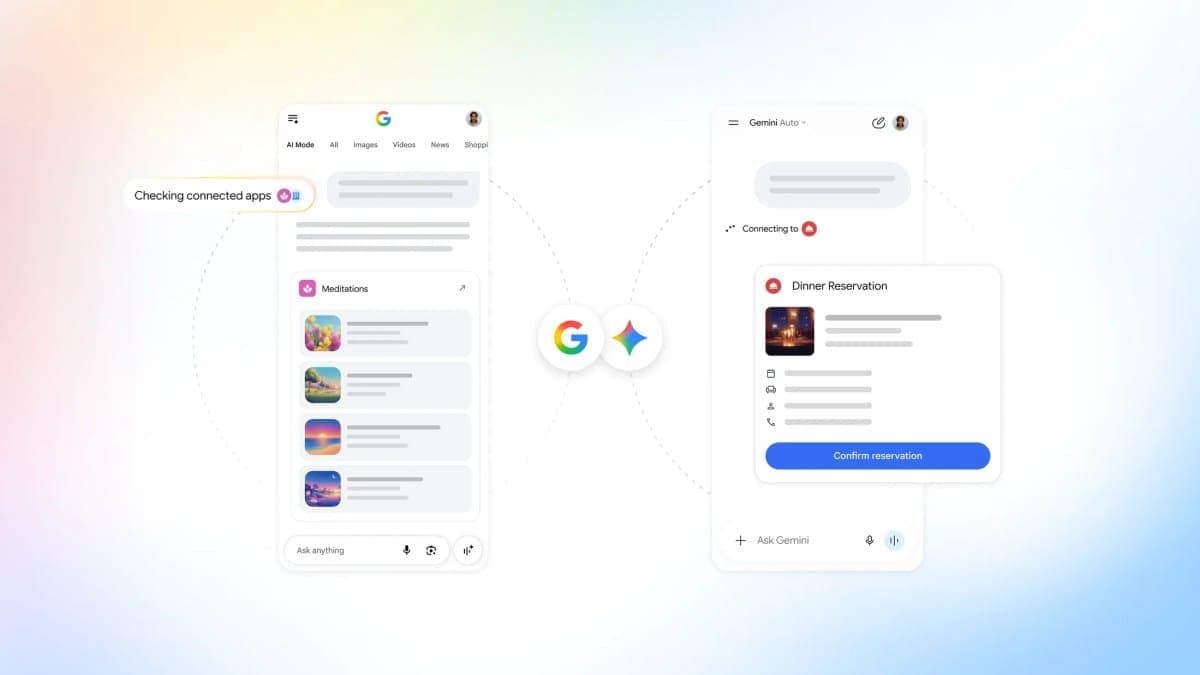
Google now allows any developer or business in the United States to register their service for inclusion in Search and Gemini through a newly launched Connected Apps Platform. The beta programme, available by waitlist, centres on a straightforward premise: users will increasingly want to accomplish tasks without leaving their AI assistant, and businesses that fail to integrate risk becoming invisible.
The mechanics are technical but not exotic. Developers integrate using a cloud-hosted Model Context Protocol server or Android MCP via AppFunctions APIs, then register and monitor performance through the Google Connected Console. Once live, companies can track traffic, latency, and error rates while retaining control over branding elements such as verified logos and authenticated accounts. The architecture mirrors the logic of search engine optimisation two decades ago, when businesses first learned that visibility in Google's results determined commercial viability.
At Opentechwire, we've tracked similar initiatives from OpenAI and Meta over the past eighteen months, each betting that the next generation of consumer software will be routed through large language models rather than home screens. The difference here is scale: Google operates the world's most-used search engine and one of the most widely deployed mobile AI assistants. If the company can convert even a fraction of its search traffic into agentic interactions, the shift in distribution channels will be material.
What Developers Get
The platform offers two entry points. Developers can choose to make their service available through Search, through the Gemini app, or both. Google has not disclosed the criteria it uses to rank or recommend connected apps, though it confirmed that developers will be able to see which surface drives the most engagement. That asymmetry of information is familiar to anyone who has worked in platform ecosystems; the platform holder sees everything, participants see a window.
More than fifty connected apps are already live in Gemini, including integrations with Adobe, Experian, Peloton, and a range of Google's own properties spanning Workspace, Photos, YouTube Music, and Home. These will roll out to Search over the coming weeks. Search currently supports a smaller set, among them Instacart, Canva, and Yahoo Fantasy Football. Google announced that Calm, the meditation app, will launch on both surfaces soon.
The product design suggests Google is positioning these integrations as convenience rather than commerce. A user might connect Canva to generate a flyer, or YouTube Music to assemble a playlist, without opening either app. The interactions remain scoped to single tasks rather than deep session engagement, at least in the current iteration. Whether that constraint is architectural or strategic remains unclear.
The Agentic Web as Distribution Channel
The term "agentic web" has gained currency in the past year to describe environments where AI models act on behalf of users, invoking services and stitching together workflows that previously required manual app-switching. The concept is not new; automation and API orchestration have existed for years. What has changed is the interface layer: natural language requests replace buttons, and the model decides which service to call.
For developers, this introduces a dependency. In the app store era, a company could invest in design, performance, and marketing to stand out. In the agentic era, a service must first be selected by the model, and that selection is opaque. Google's platform attempts to mitigate some of that opacity by offering a registration process and analytics, but it does not promise preferential placement or explain how Gemini decides which connected app to invoke when multiple options exist.
The comparison to SEO is instructive. In the early 2000s, businesses learned that appearing on the first page of Google results was existential. An entire industry formed around reverse-engineering ranking signals and optimising for them. The Connected Apps Platform may seed a similar dynamic, where companies compete not for keyword rankings but for inclusion and invocation inside AI workflows. The difference is that search rankings were at least somewhat transparent and rule-based; model behaviour is probabilistic and harder to predict.
Regional Implications and the Platform Holder's Advantage
Google's decision to launch the platform in the United States first is unsurprising given regulatory and product maturity, but it raises questions about expansion. The company has not provided a timeline for availability in other markets, including Asia, where app ecosystems and consumer behaviour differ. In markets like India, Indonesia, and Vietnam, mobile-first usage patterns and platform fragmentation mean that Google's leverage may be weaker than in the US or Europe.
There is also the matter of Google's own services. The company has integrated more than a dozen of its properties into the connected apps roster, from Workspace to Home. That vertical integration gives Google both data and distribution advantages. A developer building a calendar app competes not only with other third parties but with Google Calendar, which benefits from tighter integration, more user data, and preferential treatment within Google's own AI surfaces, whether explicit or emergent.
Platform regulation in the European Union and ongoing antitrust scrutiny in the United States may eventually force Google to disclose more about how it ranks and recommends connected apps. For now, the company has said little beyond the mechanics of integration and the availability of performance metrics. Developers entering the platform are effectively accepting that the terms of visibility will be set by Google, and may change.
What This Means for the Next Layer of Software
The broader implication is that distribution in software is shifting again. The first era belonged to desktop software and bundling. The second era was defined by the web and search engine optimisation. The third era centred on mobile app stores and their ranking algorithms. The fourth era, now taking shape, is mediated by AI models that invoke services on behalf of users, often invisibly.
In this environment, the companies that control the models and the surfaces where users interact with them hold structural power. Google, OpenAI, Anthropic, and Meta are all racing to build these surfaces and attract developers. The competition is not yet settled, and it is plausible that multiple platforms will coexist, much as iOS and Android coexist in mobile. But the early moves matter, and Google's combination of search traffic, mobile presence, and model capability gives it a strong position.
For developers, the calculus is straightforward: integrate or risk irrelevance. For users, the promise is convenience and reduced friction. For regulators, the challenge is ensuring that the agentic web does not replicate the concentration and gatekeeping dynamics that have characterised previous platform transitions. The Connected Apps Platform is an early signal of how that dynamic will unfold, and whether this time will be different.