CXMT Claims Lead in Next-Generation Memory Design as Industry Watches Closely
The Chinese memory maker's weekend announcement has sparked market reactions, though competitors retain alternative paths to maintain their position in the global semiconductor landscape.
A Weekend Announcement That Moved Markets
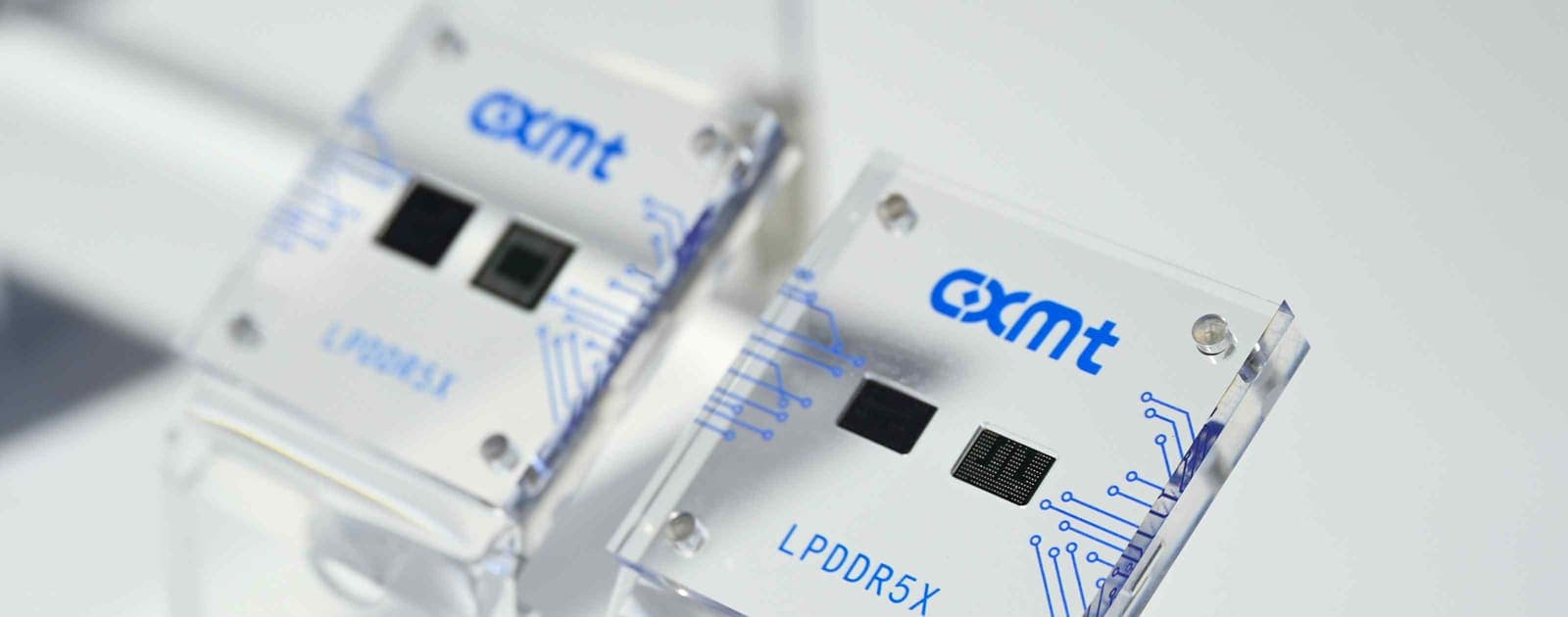
When CXMT disclosed details of its next-generation memory chip design over the weekend, the immediate response in semiconductor markets underscored how quickly the competitive landscape can shift. The Chinese memory manufacturer's technical advance in high-capacity LPDDR5X architecture represents a tangible step forward in a segment where Samsung, SK Hynix, and Micron have traditionally set the pace.
The timing matters. Memory chips remain a critical bottleneck in AI infrastructure, and any player that can deliver higher bandwidth and capacity at competitive power envelopes gains negotiating leverage with server OEMs and cloud providers. CXMT's September unveiling of its LPDDR5X chip included a claim that the company now operates "close to the leading edge of global memory production," a statement that, if technically accurate, marks a notable compression of the development gap that has historically separated Chinese memory makers from their Seoul- and Boise-based counterparts.
The Technical Stake
LPDDR5X, the low-power variant of DDR5 memory, is designed for mobile devices and increasingly for edge AI applications where thermal constraints matter as much as raw throughput. The architecture supports data rates exceeding 8,533 Mbps, nearly double the ceiling of LPDDR4X, and CXMT's entry into volume production of high-capacity versions signals progress not just in process technology but in yield management and quality control, two areas where Chinese semiconductor firms have historically struggled.
Industry executives who spoke on background acknowledge that CXMT's announcement reflects real capability, not vaporware. The company has been shipping LPDDR5 chips to smartphone makers since early 2025, and the move to the X variant, which incorporates additional power-saving features and higher density, is a logical but technically demanding progression. The question is not whether CXMT can produce these chips but at what volume, yield, and cost structure compared to incumbents.
Where Rivals Still Hold Ground
Samsung and SK Hynix have not stood still. Both have expanded their HBM3E production lines, a different memory architecture optimised for AI accelerators, and maintain dominant positions in that higher-margin segment. Micron, meanwhile, has leaned into GDDR7 for graphics and LPCAMM2 form factors for laptops, betting that differentiation by application will matter more than a head-to-head race in any single standard.
Analysts point out that memory is not a winner-take-all market. Different use cases reward different trade-offs: AI training favours HBM's bandwidth, smartphones prioritise LPDDR's power efficiency, and data centres increasingly mix multiple memory types within a single server to balance cost and performance. CXMT's strength in LPDDR5X does not automatically translate to strength across this spectrum.
There is also the question of ecosystem lock-in. Samsung and SK Hynix have decades of joint development relationships with Qualcomm, MediaTek, and Apple, partnerships that involve custom tuning, early access to roadmaps, and co-optimisation of memory controllers and SoC designs. CXMT is building those relationships now, primarily with Chinese handset and PC makers, but breaking into the tier-one US and European OEM supply chains remains a longer-term challenge, particularly under current export control regimes.
Policy and Market Access
The regulatory environment continues to shape competitive dynamics. CXMT has faced inclusion on various US entity lists, restricting its access to certain lithography tools and EDA software, though the company has worked around many of these limitations through domestic tooling and older-generation equipment pushed to higher performance. The recent lawsuit CXMT filed against the Pentagon over its designation as a Chinese military company reflects the legal and reputational battles that accompany technical ones.
For buyers, the calculus is shifting. HP, Asus, and Acer have reportedly begun incorporating CXMT chips into select product lines, driven partly by a global memory shortage that has pushed spot prices for DRAM up by more than 40 per cent since mid-2025. When supply is tight, geopolitical caution tends to take a back seat to availability and price. That dynamic has opened doors for CXMT that might have remained closed in a looser market.
Yet the same governments that imposed export controls on China are now subsidising domestic memory production in the US, Japan, and Europe. GlobalFoundries' planned expansion in New York, backed by $21 billion in public investment, and similar programmes in Kumamoto and Dresden, aim to build redundancy into memory supply chains. These projects will take years to reach volume, but they signal that the strategic importance of memory is now understood at the cabinet level across multiple capitals.
Profit Margins and the Sustainability Question
CXMT and SMIC, its foundry partner, reported a combined 620 per cent surge in profits recently, driven by both volume growth and improving margins. CXMT's profit margin has reportedly surpassed those of SK Hynix and Micron in recent quarters, a remarkable achievement for a company that was burning cash as recently as 2023.
Sceptics note that Chinese state support, in the form of subsidised financing, land, and utilities, makes direct margin comparisons misleading. If CXMT is not bearing the full cost of capital, its reported profitability may not reflect true economic efficiency. Still, even adjusting for subsidies, the trend is clear: CXMT is producing competitive products at scale, and its cost structure is improving faster than many outside observers expected.
The sustainability of those margins will depend on whether CXMT can maintain technical parity as the industry moves toward the next nodes. Memory scaling is slowing, and the incremental cost of each new generation is rising. If CXMT can keep pace without access to EUV lithography, it will validate a different development model, one that relies on process innovation and design cleverness rather than brute-force spending on the latest tools.
What This Means for the Memory Market
The immediate effect of CXMT's announcement has been to compress pricing expectations for LPDDR5X. If a credible third supplier enters volume production, buyers gain negotiating leverage, and the oligopoly pricing that has characterised the memory market for two decades weakens slightly. That is good news for device makers and, by extension, for consumers, though it is less welcome in Seoul and Boise.
Longer term, the competitive pressure may accelerate innovation. Samsung and SK Hynix are already exploring LPDDR6 and alternative memory architectures like MRAM and ReRAM, technologies that could leapfrog DRAM entirely for certain applications. Micron is investing heavily in 3D NAND and CXL-attached memory, betting that the future of data centres involves disaggregated, composable memory pools rather than monolithic DRAM modules.
For CXMT, the challenge is to avoid the trap that ensnared earlier Chinese semiconductor champions: achieving technical parity in one generation, then falling behind as the incumbents shift the battlefield. The company's ability to sustain its momentum will depend on continued access to talent, tools, and capital, all of which are now contested terrain in the US-China technology competition.
At Opentechwire, we have tracked the memory industry's evolution from a purely commercial contest into a geopolitical flashpoint. CXMT's latest move is a reminder that technological leadership is not static, and that assumptions about who leads and who follows can change faster than semiconductor roadmaps suggest. The next twelve months will reveal whether this breakthrough is an inflection point or a fleeting moment of parity before the gap widens again.