Inside China's Robotaxi Rollout: A First-Hand Account From Beijing and Shenzhen
Autonomous ride-hailing services from Pony.ai and Baidu now operate commercially in multiple Chinese cities, offering a glimpse of what driverless transport feels like in practice.
The Empty Driver's Seat
The steering wheel rotates by itself. No hands grip the rim, no foot hovers over the pedals. For a passenger settling into the rear seat of a Pony.ai robotaxi navigating Shenzhen's urban grid, the first moments trigger an instinctive unease. The absence of a human at the controls violates decades of automotive convention.
Yet that discomfort recedes quickly once the vehicle merges into traffic. What replaces it is not wonder at the technology, but an unexpected appreciation for a different kind of silence: no obligatory conversation, no awkward questions about the weather, no need to negotiate the social contract of ride-sharing with a stranger who happens to be steering. The car simply drives.
Test rides in two of China's busiest technology corridors, Shenzhen and Beijing, offered a practical view of autonomous mobility as it exists today. Pony.ai and Baidu's Apollo Go have moved beyond pilot programmes into commercial operation, charging fares and logging thousands of passenger trips each week. The experience raises a question less about whether the technology works and more about what it feels like when it does.
How the Ride Works
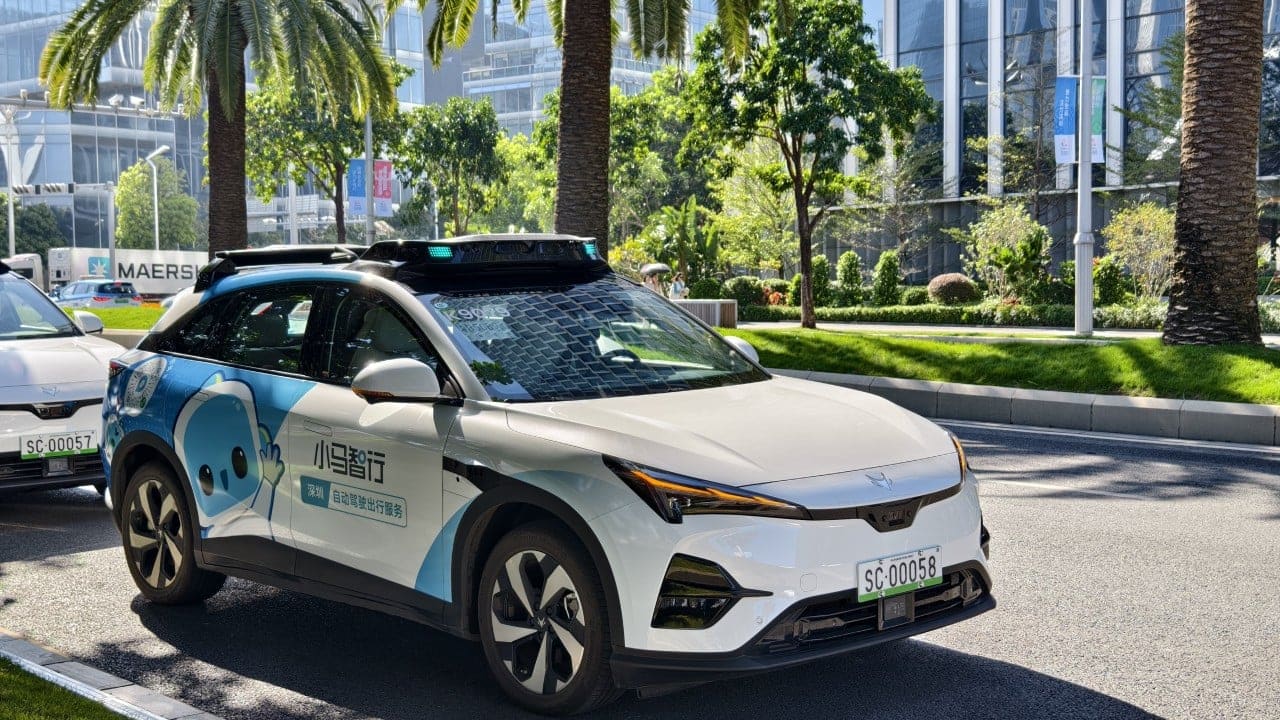
Summoning a robotaxi resembles ordering any other ride-hailing service. Passengers open an app, enter a destination within the approved service zone, and wait. The vehicle that arrives looks conventional from the outside, aside from a sensor array mounted on the roof: lidar units, cameras, and radar modules that feed data to the onboard computing stack.
Entry requires scanning a QR code displayed on the door. Once inside, the rear-seat interface, a touchscreen embedded in the back of the front seat, prompts the passenger to confirm the trip. Seat belts must be fastened before the car will move. There is no intercom to a remote operator unless something goes wrong, though both services maintain oversight centres where staff monitor fleets in real time.
The vehicle pulls away smoothly. Acceleration is gentle, braking is gradual, and lane changes are signalled well in advance. The driving style is cautious, almost excessively so. At intersections, the robotaxi waits longer than a human driver might, ensuring cross traffic has fully cleared. It yields to pedestrians even when they hover near the kerb without stepping into the road.
Traffic, Construction, and Edge Cases
Urban driving demands constant adaptation. Road conditions shift, construction zones appear without warning, and human drivers make unpredictable moves. Autonomous systems must parse all of it in real time.
During a trip through central Shenzhen, the Pony.ai vehicle encountered a section of road narrowed by construction barriers. The car slowed, edged toward the centre line, and threaded through the gap without hesitation. The manoeuvre felt deliberate rather than reactive, as though the system had processed the obstacle well before reaching it.
In Beijing, an Apollo Go robotaxi navigated a multi-lane roundabout during evening rush hour. Merging required timing: the car waited for a gap, then accelerated into the flow. Other drivers did not yield simply because the vehicle was autonomous. The robotaxi held its position, matched the speed of surrounding traffic, and exited at the correct turn without incident.
Yet the limitations surface in subtler moments. At a pedestrian crossing in Shenzhen, a cyclist veered into the lane without signalling. The robotaxi braked hard, not dangerously but abruptly enough to jolt passengers forward. A human driver might have anticipated the cyclist's trajectory a fraction of a second earlier. The system reacted correctly but without the predictive smoothness that comes from experience.
Cost, Coverage, and Competition
Baidu's Apollo Go operates in Beijing, Shanghai, Wuhan, and Chongqing, with plans to expand into additional cities by mid-2027. Pony.ai runs services in Shenzhen, Guangzhou, and parts of the Greater Bay Area. Both companies price trips competitively with traditional ride-hailing, often undercutting human-driven alternatives by 10 to 20 per cent during off-peak hours.
Service zones remain limited. In Beijing, Apollo Go covers roughly 600 square kilometres, concentrated in the city's southern and eastern districts. Shenzhen's Pony.ai zone spans approximately 450 square kilometres, avoiding the densest parts of the central business district. Passengers must start and end trips within these boundaries; cross-city journeys are not yet possible.
Regulatory approvals vary by municipality. Shenzhen permits fully driverless operation on public roads without safety drivers, a threshold Pony.ai crossed in late 2025. Beijing requires safety drivers in the front seat for most Apollo Go vehicles, though a small subset operates without them in designated areas. The patchwork reflects differing risk tolerance among local governments.
Other players are positioning for scale. WeRide, also based in Guangzhou, has secured permits in multiple cities and is testing robotaxis alongside autonomous minibuses and street sweepers. AutoX, backed by Alibaba, focuses on Shenzhen and has deployed vehicles in residential neighbourhoods. Didi, China's dominant ride-hailing platform, is developing its own autonomous fleet, though commercial launch timelines remain unannounced.
What Passengers Notice
The absence of a driver changes the in-car dynamic. There is no rearview mirror glance, no small talk, no negotiation over route preferences. For some passengers, this is a relief. For others, it feels isolating, particularly on longer trips where the hum of the electric motor and the faint whir of the lidar become the only sounds.
The cautious driving style divides opinion. Passengers accustomed to aggressive urban driving may find the robotaxi too slow, too hesitant. Those who prefer a calmer pace appreciate the predictability. Either way, the car does not adapt to passenger mood or urgency. It drives the same whether ferrying a commuter to an early meeting or a leisure traveller with time to spare.
Safety features are omnipresent. The touchscreen displays a live map showing detected vehicles, pedestrians, and cyclists in the surrounding area. Coloured boxes outline each object, updating in real time as the car moves. It is both reassuring and mildly unsettling to see the world rendered as a stream of geometric shapes.
The Road Ahead
China's robotaxi sector is expanding faster than its counterparts in Europe or North America. Regulatory frameworks in several Chinese cities now permit commercial operation at scale, a milestone that remains elusive in most Western jurisdictions. The pace reflects both policy ambition and the concentration of engineering talent in companies like Baidu, Pony.ai, and WeRide.
Fleet size is growing. Baidu announced in October 2026 that Apollo Go had logged over 8 million rides since launching commercial service in 2023. Pony.ai has not disclosed cumulative ride figures but operates several hundred vehicles across its service areas. Both companies are manufacturing purpose-built robotaxi models in partnership with domestic automakers, aiming to reduce per-unit costs and phase out retrofitted sedans.
Public acceptance is rising, though not uniformly. Surveys conducted in Beijing and Shenzhen suggest that younger passengers, particularly those under 35, are more willing to try autonomous rides. Older cohorts remain sceptical, citing safety concerns and a preference for human oversight. Repeat usage rates hover around 40 per cent, indicating that a portion of riders view robotaxis as a novelty rather than a regular transport option.
The technology is not yet seamless. Edge cases, unpredictable human behaviour, and adverse weather still challenge autonomous systems. Heavy rain degrades lidar performance; snow and fog compound the difficulty. Most services suspend operations during severe weather, a constraint that limits reliability.
Yet the trajectory is clear. Robotaxis are no longer confined to test tracks or geofenced suburbs. They navigate real cities, carry paying passengers, and operate alongside human drivers. The experience is not flawless, but it is functional. Whether that functionality translates into widespread adoption depends less on the technology itself and more on whether passengers come to trust a car that drives itself.