China's AI Chip Makers Face Investor Scepticism Despite Revenue Boom
Biwin Storage and Moore Threads report surging third-quarter sales, yet shares tumbled more than 10 per cent as broader market doubts overshadow domestic semiconductor gains.
Strong Quarters, Weak Sentiment
Biwin Storage Technology and Moore Threads each reported robust third-quarter revenue growth this week, driven by accelerating demand for artificial intelligence infrastructure across China. Yet both companies watched their share prices drop by more than 10 per cent in Thursday morning trading, a reversal that underscores the tension between operational performance and investor confidence in the mainland semiconductor sector.
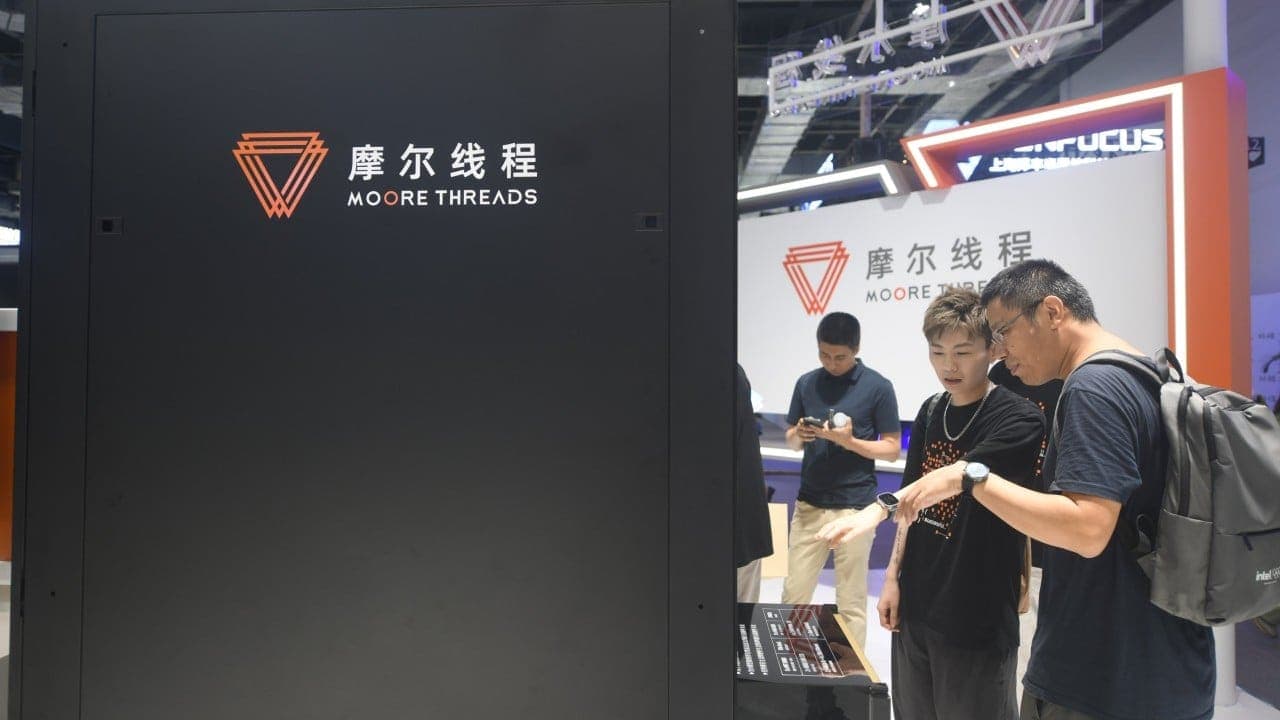
Biwin, which supplies storage modules to Google and other hyperscale customers, saw its stock fall 15.79 per cent by the close. Moore Threads, a graphics processing unit designer that has positioned itself as a domestic alternative amid US export restrictions, declined by a similar magnitude. The moves erased gains from the previous session, when Biwin had climbed 8.4 per cent and Moore Threads 5.8 per cent.
The declines came despite both firms posting what would ordinarily be viewed as validation of their AI-focused strategies. Revenue at Biwin surged on the back of higher shipments to data-centre operators building out inference and training capacity. Moore Threads, meanwhile, has benefited from Beijing's push to develop indigenous GPU capabilities following tighter US controls on advanced chips from Nvidia and AMD.
A Sector-Wide Rout
The sell-off was not confined to these two names. Mainland technology equities broadly retreated on Thursday, with semiconductor stocks bearing the brunt. At Opentechwire, we've tracked a pattern of volatility in Chinese chip names over the past quarter, as investors weigh near-term revenue tailwinds against longer-term questions about profitability, geopolitical risk, and the sustainability of domestic AI spending.
Biwin's storage products, which include solid-state drives and embedded modules optimised for high-throughput workloads, have found traction with cloud providers racing to expand GPU clusters. The company has disclosed partnerships with international hyperscalers, though it does not break out revenue by customer. Moore Threads, founded by former Nvidia China executive Zhang Jianzhong, has shipped several generations of GPUs targeting inference and edge applications, though its products still lag behind cutting-edge Nvidia silicon in raw performance and ecosystem maturity.
Both companies have seen their valuations swell over the past year as Chinese institutions and retail investors piled into any name with credible AI exposure. That enthusiasm has created a recurring cycle: strong quarterly prints drive short rallies, which are then swiftly reversed when broader market jitters resurface.
Why Revenues Alone Are Not Enough
The divergence between revenue growth and share-price performance reflects several underlying concerns. First, profitability remains elusive for many Chinese semiconductor firms, which continue to invest heavily in research, fabrication partnerships, and talent acquisition. Moore Threads, for instance, has not yet posted a net profit, and its gross margins are compressed by the cost of tape-outs at third-party foundries and the need to subsidise early adopters.
Second, the competitive landscape is intensifying. Biwin competes with established storage vendors such as Samsung, SK hynix, and Western Digital, all of which have their own AI-optimised product lines. Moore Threads faces not only export-controlled Nvidia chips that still reach some Chinese customers through grey channels, but also a growing cohort of domestic rivals, including Biren Technology and Iluvatar CoreX, each vying for the same pool of government-backed procurement and private-sector deployments.
Third, macroeconomic headwinds are weighing on the broader Chinese equity market. Concerns about the pace of economic recovery, property-sector stress, and the potential for further US technology restrictions have made investors more risk-averse, particularly towards high-valuation growth stocks with uncertain paths to sustained profitability.
The Export-Control Shadow
US export controls, tightened in successive rounds since 2022, have reshaped the Chinese GPU and storage markets. While the restrictions were intended to limit Beijing's access to cutting-edge chips for military and surveillance applications, they have also created a protected domestic market that benefits firms like Moore Threads and Biwin. Chinese data-centre operators that once defaulted to Nvidia A100 or H100 GPUs are now evaluating domestic alternatives, even if those products offer lower performance per watt or less mature software stacks.
Yet this dynamic cuts both ways. The same export controls that shield Chinese firms from foreign competition also limit their access to advanced packaging technologies, electronic design automation tools, and leading-edge fabrication processes. Moore Threads, for example, relies on older process nodes and must design around the absence of high-bandwidth memory modules that US firms can source freely. Biwin, though less directly affected, has had to navigate supply-chain constraints on controller chips and NAND flash from certain suppliers.
The result is a domestic semiconductor industry that is growing rapidly in revenue terms but remains structurally constrained in its ability to close the performance gap with global leaders. Investors are acutely aware of this ceiling, which helps explain why revenue beats alone are insufficient to sustain share-price momentum.
Outlook and Uncertainty
Both Biwin and Moore Threads are likely to continue posting strong revenue growth in the near term, assuming Chinese AI infrastructure spending remains robust. The central government has made semiconductor self-sufficiency a strategic priority, and local governments have allocated billions of yuan in subsidies, procurement commitments, and tax incentives to nurture domestic champions.
Whether that translates into durable shareholder value depends on execution in three areas: achieving positive operating leverage as volumes scale, defending market share against both foreign and domestic competitors, and navigating an unpredictable geopolitical environment. The funding rounds we've followed across the region suggest that late-stage investors are becoming more disciplined, demanding clearer paths to profitability rather than rewarding revenue growth at any cost.
For now, the market's message is unambiguous. Revenue growth is necessary but not sufficient. Chinese semiconductor firms must demonstrate that they can convert surging top lines into sustainable margins, and that their products can compete on merit rather than merely filling a gap created by export controls. Until those questions are answered, expect volatility to remain the norm, even when quarterly results look strong on the surface.