Apple's $12,299 Mac Studio Signals the End of Prosumer Computing
The M5 Ultra configuration makes clear who Apple's most powerful desktop is really for: AI labs and VFX studios with budgets to match.
A Desktop That Knows Its Audience
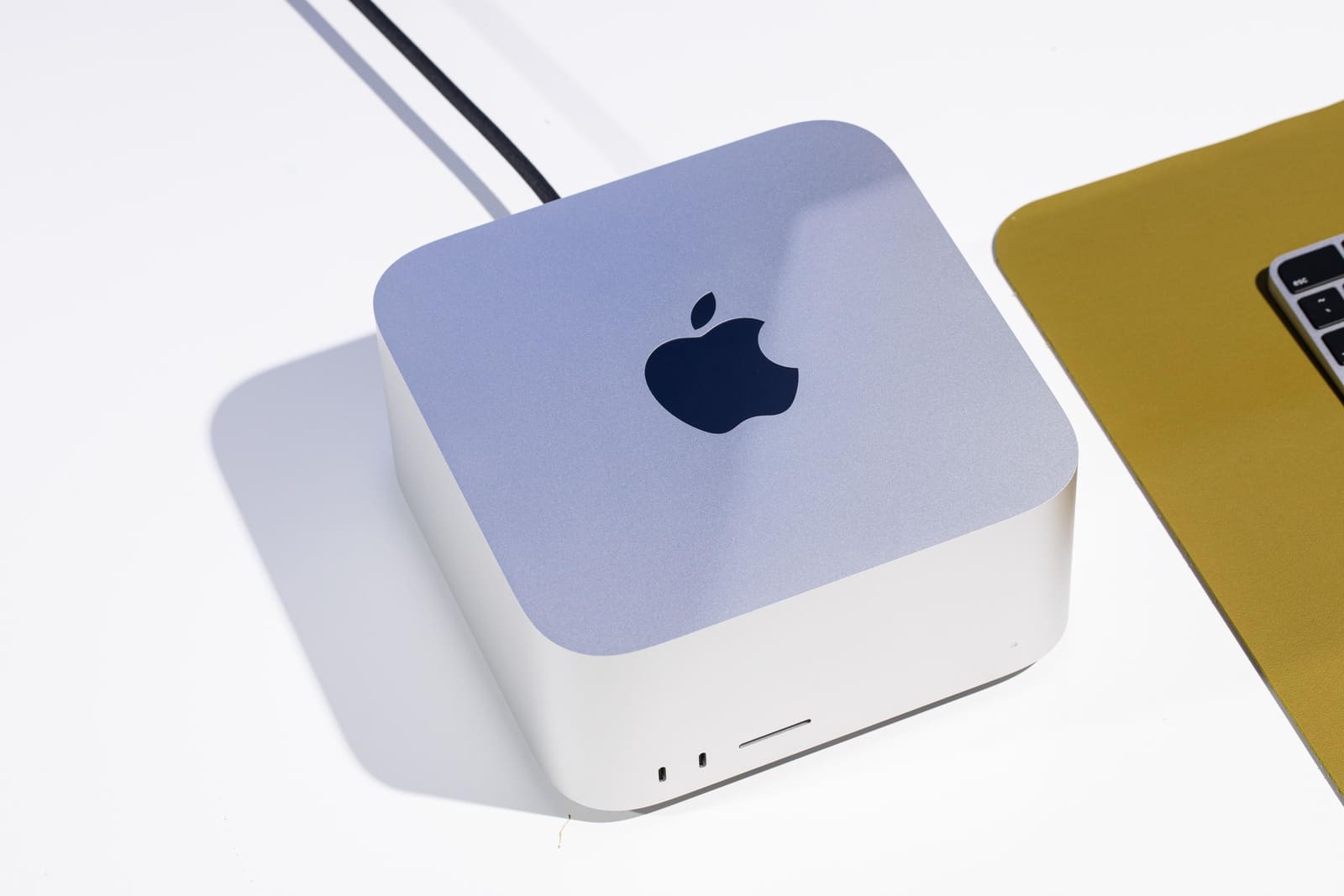
Apple began shipping its refreshed Mac Studio on 21 September 2026, and the top-specification unit now costs $12,299. That configuration carries an M5 Ultra chip with 36 CPU cores and 80 GPU cores, 256 GB of unified memory, and 4 TB of solid-state storage. The price point alone tells you something fundamental has changed about who this machine is meant to serve.
The industrial design remains unchanged from the 2022 version. The aluminium enclosure, the thermal architecture, the port layout all carry over. What has shifted is the silicon inside and, more importantly, the workloads Apple expects users to run on it.
Beyond Traditional Benchmarks
Standard content-creation benchmarks struggle to meaningfully stress a machine with this specification. Video encoding, even at 8K resolution, does not fully tax 36 cores. Photo processing completes before timers can register meaningful differences. The usual suite of creative-application tests that publications use to evaluate desktop computers were designed for an era when 16 cores felt extravagant.
The M5 Ultra configuration is engineered for a different class of task: training and fine-tuning machine-learning models on-device, rendering complex simulations with tens of millions of polygons, running real-time ray tracing across multiple 6K displays. These are workloads that until recently required rack-mounted servers or cloud instances billed by the hour.
Apple has not marketed the Mac Studio as a general-purpose desktop for some time, but this generation makes the segmentation explicit. The entry-level M5 configuration remains accessible to high-end photographers and editors. The Ultra variant is something else entirely.
The AI Workstation Calculus
At Opentechwire, we have tracked the rising cost of on-premise AI development hardware across Asia and North America. A comparable Linux workstation with dual high-end GPUs, 256 GB of system memory, and fast NVMe storage typically runs between $10,000 and $15,000 before factoring in the cost of CUDA software licences and infrastructure overhead.
The Mac Studio's unified memory architecture offers an advantage in certain inference and fine-tuning scenarios where moving data between discrete CPU and GPU memory creates latency. For teams working with large language models or diffusion-based image generators, that architectural benefit can translate into faster iteration cycles.
However, the trade-off is ecosystem lock-in. Apple's Metal API and Core ML framework are mature, but the overwhelming majority of open-source AI tooling assumes NVIDIA CUDA or, increasingly, AMD ROCm. Developers betting on the Mac Studio are also betting that Apple will maintain competitive silicon performance and that critical libraries will maintain macOS support.
What the Pricing Tells Us
The $12,299 configuration is not the ceiling. Adding more storage or opting for additional memory pushes the price higher still. This is deliberate positioning. Apple is not trying to win over prosumers who might stretch their budget for a more capable machine. It is targeting institutions and studios with capital budgets and multi-year depreciation schedules.
This mirrors a broader trend across the workstation market. Dell's Precision and HP's Z-series lines have similarly climbed in price as configurations have grown more specialised. Lenovo's ThinkStation P-series desktops aimed at AI and scientific computing routinely exceed $10,000. The difference is that Apple's vertical integration allows it to extract margin at the silicon level, not just the system level.
For independent developers and small studios in markets such as Jakarta, Manila, or Ho Chi Minh City, where purchasing power is lower and import duties add another 10 to 25 per cent, the Mac Studio Ultra is effectively out of reach. The equipment gap between well-funded teams in Singapore or Seoul and smaller operations elsewhere in Southeast Asia continues to widen.
The Thermal and Efficiency Angle
One area where the Mac Studio holds a clear advantage is power consumption. The M5 Ultra under sustained load draws substantially less power than a dual-GPU Linux workstation performing equivalent tasks. For studios running multiple units in a render farm or AI lab, the difference in electricity cost and cooling infrastructure can be significant over a three-year hardware cycle.
Apple's ARM-based architecture has matured to the point where performance-per-watt is no longer a compromise. The M5 Ultra delivers performance that would have required active liquid cooling and 500-watt power supplies in an x86 system just two years ago. That efficiency matters in regions where electricity is expensive or unreliable, and where air conditioning costs can equal or exceed the power draw of the equipment itself.
What Happens to the Middle
The more interesting question is what happens to the tier of users who once aspired to own Apple's flagship desktop. The Mac Studio was introduced as a bridge between the Mac Mini and the Mac Pro, a machine for serious professionals who did not need the modularity or PCIe expansion of the tower.
That middle ground is narrowing. The Mac Mini with M5 Pro is capable enough for most video editors, motion designers, and developers. The Mac Studio Ultra is overkill for everyone except a small set of specialists. The space in between, where someone might justify the expense for a meaningful but not transformational performance gain, is vanishing.
This is not unique to Apple. Across the computing industry, product lines are bifurcating into good-enough mainstream devices and highly specialised workstations with little in between. The economics of silicon design and the diversification of workloads make it difficult to serve both segments with a single product.
Forward Deployment
Apple's broader strategy appears to be positioning the Mac Studio as the hardware foundation for on-premise AI development within its ecosystem. The company has been steadily improving its machine-learning frameworks, expanding Metal Performance Shaders, and courting researchers who want an alternative to NVIDIA's near-monopoly in AI compute.
Whether that strategy succeeds depends on factors beyond hardware performance: the breadth of model support in Core ML, the willingness of major AI labs to maintain macOS toolchains, and the pace at which Apple can iterate its silicon relative to competitors. The M5 Ultra is powerful, but power alone does not build an ecosystem.
For now, the Mac Studio occupies a specific niche. It is a machine for teams that have already committed to the Apple platform, that value energy efficiency and thermal performance, and that have the budget to treat a $12,000 workstation as a routine capital expense. Everyone else is left to wonder what a computer with 36 cores and 256 GB of memory might feel like, and whether they will ever need to find out.