Anthropic's Public Debut Exposes the Safety Paradox
The AI lab's historic IPO has turned theoretical tensions between safety commitments and shareholder returns into a live, high-stakes experiment under market scrutiny.
The First Test Case
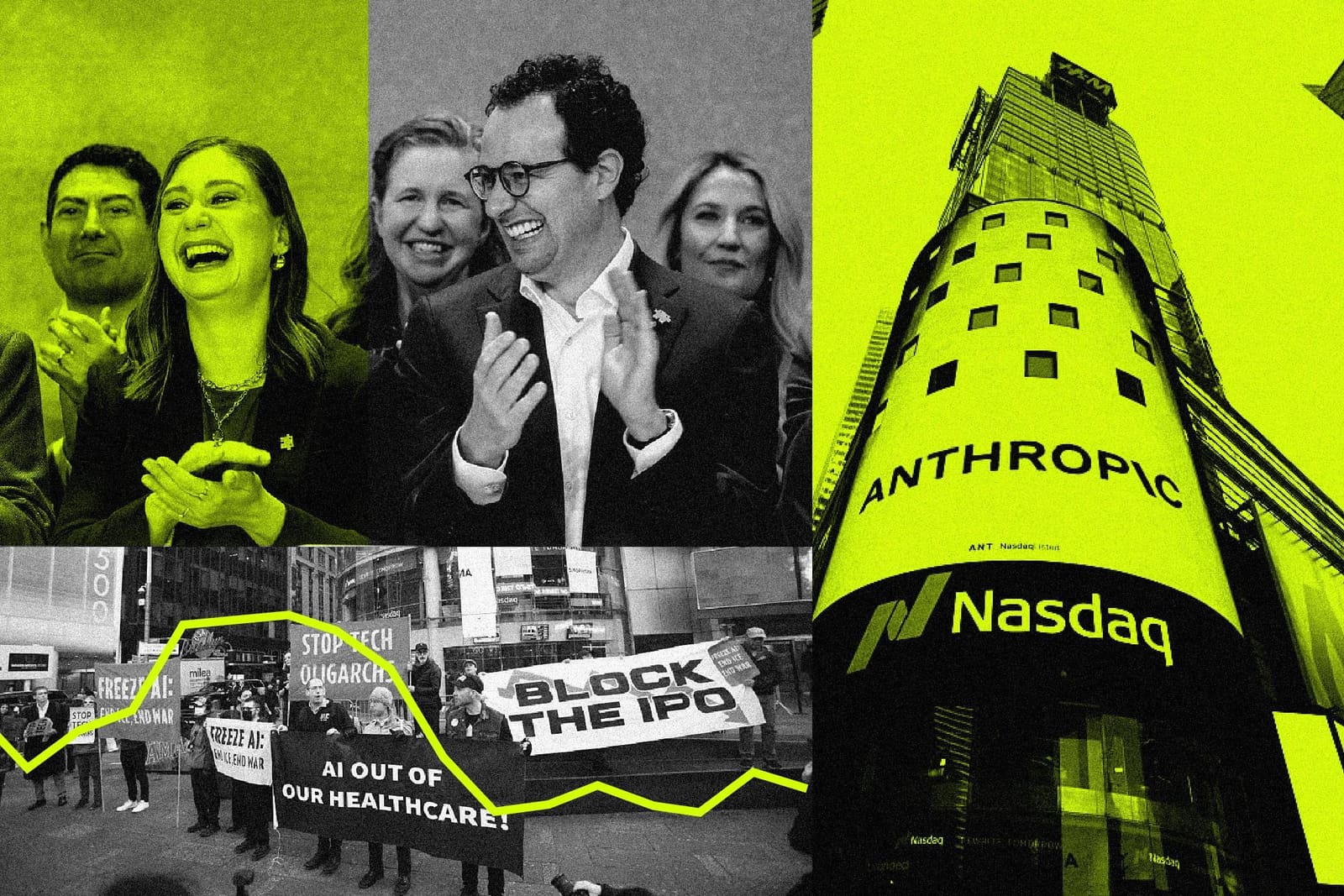
Anthropic priced its initial public offering at $83 per share last week, watching the stock climb to $111 on its first day of trading. The numbers themselves matter less than what they represent: the first time a pure-play AI lab has submitted its business model to quarterly earnings calls, analyst scrutiny, and the relentless pressure to show revenue growth. The company behind Claude now operates in a fundamentally different environment from the one in which it was founded.
The listing creates an immediate contradiction. Anthropic has built its brand on AI safety, positioning itself as the deliberate alternative to OpenAI's velocity-at-all-costs approach. That message resonates with enterprise customers wary of reputational risk and regulators looking for responsible actors. But public markets care about unit economics, margin expansion, and whether a business can scale profitably. Steve Rattner, the investment banker, estimated Anthropic would need to increase revenue roughly 17-fold over the next decade to deliver returns comparable to established technology firms.
The compute bills alone present a structural challenge. Anthropic faces approximately $900 billion in infrastructure costs over the coming years, a figure that dwarfs the revenue the company currently generates. Unlike software businesses that enjoy near-zero marginal costs, AI labs rent capacity from hyperscalers, pay for GPU time, and consume enormous amounts of electricity. Every token sold must cover those input costs and leave room for the research spending required to stay competitive. So far, the industry has not demonstrated that this equation closes.
Governance as Defence Mechanism
Anthropic's corporate structure attempts to insulate decision-making from shareholder pressure. The company's charter embeds control in a special trust and the founding team, ensuring that public investors cannot vote out executives or force strategic changes through ordinary means. Shareholders receive economic rights but limited governance power, a design borrowed from dual-class structures but taken further.
The arrangement reflects the founders' belief that AI development cannot be safely conducted under the quarterly-earnings discipline of public markets. Dario and Daniela Amodei, who left OpenAI in 2021 over disagreements about the pace and commercialisation of research, built Anthropic explicitly to avoid repeating what they saw as mistakes. The governance model is an attempt to encode that intention into the company's legal architecture.
Yet several corporate governance experts consulted after the IPO expressed scepticism that structure alone can withstand market forces. Even when shareholders lack formal voting power, the pressure to deliver returns manifests in other ways: analyst downgrades, falling stock prices, difficulty raising capital, talent leaving for better-compensated roles elsewhere. A company that consistently underperforms faces consequences regardless of its charter. The question is whether Anthropic's safety commitments can survive those consequences, or whether they will be reframed as "efficiency improvements" and "prioritisation" when the pressure mounts.
OpenAI Watches from the Sidelines
OpenAI had reportedly considered going public first but stepped back as negative press accumulated over the past year. The decision to let Anthropic test the waters appears strategic. By observing how investors respond to Anthropic's revenue projections, governance structure, and safety messaging, OpenAI gains data it can use to shape its own IPO narrative.
Sam Altman and CFO Sarah Friar have appeared at multiple industry conferences in recent weeks, a pattern consistent with pre-IPO visibility building. Altman was said to have been focused on beating Anthropic to market at one point, but the calculus shifted as OpenAI weathered criticism over content licensing, safety researcher departures, and the chaotic board episode in late 2023. Letting Anthropic go first allows OpenAI to position itself as the safer bet, the company with proven scale and enterprise adoption, rather than the first mover absorbing all the risk.
The dynamic mirrors broader competition between the two labs. Anthropic has leaned into safety as a differentiator, pitching Claude to enterprises as the responsible choice. OpenAI has emphasised deployment speed and ecosystem breadth, building Copilot integrations and consumer products that put its models in front of hundreds of millions of users. Both strategies carry risk. Anthropic must prove safety can coexist with profitability; OpenAI must prove velocity has not created technical debt or regulatory exposure that will limit future growth.
The Margin Squeeze
Token economics present a concrete problem. Anthropic sells API access and subscriptions, charging customers per token generated. Microsoft and other hyperscalers are simultaneously working to drive token prices down, treating models as commoditised infrastructure beneath higher-level products like Copilot. Satya Nadella said publicly this month that Microsoft's platform is designed to route requests to whichever model offers the best price-performance ratio for a given task, making individual labs fungible.
That poses a direct threat to Anthropic's ability to capture margin. If large customers can switch providers based on real-time pricing, the lab has little room to raise prices even as compute costs climb. The alternative is to lock customers into ecosystems where switching costs are high, but that requires building integrations, tooling, and workflow dependencies that take time and engineering resources to develop.
Anthropic has already tested the boundaries of pricing tolerance. In the past year, individual customers and small businesses complained publicly about price increases for equivalent or degraded service quality. The company issued a statement acknowledging the feedback and rolled back some changes, but the episode illustrated the tension. Raising prices alienates users; holding prices flat while costs rise erodes margins. Neither path is sustainable without a step-change in inference efficiency or a significant expansion of the customer base willing to pay premium rates.
Enterprise and government contracts offer one route to better unit economics. Large organisations are less price-sensitive on a per-token basis and more focused on security, compliance, and support. Anthropic has invested in this segment, pursuing partnerships with agencies and Fortune 500 firms that value the safety positioning. But those deals move slowly, involve lengthy procurement cycles, and often include volume discounts that limit upside.
What Comes Next
The IPO forces Anthropic to make trade-offs that were previously theoretical. Safety research is expensive. It requires hiring specialised talent, running extensive red-teaming exercises, and sometimes delaying product launches to address risks. All of those activities consume resources without directly generating revenue. In a private company funded by mission-aligned investors, those costs can be justified as long-term investments. In a public company measured quarter by quarter, they become harder to defend.
Several AI safety researchers who left Anthropic over the past 18 months cited concerns that commercial pressure was already reshaping priorities before the IPO. The company has consistently denied that safety work is being deprioritised, pointing to its constitutional AI research and ongoing collaboration with academic institutions. But the structural incentives have now shifted in a way that makes those assurances harder to maintain.
The broader industry is watching. If Anthropic can demonstrate that a safety-first approach is compatible with public-market expectations, it establishes a template other labs might follow. If the company is forced to choose between safety commitments and financial performance, the message to the rest of the sector is that those goals cannot coexist at scale. Either outcome will shape how frontier AI development is funded, governed, and regulated over the next decade.
For now, Anthropic's valuation reflects investor belief that the company can thread the needle. The stock's first-day performance suggests the market is willing to grant time and capital to prove the model works. But time in public markets is measured in quarters, not years, and the compute bills are already due.