AMD Bets $8.2 Billion on World Models with World Labs Acquisition
The chipmaker's largest AI play yet brings Fei-Fei Li's spatial intelligence startup in-house as competition with Nvidia intensifies across inference and training markets.
An $8.2 Billion Pivot to Spatial AI
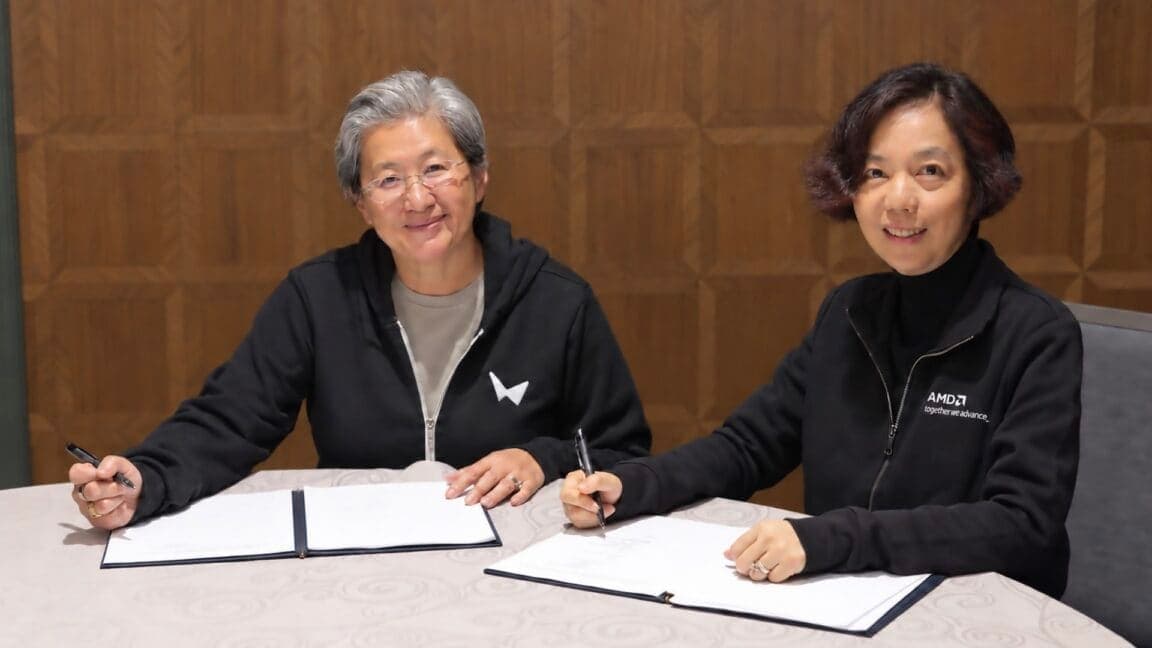
AMD announced plans to acquire World Labs, the spatial intelligence startup founded by computer vision pioneer Fei-Fei Li, in a transaction valued at $8.2 billion. The deal, subject to regulatory clearance, is expected to close before year-end and represents AMD's most aggressive bet yet on AI workloads beyond text-centric large language models.
World Labs launched in 2024 with $230 million in venture capital, part of which came from AMD itself. Li co-founded the company alongside researchers Justin Johnson, Christoph Lassner, and Ben Mildenhall. Their stated mission: build AI systems capable of generating and reasoning about three-dimensional environments - what the industry calls world models or spatial intelligence.
At Opentechwire, we've tracked AMD's AI strategy as it has pivoted from discrete accelerator products toward full-stack software and now strategic acquisitions. This transaction follows a pattern visible across the semiconductor industry, where chipmakers are no longer content to supply compute alone. They want the algorithms, too.
Why World Models Matter Now
World models differ fundamentally from the transformer architectures that underpin ChatGPT or Claude. Instead of predicting the next token in a sequence of text, these systems aim to simulate physical environments - predicting how objects move, how light behaves, how scenes evolve over time. Training typically relies on vast video datasets, though competing approaches exist.
The commercial appeal is straightforward. Robotics companies need models that understand spatial relationships. Autonomous vehicle developers need predictive simulations of road scenarios. Game studios and visual effects houses want procedural 3D content generation. Industrial digital twins require physics-aware scene synthesis.
Fei-Fei Li's credibility in computer vision - she led the ImageNet project that catalysed the deep learning revolution - lent World Labs significant early momentum. But translating research prototypes into products that run efficiently on AMD's Instinct accelerators or EPYC CPUs is another challenge entirely. That engineering gap is what $8.2 billion is meant to close.
The Nvidia Dimension
AMD has spent the past three years attempting to erode Nvidia's dominance in AI training and inference. ROCm, AMD's answer to CUDA, has improved but still lags in software maturity and ecosystem support. Large cloud buyers have shown cautious interest in diversifying away from Nvidia's H100 and forthcoming Blackwell chips, yet actual deployments remain heavily skewed toward Nvidia's stack.
Acquiring World Labs gives AMD something Nvidia does not yet own: a vertically integrated world model capability. Nvidia has partnerships and research collaborations, but it has not acquired a leading spatial AI startup outright. If AMD can optimise World Labs' models to run best on its own silicon - and demonstrate tangible performance or cost advantages - it gains a differentiated offering for customers in robotics, simulation, and embodied AI.
The timing aligns with broader industry interest in modalities beyond text. Multimodal models that handle images, video, and 3D data are the next frontier, and inference for these workloads is far more compute-intensive than text. AMD's bet is that world models will become a high-margin application class where hardware-software co-design confers lasting advantage.
Integration Risks and Open Questions
Acquisitions of this scale in AI carry well-documented risks. Talent retention is the first concern. Li and her co-founders joined World Labs to pursue a specific research vision, not to become AMD employees navigating enterprise chip roadmaps. Whether they remain post-acquisition - and for how long - will determine much of the deal's technical success.
Second, AMD must decide whether to keep World Labs' models proprietary or open-source parts of the stack to accelerate adoption. Nvidia's strategy has been to keep CUDA closed but support a wide range of third-party frameworks. AMD has occasionally leaned into open ecosystems (ROCm is nominally open, though complex to deploy). A closed, AMD-only world model could limit uptake; an open one might not deliver competitive moat.
Third, regulatory scrutiny is non-trivial. An $8.2 billion acquisition of a two-year-old startup with no disclosed revenue will draw questions about valuation, competitive dynamics, and whether the deal forecloses access to critical AI capabilities. US and EU regulators have both signalled heightened attention to AI-related mergers.
What It Signals About the Sector
This acquisition is the clearest sign yet that chipmakers view owning AI model IP as strategically necessary, not optional. Intel's Habana Labs acquisition in 2019 foreshadowed this, but World Labs is higher-profile and more expensive. If the deal closes, expect other semiconductor vendors - Qualcomm, Marvell, Broadcom - to evaluate similar moves, particularly in edge AI and specialised inference domains.
For venture-backed AI startups, the precedent is notable. World Labs went from founding to $8.2 billion exit in roughly two years, albeit with exceptional founder pedigree and a category - world models - that maps cleanly onto hardware differentiation. Not every AI startup will find a strategic buyer willing to pay that multiple, but those solving problems adjacent to semiconductor roadmaps now have a benchmark.
The deal also underscores a structural shift in AI competition. The race is no longer just about training the largest model or serving the most tokens per second. It is about owning the full stack - silicon, systems software, model architectures, and application tooling - in domains where general-purpose platforms have not yet ossified. World models, for now, remain one of those domains. AMD is wagering $8.2 billion that it can define the category before Nvidia does.