Amazon Deploys Package Stickers to Rally Opposition Against New York Labour Bill
The retail giant is turning deliveries into political messaging, asking customers to lobby against legislation that would mandate direct employment of delivery contractors in the city
From Logistics to Lobbying
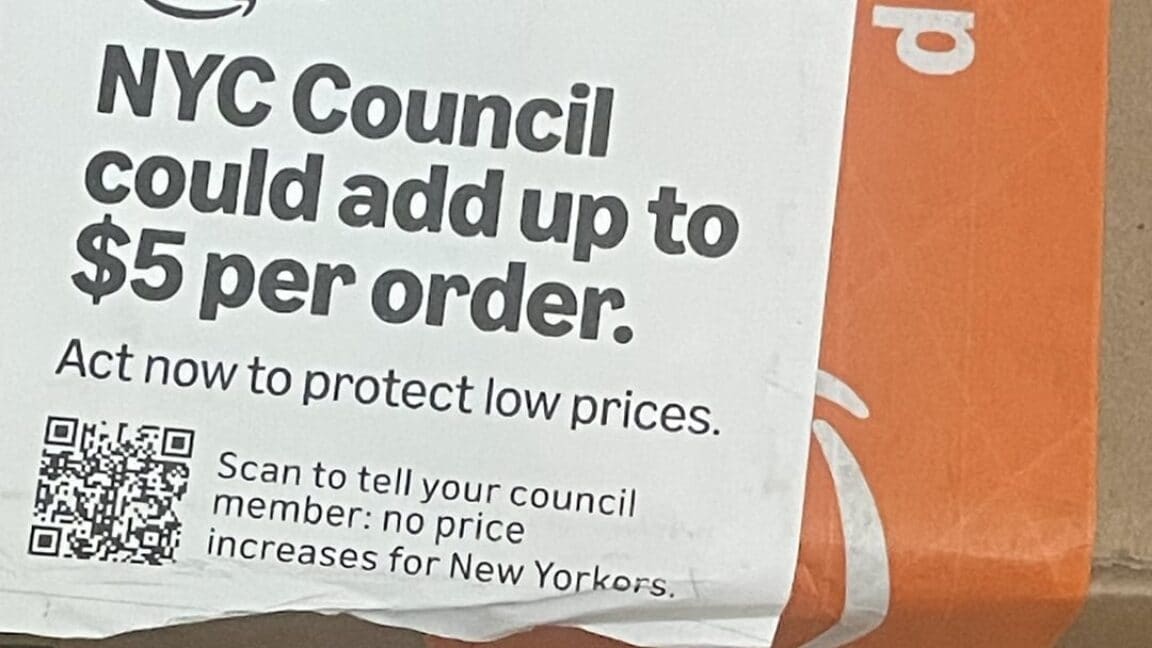
Amazon has begun affixing political messaging directly onto delivery packages sent to New York City residents, a tactic that transforms the company's vast distribution network into a lobbying apparatus. The stickers, which appeared on boxes over the weekend, carry a stark warning: "NYC Council could add up to $5 per order. Act now to protect low prices." Recipients scanning the accompanying QR code are directed to contact local council members in opposition to pending legislation.
The move represents the first time Amazon has used its physical packaging as a vehicle for political advocacy. Whilst the company has previously engaged in high-profile public campaigns over issues such as its abandoned second headquarters location, turning cardboard boxes into campaign materials crosses into uncharted territory for corporate lobbying in the retail sector.
The legislation in question, formally designated Introduction 0518-2026 and commonly referred to as the Delivery Protection Act, would compel Amazon and similar operators maintaining last-mile distribution facilities within New York City to convert third-party delivery contractors into direct employees. The reclassification would bring these workers under the company's payroll, with corresponding changes to labour protections, benefits structures, and operational oversight.
Multi-Channel Pressure Campaign
The package stickers form only one element of a broader campaign Amazon has mounted against the proposed ordinance. The company has simultaneously deployed digital messaging across its e-commerce platform, including a homepage banner visible to users logging in from New York City addresses and in-application alerts that appear when shoppers browse on mobile devices. Both digital touchpoints direct users to advocacy materials and facilitate direct contact with elected officials.
Amazon has also published a detailed position statement outlining its objections to the legislation. The company argues that compliance would force a reassessment of its operational footprint in the city, potentially requiring relocation of facilities to jurisdictions outside municipal boundaries. Such a shift, Amazon contends, would degrade service quality through longer delivery windows and inflate costs for consumers across the metropolitan area. The company further warns of collateral damage to small and medium enterprises that rely on its fulfilment infrastructure, claiming thousands of jobs connected to these businesses would face jeopardy.
The intensity and coordination of this multi-channel approach underscore the financial stakes Amazon perceives in the legislation. Last-mile delivery constitutes one of the most cost-intensive components of e-commerce operations, and the business model Amazon has constructed relies heavily on a flexible contractor workforce that can scale rapidly in response to demand fluctuations. Converting that workforce to direct employment would fundamentally alter cost structures, shift liability frameworks, and constrain the operational flexibility that has enabled Amazon's rapid delivery promises in dense urban markets.
Labour and Political Dynamics
The Delivery Protection Act has attracted support from labour organisations and progressive elected officials who view the legislation as a corrective to what they characterise as exploitative employment arrangements. The International Brotherhood of Teamsters, which has been attempting to organise Amazon workers across multiple facilities, backs the bill as a mechanism to extend workplace protections to a category of workers currently excluded from many labour law safeguards. The union argues that Amazon's contractor model deliberately fragments the workforce to prevent collective bargaining and minimise the company's legal obligations regarding wages, hours, and working conditions.
Mayor Zohran Mamdani has also expressed support for the measure, framing it as necessary protection for workers in an industry characterised by high injury rates, intense productivity surveillance, and income instability. The backing of both organised labour and key political figures creates a coalition that has sufficient institutional weight to advance the legislation through the city council's committee structure.
The standoff reflects a broader tension playing out in multiple jurisdictions worldwide as policymakers grapple with employment models that have proliferated in the gig economy. From California's Proposition 22 battle over rideshare driver classification to ongoing disputes in the European Union over platform worker rights, regulators are attempting to draw boundaries that balance operational flexibility for technology companies against minimum standards for worker welfare. New York City's proposal represents one of the more aggressive interventions, targeting not just app-based platforms but the logistics arms of traditional e-commerce retailers that have adopted similar contractor-heavy staffing approaches.
Precedent and Risk Calculation
Amazon's decision to leverage its delivery infrastructure for political messaging carries reputational risks that the company appears willing to accept in exchange for mobilising customer opposition. Whilst corporate advocacy on legislation is routine, instrumentalising the customer relationship in this manner invites accusations of manipulation, particularly given the power asymmetry between a trillion-dollar corporation and individual consumers who may feel pressured to participate in advocacy campaigns as a condition of continued service quality.
The tactic also raises questions about the boundaries of acceptable corporate political activity. If Amazon can use package surfaces to lobby against labour protections, the precedent opens pathways for other companies to embed political messaging into routine commercial transactions. The cumulative effect could transform everyday consumer experiences into battlegrounds for corporate policy preferences, a development that may generate its own political backlash even if the immediate campaign succeeds in derailing the New York legislation.
For Amazon, however, the calculation appears straightforward: the cost of converting tens of thousands of contractors to employees in one of the company's most important markets justifies extraordinary measures. Should the New York ordinance pass and survive legal challenges, it would likely inspire similar legislation in other major cities where Amazon maintains significant delivery operations. The company's aggressive response suggests it views this moment as a critical juncture where the future structure of its logistics model hangs in the balance.
Implications for Urban Policy
The confrontation between Amazon and New York City lawmakers illuminates the limited leverage municipal governments possess when negotiating with platform-scale corporations. Amazon's threat to relocate facilities outside city boundaries exploits the jurisdictional fragmentation that characterises metropolitan governance in the United States, where companies can shift operations across municipal lines to avoid unfavourable regulatory environments whilst still serving the same customer base from nearby locations.
This dynamic constrains the policy options available to city councils seeking to regulate working conditions or corporate behaviour. Even when local officials command democratic mandates for reform, the mobility of capital and the geography of regional economies enable large firms to circumvent local rules by relocating just beyond enforcement reach. The result is a race-to-the-bottom pressure that undermines attempts to establish higher labour standards in individual jurisdictions.
Amazon's package-sticker campaign will likely be studied by other corporations facing similar legislative challenges, potentially establishing a template for mobilising customer bases against worker-protection measures. Whether the approach proves effective in derailing the Delivery Protection Act remains to be determined, but the company's willingness to deploy it signals the intensity of corporate resistance to employment reclassification mandates.
The New York City Council's response to this pressure campaign will offer an early indication of whether local governments can withstand coordinated corporate opposition when attempting to regulate the employment practices of dominant technology and logistics firms. The outcome will reverberate beyond the city's boundaries, shaping the calculus of both policymakers and corporations in similar disputes across other jurisdictions.