The AI Race Cannot Be Won in Isolation
Supply chain interdependence ensures neither Beijing nor Washington can dominate artificial intelligence on its own, even as both nations chase technological supremacy.

The Interdependence Dilemma
The pursuit of artificial intelligence supremacy has become a defining feature of great-power competition, yet the infrastructure required to build frontier models does not respect national borders. Bank of America's analysis reveals a fundamental constraint: neither the United States nor China possesses the complete vertical stack needed to dominate AI development independently.
Matty Zhao, co-head of China equity at Bank of America, framed the challenge in supply chain terms. China has built formidable capacity in power infrastructure and industrial manufacturing systems, the physical backbone that supports large-scale compute operations. But advanced semiconductor fabrication, high-bandwidth memory modules, and specialised materials for chip production remain dependent on suppliers outside the country's borders.
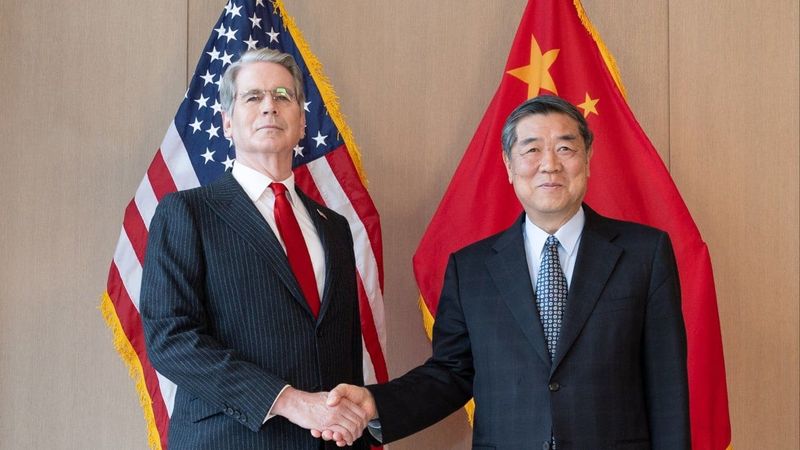
The observation arrives as bilateral discussions approach, a moment when both governments are under domestic pressure to demonstrate technological autonomy. Yet the economics of AI infrastructure tell a different story.
Where Strengths Diverge
At Opentechwire, we have tracked how regional specialisation has created asymmetric dependencies across the AI value chain. China's state-led investment in energy grids and heavy manufacturing gives it an edge in the operational layer where models run at scale. Data centres require not just chips but stable power, cooling systems, and physical resilience against grid fluctuations. Chinese firms have moved quickly to secure these inputs domestically.
The United States, meanwhile, retains control over critical chokepoints further upstream. Design tools for cutting-edge semiconductors, lithography equipment from allied nations, and the intellectual property embedded in GPU architectures remain concentrated in American and partner ecosystems. Export controls introduced over the past two years have aimed to preserve this advantage, restricting access to chips capable of training large language models beyond certain parameter thresholds.
But interdependence cuts both ways. American cloud providers rely on Asian supply chains for memory, packaging, and assembly. Rare earth processing, essential for high-performance computing components, is overwhelmingly concentrated in China. A decoupling scenario would impose costs on both sides, raising the question of whether either government is willing to bear the economic and innovation drag that true autarky would demand.
The Third-Party Leverage
What complicates the binary framing is the role of other economies. South Korea supplies the majority of the world's high-bandwidth memory, a component that has become the new bottleneck as models scale. Taiwan fabricates the most advanced logic chips, a capability neither Beijing nor Washington can replicate domestically within the next five years. Japan controls niche materials and precision equipment. The Netherlands holds the monopoly on extreme ultraviolet lithography machines.
Each of these jurisdictions has its own strategic calculus. South Korean memory manufacturers face pressure from both capitals to limit or expand supply depending on the diplomatic climate. Taiwanese foundries navigate export compliance regimes while maintaining commercial relationships across the strait. Japanese firms have historically leaned towards alignment with Washington but remain economically exposed to Chinese demand.
This distributed control means that AI dominance is not a zero-sum contest between two players. It is a multilateral negotiation where smaller tech economies hold veto power over critical nodes. Any government attempting to monopolise the AI stack must either coerce or compensate third parties, neither of which is straightforward in a landscape where firms prioritise margin and market access over geopolitical alignment.
Policy Implications in a Fragmented Landscape
The recognition of mutual dependence has not, so far, translated into policy moderation. Export controls have tightened, investment screening has expanded, and both governments have poured subsidies into domestic semiconductor capacity. The assumption appears to be that short-term pain is worth long-term autonomy.
But the timeline matters. Building a competitive foundry capable of producing three-nanometre chips requires not just capital but tacit knowledge, supply chain coordination, and iterative learning that takes years. Memory production at scale demands similar lead times. If the goal is to achieve AI leadership within the current decade, neither side can afford to wait for domestic substitutes to mature. They must continue sourcing from the same global ecosystem they publicly distrust.
This creates an unstable equilibrium. Firms operate under regulatory uncertainty, unsure whether today's permitted transaction will be sanctioned tomorrow. Research collaboration stalls as visa restrictions and security clearances multiply. Talent flows, once a lubricant for innovation diffusion, face new friction.
The Bank of America assessment does not predict a resolution, but it does suggest that the current trajectory is unsustainable if the objective is functional AI ecosystems. Models require not just chips but data, energy, software frameworks, and iterative deployment at scale. No single jurisdiction commands all these inputs in sufficient quantity and quality.
What the Summit Will Not Solve
Bilateral talks this week are unlikely to reverse the decoupling momentum. Domestic political incentives in both capitals reward toughness, not compromise. But the underlying economic reality identified by Zhao and others in the financial sector may eventually impose discipline. Markets dislike inefficiency, and duplicating the entire AI supply chain in parallel is inefficient by definition.
The question is whether governments will acknowledge interdependence as a constraint or continue treating it as a problem to be engineered away. The latter path is feasible in theory, but the cost in time, capital, and foregone innovation is higher than either side has yet admitted publicly.
At Opentechwire, we see this tension playing out across boardrooms in Seoul, Hsinchu, and Tokyo. Executives are hedging, building redundant capacity, and lobbying for carve-outs. None of them believe the world will neatly bifurcate into two self-contained tech spheres. But they are preparing for a messier reality where supply chains fracture along unpredictable lines, and where the race for AI dominance becomes a test of which system can tolerate more friction without stalling entirely.
The Bank of America framing is useful because it shifts the conversation from capability to sustainability. Both the United States and China can build impressive AI systems today. The harder question is whether they can maintain that pace while cutting off the inputs that made it possible in the first place.