Xpeng Pushes L4 Commercialisation Through Partner Model, Not Fleet Ownership
The Chinese EV maker is testing robotaxis in Guangzhou while building a licensing play for overseas mobility platforms, with CEO He Xiaopeng betting on a 2028 timeline for deployment.
From Test Track to Public Streets
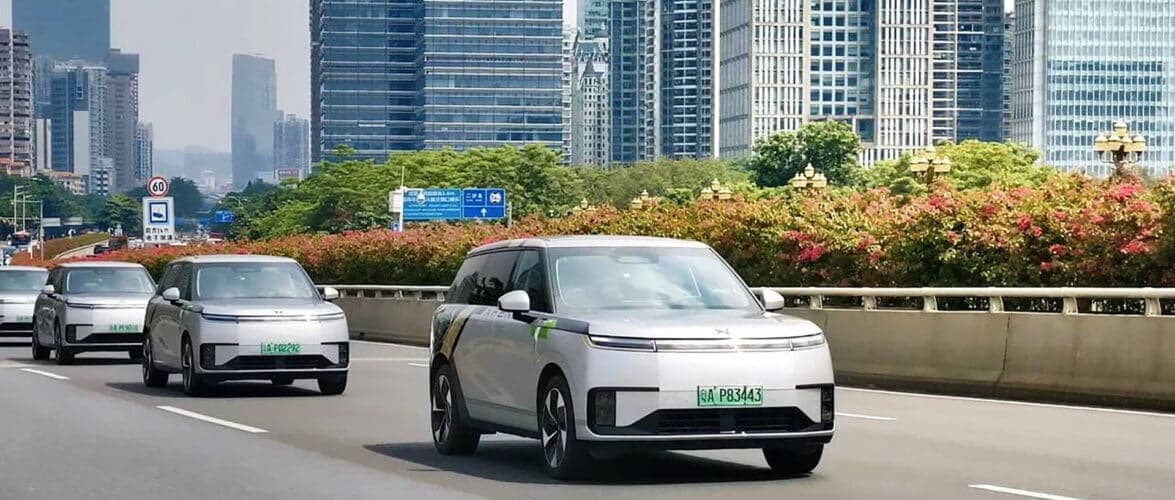
Xpeng has moved its Level 4 autonomous driving programme into public demonstration mode in Guangzhou, marking a shift from closed-loop technical validation to real-world service operations. The company, which trades in Hong Kong and New York, received municipal approval to run robotaxi trials that put paying passengers in vehicles navigating mixed traffic, weather conditions, and the unpredictable edge cases that laboratory environments cannot replicate.
The demonstration phase is not about proving the car can drive itself. That threshold has already been crossed in controlled settings across the industry. What Xpeng is testing now is whether the entire service stack holds together when demand fluctuates, when vehicles need charging or cleaning, when passengers miss their pickup window, and when software updates must be pushed to a fleet that cannot afford downtime. These operational questions determine whether autonomous mobility becomes a sustainable business or remains an engineering showcase.
Xpeng launched the Yoyo brand on 8 October, opening ride requests through a WeChat mini programme distributed via invitation codes. The vehicles are modified GX models, which Xpeng describes as the first robotaxi in China designed for volume manufacturing from the ground up, rather than retrofitted from a consumer platform. Each unit carries four Turing AI chips delivering 3,000 trillion operations per second of effective compute, paired with a second-generation vision-language-action model that processes sensor data and decides how the vehicle should respond.
The VLA Architecture Bet
At the World Intelligent Connected Vehicles Conference, chairman and CEO He Xiaopeng outlined the technical foundation linking Xpeng's consumer assisted-driving features to its Level 4 ambitions. The company's second-generation VLA model uses a unified architecture spanning Level 2 through Level 4 capabilities, allowing engineers to transfer learning and data across regulatory categories that have historically been siloed.
Vision-language-action models are a newer branch of AI that combine visual perception, natural-language reasoning, and decision-making in a single loop. In the context of autonomous driving, this means the system does not just recognise objects and lanes; it interprets scenes in a way that approximates how a human driver would narrate the situation to themselves, then translates that understanding into steering, braking, and acceleration commands. The advantage is generalisation: a VLA model trained on diverse scenarios should adapt to novel situations more gracefully than narrower perception-planning pipelines.
He Xiaopeng expects the technology to be ready for deployment around the second half of 2028, contingent on coordinated progress in both hardware and software. That timeline is aggressive but not implausible. Several Chinese manufacturers are converging on similar dates, driven by provincial governments eager to showcase smart-city credentials and by investors who want to see returns on the capital poured into compute clusters and sensor arrays over the past five years.
Regulation, He acknowledged, will lag. He estimates that formal approvals for commercial Level 4 services will arrive between 2028 and 2032, rolling out in stages by country, region, and use case. This staggered rollout creates an opportunity for companies that can demonstrate safety and reliability early, because regulators tend to write rules around the systems they have already observed in pilot programmes.
A Licensing Play, Not a Fleet Play
Xpeng's stated ambition is not to become the next Uber or Didi. The company intends to supply technology to mobility operators rather than run large fleets under its own brand. Partners would receive the vehicle platform, the autonomous driving software stack, and access to Xpeng's AI infrastructure. They would then deploy those assets using their own dispatch systems, maintenance networks, and customer-acquisition channels.
Revenue for Xpeng would come from hardware sales, recurring technical services, and commissions tied to ride volume or mileage. This model shifts capital intensity and operational risk to partners while allowing Xpeng to scale geographically without building local operations in every city. It also aligns with the company's core competence: Xpeng is an automotive and AI engineering firm, not a service-operations business.
The Guangzhou pilot is the proving ground for this approach. The Yoyo team is tracking vehicle utilisation rates, dispatch efficiency, per-kilometre service costs, and fleet-management workflows. These metrics will inform the playbook that Xpeng hands to partners. If utilisation is too low, the unit economics break. If dispatch is slow, passengers defect to human-driven alternatives. If maintenance cycles disrupt availability, the fleet cannot achieve the density needed to justify the upfront investment.
Guangzhou is also where Xpeng has concentrated its robotaxi research and manufacturing capacity, making it the natural first node in what the company hopes will become a global network. Local operations allow tight feedback loops between engineering, production, and service teams. Bugs can be diagnosed and patched quickly. Hardware revisions can be tested on a small batch before rolling out to the broader fleet. This iterative process is harder to sustain when operations are distributed across continents with different regulatory regimes and road conditions.
European Conversations
Xpeng is already in discussions with mobility platforms in Europe. Speaking at the Paris Motor Show, He Xiaopeng said the company is in advanced talks with several operators, though he did not name them or specify timelines. European cities present a different set of challenges: narrower streets, older infrastructure, more pedestrians, and stricter data-localisation requirements. But they also represent large addressable markets with high labour costs, making the economics of autonomous fleets more compelling than in regions where human drivers are inexpensive.
European regulators have generally taken a cautious stance on Level 4 systems, favouring small-scale pilots and incremental expansion. That caution may work in Xpeng's favour if it means regulators are willing to engage with foreign technology providers that can demonstrate mature safety records from operations in China. The company's licensing model also reduces political friction: a local operator remains the customer-facing entity, while Xpeng supplies the enabling technology in the background.
The timing of these conversations is strategic. Several European mobility platforms are evaluating their autonomous roadmaps, and some have scaled back internal development efforts after concluding that the capital required to compete with well-funded Chinese and American programmes is prohibitive. Xpeng's pitch is that it has already absorbed those costs and can offer a turnkey solution.
The Operational Gauntlet
Public demonstrations expose robotaxi systems to stresses that simulations and closed-course testing cannot replicate. Passengers behave unpredictably. They enter incorrect addresses, leave belongings in vehicles, or attempt to override safety protocols. Other road users do not follow traffic laws perfectly. Pedestrians jaywalk, motorcyclists weave between lanes, delivery trucks double-park. Weather varies. Roadworks appear overnight. Software must handle all of this not occasionally, but reliably enough that the service does not collapse under its own operational friction.
Xpeng's Guangzhou pilot is designed to surface these problems while the fleet is small and the stakes are manageable. Each incident is an opportunity to refine the software, adjust service protocols, or redesign hardware interfaces. The company is also learning how to manage a fleet at scale: how often vehicles need cleaning, how to schedule charging to avoid range anxiety during peak hours, how to route maintenance without pulling too many units offline at once.
These lessons are less glamorous than breakthroughs in perception algorithms or compute efficiency, but they are just as important to commercialisation. A robotaxi that drives flawlessly but spends half its time out of service is not a viable product. A dispatch system that cannot balance supply and demand will frustrate passengers and waste capital. A business model that cannot cover operating costs and generate returns will not attract the partners Xpeng needs to scale.
The 2028 Bet
He Xiaopeng's 2028 timeline assumes that hardware, software, and regulation will align within a two-year window. That is optimistic. Sensor costs must continue falling. Compute must become more power-efficient. Safety validation frameworks must mature. Insurance models must adapt. Public acceptance must grow. Any one of these could slip, pushing deployment further out.
But the timeline is also a signal. By committing to a date, He is forcing internal teams to prioritise and make trade-offs. It is also a message to potential partners: Xpeng is moving quickly, and operators that want to be early adopters should begin discussions now. In a market where several players are converging on similar capabilities, speed to deployment may matter as much as technical superiority.
At Opentechwire, we have tracked the progression of Chinese autonomous driving programmes over the past three years, and the shift from technical milestones to operational pilots marks a genuine inflection point. The question is no longer whether Level 4 systems can drive safely in controlled environments. The question is whether the surrounding business model, regulatory framework, and service infrastructure can support deployment at scale. Xpeng's Guangzhou pilot is one attempt to answer that question before the window closes.