Washington's Voluntary AI Pact Leaves Enforcement Vacuum as Beijing and Brussels Forge Binding Rules
The White House secured commitments from leading tech firms to self-regulate AI risks, but the absence of legal teeth may hand global standard-setting to rivals with harder regulatory frameworks.
A Handshake Deal in a High-Stakes Arena
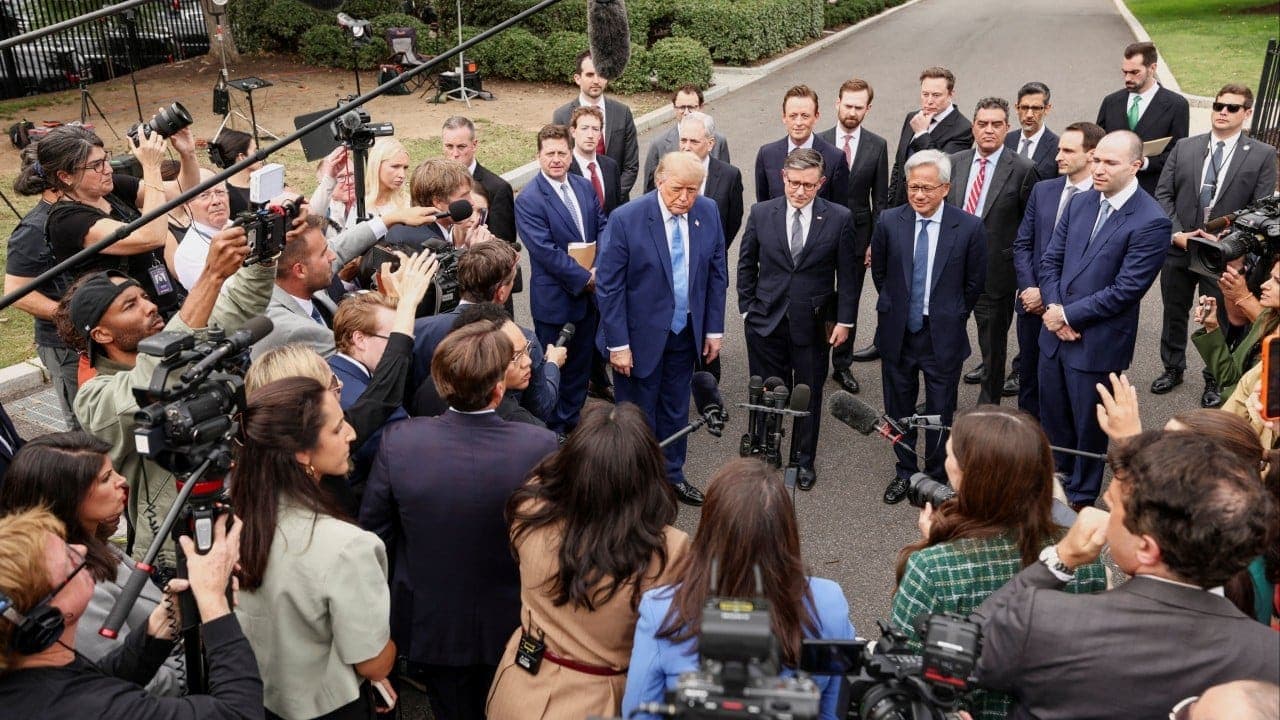
At a White House ceremony flanked by executives from the world's most influential AI laboratories, President Donald Trump unveiled a voluntary agreement designed to rein in the technology's most acute dangers. The pact centres on internal audits, external review and board-level oversight, all without the scaffolding of statute or sanction. Aides described the commitments as "morally binding", a phrase that captures both ambition and ambiguity in equal measure.
The backdrop is hard to ignore. Generative models now draft legal briefs, synthesise drug candidates and pilot drones, and the compute behind them is doubling every few months in some facilities. Governments from Seoul to Ottawa are scrambling to articulate red lines. Washington's instinct has been to preserve velocity, to let the laboratories iterate and the market sort winners from losers. But by stopping short of enforcement, the administration may have ceded the very terrain it sought to protect.
Why Voluntarism Appeals, and Where It Falls Short
The case for a light touch rests on three pillars. First, AI research moves faster than legislative calendars; prescriptive rules risk locking in yesterday's architecture just as the field pivots to something new. Second, the United States remains home to the majority of frontier labs, and heavy regulation might push talent and capital to jurisdictions with fewer constraints. Third, industry insiders argue they understand the failure modes of large language models and reinforcement learning better than any regulator ever could.
Each pillar has merit. Compliance costs do fall disproportionately on smaller entrants, and premature mandates can calcify around the wrong technical paradigm. Yet voluntarism carries its own costs. Without binding obligations, individual firms face a prisoners' dilemma: any laboratory that invests heavily in safety while rivals race ahead risks losing market share and, ultimately, survival. External audits sound reassuring until one asks who picks the auditor, what standards they apply and whether their findings ever see daylight. Board oversight is only as robust as the directors' technical fluency and willingness to challenge management. In practice, moral suasion often defers to quarterly earnings.
History offers a cautionary lesson. The financial sector spent decades refining voluntary codes of conduct for derivatives trading, risk modelling and disclosure. When the mortgage-backed securities market unravelled in 2008, those codes proved insufficient. Regulators worldwide responded with binding capital requirements, stress tests and resolution frameworks. AI may not trigger a credit crunch, but the externalities, ranging from mass disinformation to autonomous-weapons proliferation, carry stakes that are at least as high.
How Beijing Is Building a Parallel Regulatory Architecture
China has taken a markedly different path. Over the past three years, authorities in Beijing have rolled out a suite of rules targeting algorithmic recommendation, deep synthesis, and generative AI services. The measures require firms to register models with the Cyberspace Administration, submit to security assessments and accept content filters aligned with state priorities. Penalties for non-compliance include fines, service suspensions and, in extreme cases, criminal liability for executives.
The system is neither liberal nor light. It embeds political imperatives into technical design, compelling laboratories to screen outputs for anything the government deems harmful to social stability or national security. International observers rightly criticise the lack of due process and the chilling effect on open research. But from a governance perspective, the framework is coherent and enforceable. Companies know the rules, and the state has the tools to enforce them.
That coherence is starting to matter beyond China's borders. As Chinese AI vendors expand into Southeast Asia, the Middle East and parts of Africa, they carry with them a model of regulation that privileges state oversight and centralised accountability. Governments in those regions, many of which lack the technical capacity to draft bespoke AI laws, are studying Beijing's playbook. If the choice is between a voluntary US accord with no enforcement mechanism and a Chinese template with clear lines of authority, some may find the latter more legible, even if less palatable on civil-liberties grounds.
The European Union's Bet on Binding Standards
Brussels has charted a third course. The AI Act, which entered into force earlier this year, classifies systems by risk and imposes obligations that scale accordingly. High-risk applications, such as those used in hiring, credit scoring or law enforcement, must meet transparency, accuracy and human-oversight requirements before deployment. Prohibited uses, including real-time biometric surveillance in public spaces with narrow exceptions, are banned outright. The regulation applies to any provider placing an AI system on the EU market, regardless of where the firm is headquartered.
Enforcement is delegated to national authorities, with fines reaching up to seven per cent of global annual turnover for the gravest violations. The Act also establishes a European AI Board to ensure consistent interpretation across member states and to co-ordinate market surveillance. Critics, especially in Silicon Valley, warn that the regime is too prescriptive, that it will stifle innovation and drive labs to friendlier jurisdictions. Proponents counter that clear rules reduce legal uncertainty, protect consumers and, over time, confer a competitive advantage on firms that learn to build compliance into their engineering culture from the start.
What is undeniable is that the EU has staked a claim to global standard-setting. Just as the General Data Protection Regulation became a de facto worldwide benchmark for privacy law, the AI Act may shape how companies design and document their systems, even when operating outside Europe. Multinational laboratories are unlikely to maintain one set of safeguards for Brussels and another for Washington; the more stringent regime tends to become the floor.
The Standard-Setting Contest and Its Implications
At Opentechwire, we've tracked regulatory divergence in other domains, from data localisation to export controls on semiconductor manufacturing equipment. AI governance is following a similar pattern, but with higher stakes. The jurisdiction that defines what counts as an acceptable level of model interpretability, or how algorithmic bias should be measured and mitigated, will shape the norms that others adopt or resist. Standards bodies, industry consortia and bilateral agreements all play a role, yet the heaviest influence comes from large markets with enforceable rules.
The United States retains formidable advantages. Its research ecosystem is unmatched, its venture capital deep and its technology firms dominant in cloud infrastructure, foundation models and application layers. But advantage in capability does not automatically translate into influence over norms. If Washington declines to anchor its voluntary commitments in statute, other powers will fill the void. Companies seeking global reach will optimise for the most stringent requirement they face, and that requirement is increasingly likely to originate in Beijing or Brussels, not in Washington.
There are also geopolitical dimensions. AI governance is becoming a vector of soft power. Countries that export regulatory frameworks export values, whether those values emphasise individual rights, state stability or market efficiency. A voluntary US approach may preserve domestic flexibility, but it offers little for partners seeking a template to adapt. By contrast, both China and the EU are actively courting third countries, offering technical assistance, training programmes and model legislation. The race is not only about who builds the most capable models, but about whose rules govern their use.
What a Durable US Framework Might Require
Voluntary agreements need not be toothless. The administration could strengthen them by tying participation to federal procurement, research grants or export licences for advanced chips. It could mandate transparency around audits, requiring participating firms to publish summaries of findings and remediation steps. It could establish an independent oversight board with technical expertise and subpoena power, giving the commitments credibility without the full apparatus of a new regulatory agency.
Legislation remains the more durable path. A federal AI safety statute could set baseline requirements for high-risk systems, create a notification regime for severe incidents and empower agencies such as the Federal Trade Commission or the National Institute of Standards and Technology to develop detailed standards through notice-and-comment rulemaking. Such a law would not preclude innovation; it would provide legal certainty and a level playing field. It would also signal to allies that the United States is serious about governance, not merely about capability.
The current accord, for all its limitations, may serve as a bridge. If it prompts genuine investment in safety research, improves incident-response protocols and fosters a culture of accountability inside the laboratories, it will have been worthwhile. But bridges are temporary structures. Without a foundation of enforceable rules, the United States risks arriving at the next stage of AI development without the governance architecture to match, while its rivals set the terms for everyone else.