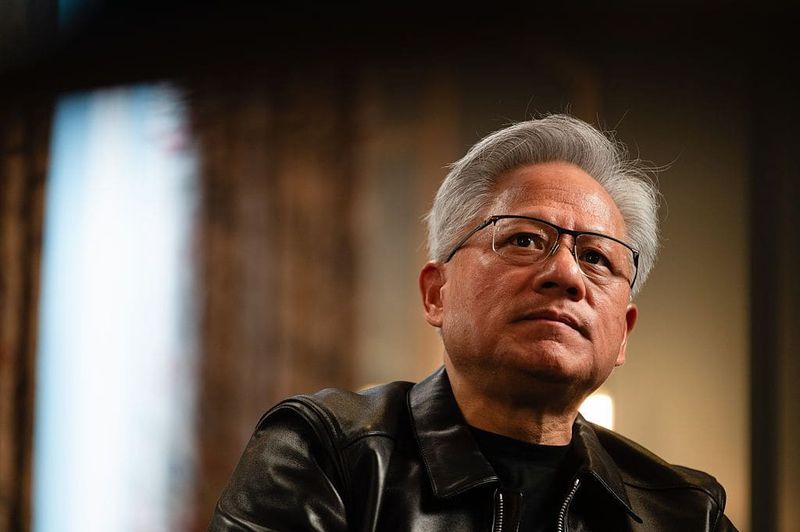
Washington Moves to Restrict AI Chip Sales Amid Nvidia Leadership Crisis
Bipartisan momentum builds for tighter semiconductor controls as lawmakers demand public testimony from company executives and administration officials
Legislative Push Gains Speed
The departure of Jensen Huang from Nvidia's chief executive role, following disclosures about his connections to an individual suspected of intelligence activities on behalf of China, has accelerated legislative efforts to impose stricter limitations on the sale of high-performance computing components. Lawmakers across party lines are now coalescing around measures that would narrow the pathways through which advanced processors reach destinations subject to national security scrutiny.
Senate Minority Leader Chuck Schumer has called for both Huang and officials from the Trump administration to appear before Congress. Senate Banking Committee Chairman Tim Scott has dispatched formal requests to Huang and Commerce Secretary Howard Lutnick, asking them to provide public testimony. The convergence of Democratic and Republican interest signals a rare moment of alignment on trade policy in an otherwise fractured legislative environment.
The episode has exposed what many on Capitol Hill view as inadequate oversight of technology transfers, particularly in sectors where hardware capabilities translate directly into strategic advantage. For policymakers, the question is no longer whether to tighten controls, but how quickly new rules can be drafted and enforced without disrupting the commercial relationships that underpin much of the semiconductor industry's revenue.
Stalled Legislation Finds New Life
The Remote Access Security Act, introduced in the House of Representatives in April 2025, had languished in the Senate for more than a year. The bill sought to close loopholes that allow buyers in restricted jurisdictions to access computing power remotely, effectively circumventing hardware export limits. With heightened attention on supply chain vulnerabilities, the legislation is now receiving a second look from committees that had previously shown little appetite for advancing it.
House Speaker Mike Johnson acknowledged a "growing consensus" around limiting chip exports to China, a shift that reflects both political pressure and concern within the intelligence community. Johnson has personally endorsed efforts to curtail access to the most capable AI processors, a stance that aligns him with voices in the Senate who have long advocated for a more aggressive posture on technology trade.
While the Remote Access Security Act may not pass in its current form, elements of the proposal are likely to be folded into broader legislative vehicles. The willingness of leadership to prioritise the issue suggests that some version of enhanced export restrictions will reach the floor for a vote before the end of the current session.
Implications for Semiconductor Supply Chains
Nvidia's revenue model has historically relied on serving a global customer base, including firms in mainland China that deploy its graphics processing units for data centre operations, research applications, and training large language models. Any expansion of export controls will force the company to recalibrate its product roadmap, potentially designing chips that meet performance thresholds acceptable to US regulators while remaining commercially viable.
The existing framework, managed by the Bureau of Industry and Security within the Commerce Department, uses metrics such as processing speed and interconnect bandwidth to determine which products require export licences. Tightening those thresholds, or introducing new criteria related to remote access and cloud deployments, would compel manufacturers to create additional product variants or abandon certain markets altogether.
Competitors based in Asia are watching closely. Firms in South Korea and Taiwan, which supply foundry capacity and memory components to US chip designers, face the prospect of secondary restrictions that could complicate their own sales into China. The integrated nature of semiconductor supply chains means that unilateral US policy changes ripple outward, affecting production schedules, inventory planning, and partnership agreements across multiple jurisdictions.
Enforcement Gaps Under Scrutiny
Beyond the specific legislative proposals, the Huang case has drawn attention to enforcement mechanisms that lawmakers believe have been underresourced or poorly coordinated. The Commerce Department's Office of Export Enforcement operates with a budget and staffing level that critics argue is mismatched to the scale of global semiconductor trade. Calls are mounting for increased funding, expanded investigative authority, and closer collaboration with intelligence agencies.
One area of particular concern is the use of shell companies and intermediaries to obscure the final destination of controlled goods. Even when export licences are denied, shipments can be rerouted through third countries or repackaged in ways that evade detection. Legislators are exploring whether to mandate more rigorous end-use verification, including on-site inspections and real-time reporting requirements for distributors.
The challenge for regulators is balancing security objectives with the commercial interests of an industry that contributes substantially to US economic output. Overly restrictive rules risk pushing customers toward suppliers in other countries, eroding market share for American firms and reducing the leverage that export controls are meant to provide. Finding that equilibrium will require detailed technical input and sustained dialogue between government and industry.
Regional Context and Strategic Competition
The push for tighter chip export rules unfolds against a backdrop of intensifying technology competition across the Asia-Pacific. Beijing has invested heavily in domestic semiconductor development, aiming to reduce reliance on foreign suppliers and achieve self-sufficiency in critical components. Progress has been uneven, with Chinese firms making strides in older process nodes but struggling to match the performance of leading-edge designs from the United States, South Korea, and Taiwan.
Export restrictions accelerate that divergence, creating a bifurcated market in which Chinese customers have access to less capable hardware while firms in allied nations continue to benefit from the latest innovations. That dynamic shapes both military and economic calculations, as advanced AI models require computational resources that older chips cannot deliver at scale.
For governments in Seoul, Tokyo, and Taipei, the question is how to navigate a policy environment in which the United States is the primary architect of export controls but not the sole supplier of semiconductors. Each has its own trade relationships with China, and each faces domestic pressure to preserve commercial ties even as security concerns mount. The result is a patchwork of national policies that sometimes complement, and sometimes conflict with, US objectives.
What Comes Next
Testimony from Huang and senior Commerce Department officials is expected to take place within the coming months, providing lawmakers with an opportunity to probe the circumstances that led to the leadership change at Nvidia and to assess whether existing export compliance programmes are fit for purpose. The hearings will also serve as a platform for legislators to outline their priorities and signal which provisions are likely to appear in future legislation.
Industry groups are preparing for a protracted negotiation over the details. Trade associations representing chip manufacturers, equipment suppliers, and cloud service providers are mobilising to ensure that any new rules account for the operational realities of a sector characterised by long development cycles and complex interdependencies. Their participation will shape the final text of any bill that advances through committee.
The outcome will hinge on whether Congress can reconcile competing objectives: restricting access to sensitive technology without undermining the competitiveness of US firms, preserving alliances with partners in Asia while addressing their concerns about secondary impacts, and responding to immediate security threats without locking in policies that become obsolete as technology evolves. The Nvidia episode has created the political momentum for change; translating that into durable policy remains the harder task.