Unitree Robots Paint and Play Chess with No Task-Specific Training
Chinese robotics firm demonstrates GPT-6-powered humanoids executing complex physical tasks through general-purpose AI, marking a shift from specialised programming to adaptive reasoning in embodied systems.
From Specialised Code to General Reasoning
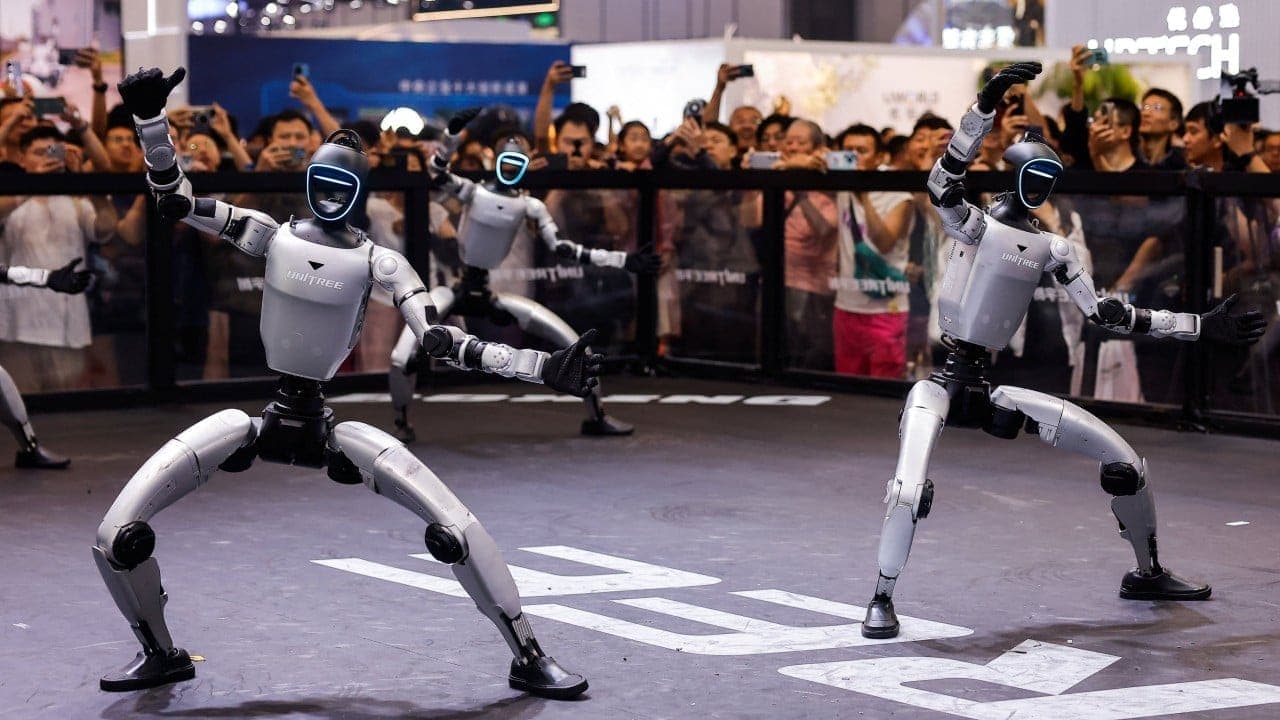
Unitree Robotics has built humanoid machines capable of painting and playing chess without receiving dedicated training for those activities. The Chinese firm's founder, Wang Xingxing, demonstrated the systems at the China International Import Expo in Shanghai on 5 November, emphasising that the robots rely on OpenAI's GPT-6 model to handle intricate physical sequences in real time.
The machines execute tasks such as replacing brush water mid-painting and blending pigments on a palette, actions that typically require hand-coded routines or reinforcement learning runs spanning thousands of attempts. Unitree's approach delegates that complexity to the language model, which interprets the task, plans sub-steps and adjusts as the environment changes.
What GPT-6 Brings to Embodied AI
GPT-6 represents OpenAI's latest generation of large language models, though technical specifications remain under embargo. What Unitree's demonstration suggests is that the model can generate low-level motor commands or high-level action primitives that a robot middleware translates into joint trajectories and gripper movements.
Traditional robotic systems separate perception, planning and control into discrete modules, each tuned for a narrow set of scenarios. A frontier language model collapses much of that pipeline: it reasons over visual input, maintains context across multi-step operations and adapts when an object slips or a colour runs dry. The trade-off lies in latency and the need for reliable real-time inference infrastructure, constraints that have historically confined general-purpose AI to simulation or cloud-tethered prototypes.
Unitree's machines appear to operate with sufficient responsiveness for tasks measured in seconds rather than milliseconds. Painting and board games afford the system time to think between moves, a luxury that assembly lines or surgical robots cannot offer. The firm has not disclosed whether inference runs on-device, at the edge or in a data centre, nor whether the models are fine-tuned on robotics corpora or used zero-shot.
The Economics of Zero-Training Deployment
Eliminating task-specific training carries commercial weight. A manufacturer deploying hundreds of robots across variable workflows today must budget for extensive data collection, simulation environments and iterative tuning. If a single foundation model can generalise to pouring, fastening, sorting and inspection without per-task datasets, the cost structure of automation shifts.
Unitree's demonstration targets that promise. Chess and painting are cognitively rich but physically forgiving, domains where errors rarely damage hardware or endanger people. Scaling the approach to high-stakes or high-speed environments will require safety guarantees that language models do not yet provide, alongside real-time performance that current inference stacks struggle to deliver at the edge.
The firm's choice of GPT-6 also signals a deepening interdependence between hardware makers and the handful of labs producing frontier models. OpenAI, Anthropic and Google control the capabilities that embodied-AI companies depend on, creating bottlenecks in access, pricing and geopolitical export posture. Unitree, based in Hangzhou, operates in a regulatory environment where model access from US developers has grown uncertain, making the successful integration of GPT-6 a noteworthy data point in cross-border AI supply chains.
Implications for Humanoid Development in Asia
Humanoid robotics has attracted significant capital across China, Japan and South Korea over the past eighteen months, driven by labour-cost projections and national industrial policy. Unitree competes with firms such as Fourier Intelligence, UBTECH Robotics and XPeng's robotics division, all racing to demonstrate commercially viable form factors.
The shift from scripted motion to model-driven reasoning compresses development cycles but raises new questions. A language model's failure modes differ from those of classical control algorithms: it may misinterpret ambiguous instructions, hallucinate non-existent objects or generate plausible but unsafe sequences. Validating these systems for deployment beyond controlled expo floors will require testing regimes that the robotics industry is still designing.
Asia-Pacific markets present both opportunity and constraint. Labour availability varies sharply between Singapore's tight market and Indonesia's demographic dividend; regulatory frameworks for autonomous systems remain fragmented; and infrastructure for real-time AI inference is unevenly distributed. Unitree's demonstration positions the firm in a narrative where general-purpose intelligence solves the localisation problem, but the economics of compute, liability and after-sales support will determine whether that narrative holds in volume production.
Next Milestones and Open Questions
Unitree has not announced a commercial release date for the painting and chess-capable units, nor pricing. The firm's earlier humanoid models have been aimed at research institutions and pilot customers in logistics and hospitality, sectors where the case for humanoid form factor over wheeled or articulated-arm robots remains contested.
The broader test for GPT-6 in robotics will unfold as more developers gain access to the model and publish benchmarks on manipulation, navigation and multi-modal reasoning tasks. OpenAI's partnership strategy, licensing terms and inference costs will shape how widely the technology diffuses beyond showcase demonstrations.
For now, Unitree's exhibit in Shanghai offers a concrete glimpse of what frontier language models enable when embedded in physical agents: tasks that once demanded months of engineering effort executed through natural-language goals and real-time adaptation. Whether that capability translates into profitable, safe and scalable products is the question the next twelve months will begin to answer.